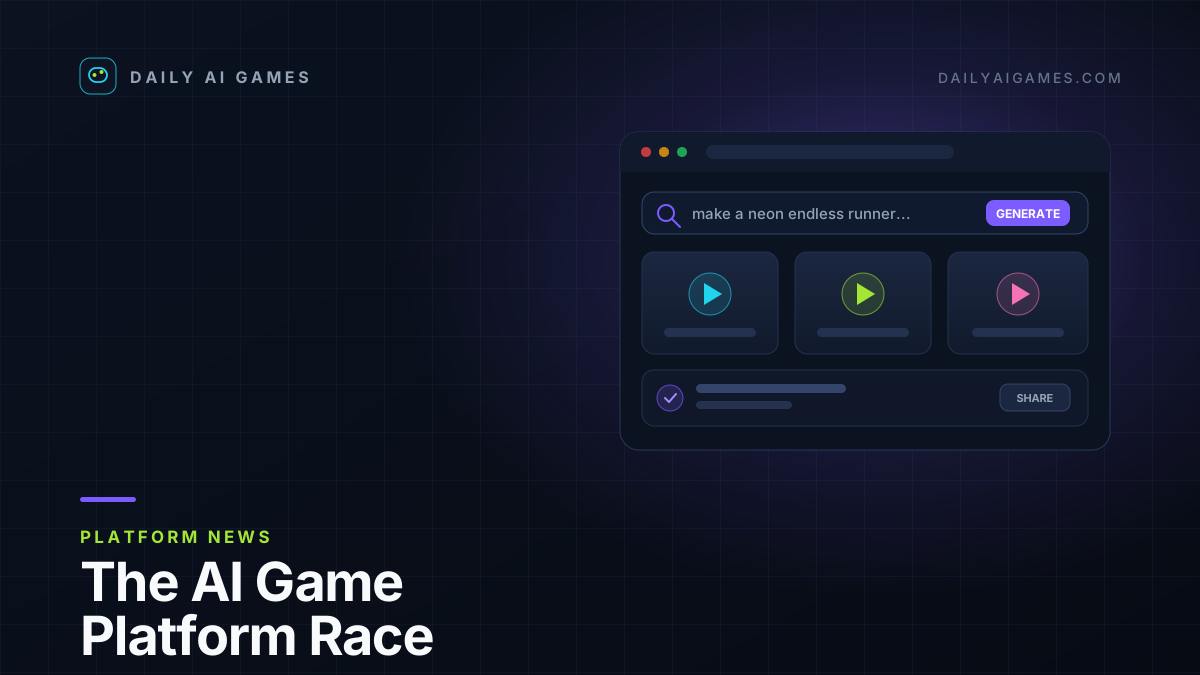
October 2026 may be remembered as the month AI game creation stopped being a demo and became a distribution business. In the space of two weeks, Google opened Playground to US users, Astrocade reported 10 million monthly players, Microsoft announced a new Xbox Labs research group, and Roblox published an unusually candid evaluation of its own AI game-building tool. Each announcement is interesting on its own. Together they show where the bottleneck in AI games has moved: away from generating code, and toward finding something worth playing.
Google Playground: one prompt, one playable browser game
Google launched Playground on October 7 as an experimental platform for creating browser games from natural language. The pitch is simple: describe a game, get something playable, then keep editing it by talking to it. Playground is powered by three models working together — Gemini for logic and behavior, Nano Banana for art, and Lyria for music and sound.
The product details matter more than the demo:
- It supports 2D and 3D projects, single-player and some multiplayer experiences.
- Creators can start from a blank project, a starter prompt, or guided assistance.
- Changes to characters, environments, rules and physics happen conversationally, without rebuilding the project.
- You can upload images as game assets.
- Finished games can stay private, be shared by link, or be submitted to the Explore gallery.
- Leaderboards, Play Games profiles, handles, ratings and creator follows are built in.
- Published games go through safety screening, and creators are responsible for third-party IP.
Access is limited to US users aged 18 and older, and generation runs on weekly tokens, with higher limits tied to Google One AI plans. A planned Unity Spark integration is the part to watch: Google says it will bring Unity’s runtime, professional mechanics and high-fidelity 3D into the same conversational workflow.
That last point changes the strategic picture. A prompt-to-game toy is a novelty. A prompt-to-game pipeline that can graduate into a real engine is a threat to the traditional prototype stage — and a shortcut for small teams testing ideas.
Astrocade proves the audience exists
The same week, GamesBeat reported that Astrocade had grown from roughly 5 million to 10 million monthly active players in four months. The platform says those players generate 220 million gameplay sessions a month across more than 100,000 third-party “playables,” with creators in 191 of the 193 UN member countries.
Two numbers stand out. First, the catalog size: 100,000 playables is far beyond what any curated store could review by hand. Second, the audience split: Astrocade describes its players as 50-50 male and female, aged 18 to 45 and older. This is not a niche for AI enthusiasts. It looks like mainstream short-session entertainment.
CEO Amir Sadeghian told GamesBeat that Astrocade sees itself as “a new kind of YouTube” rather than a new Roblox, with creators paid according to how much their games are played. The company raised $56 million in May from investors including Sequoia, Sea, Google’s AI Futures Fund and Nvidia, and is preparing an iOS launch.
For anyone building browser games, the lesson is uncomfortable but useful: distribution and recommendation may matter more than generation quality. If 100,000 AI-made games are already competing for attention, shipping another competent clone is not a strategy.
Roblox measures the gap: 98 for code, 31 for design
The most useful data point of the month came from Roblox. On October 8, the company shared an evaluation of its AI tool Build. A 3D game with moving obstacles, checkpoints and a finish line was generated in eight minutes. Automated testing gave the code and functionality 98 out of 100. The game design score was 31.
The game ran to completion. It simply had little replay value and nothing that changed between attempts. Wired separately reported that asking Google’s Playground to fix a character-stuck bug introduced new errors.
That gap — working code versus a reason to play again — is exactly what our own testing keeps finding. AI is now good at producing the first playable version of a known genre. It is much less reliable at pacing, risk-reward tuning, enemy placement, difficulty curves and the small feedback details that make a run feel fair. Those are design decisions, and they still need a designer.
Microsoft and Meta are hedging in different directions
Microsoft’s contribution was Xbox Labs, announced October 13: a small research organization of game developers, engineers and scientists exploring user-led game mods. Reported experiments include running Windows PC games on Apple devices or in web browsers, and combining different games into new experiences. The emphasis is on reviving old games and widening participation, not on shipping an AI game maker.
Meta, meanwhile, is turning creation into distribution. Horizon Create and Horizon Studio, announced last month, will let creators show games not only inside Horizon but also on Instagram and Facebook. Google is doing the same with Playground’s Explore gallery and Play Games profiles. Platforms are no longer just handing out tools; they are plugging generated games into feeds with billions of potential viewers.
Can you play these games on Daily AI Games?
Not as embedded games. Playground titles live inside Google’s platform and launch there; Astrocade’s playables are hosted on astrocade.com; neither offers a portable HTML5 build, and rehosting them would conflict with the platforms’ terms. We link to the official destinations instead: Google Playground (US, 18+, experimental) and Astrocade (free, browser-based). For playable browser games you can open right now, browse our game catalog.
What this means for browser game players
The practical result of all this competition is good for players: more free browser games, faster iteration, and less friction between an idea and a playable link. It also makes curation more valuable. When anyone can generate a game in minutes, the hard question becomes which ones are worth your time.
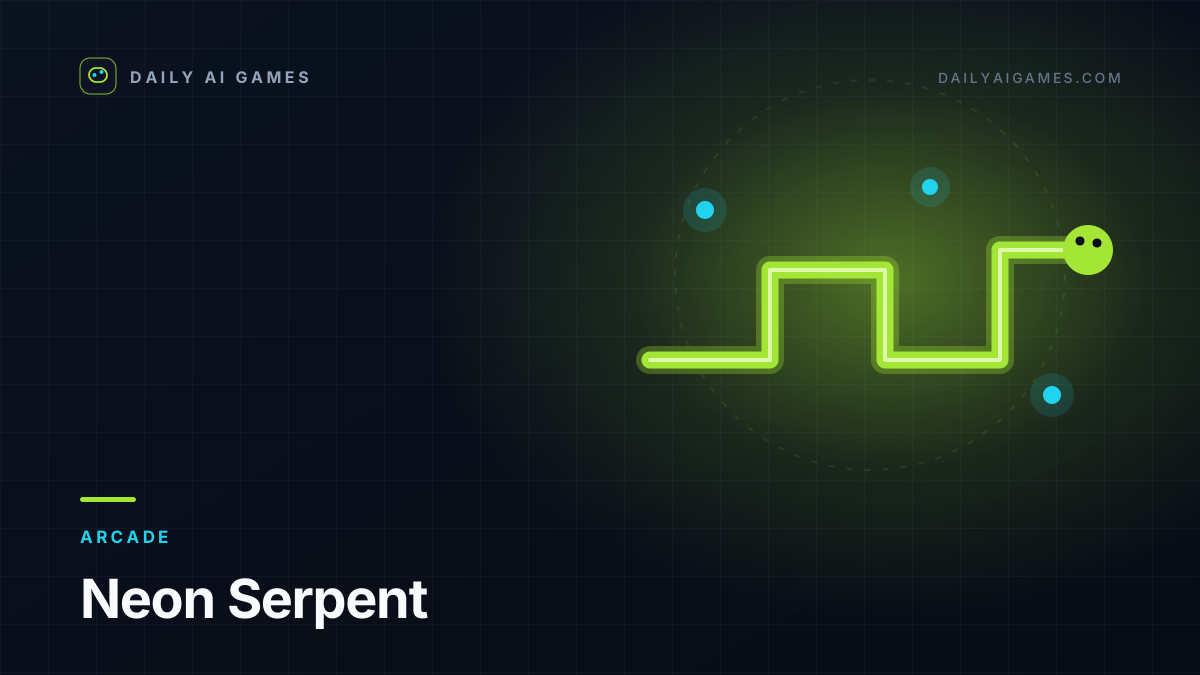
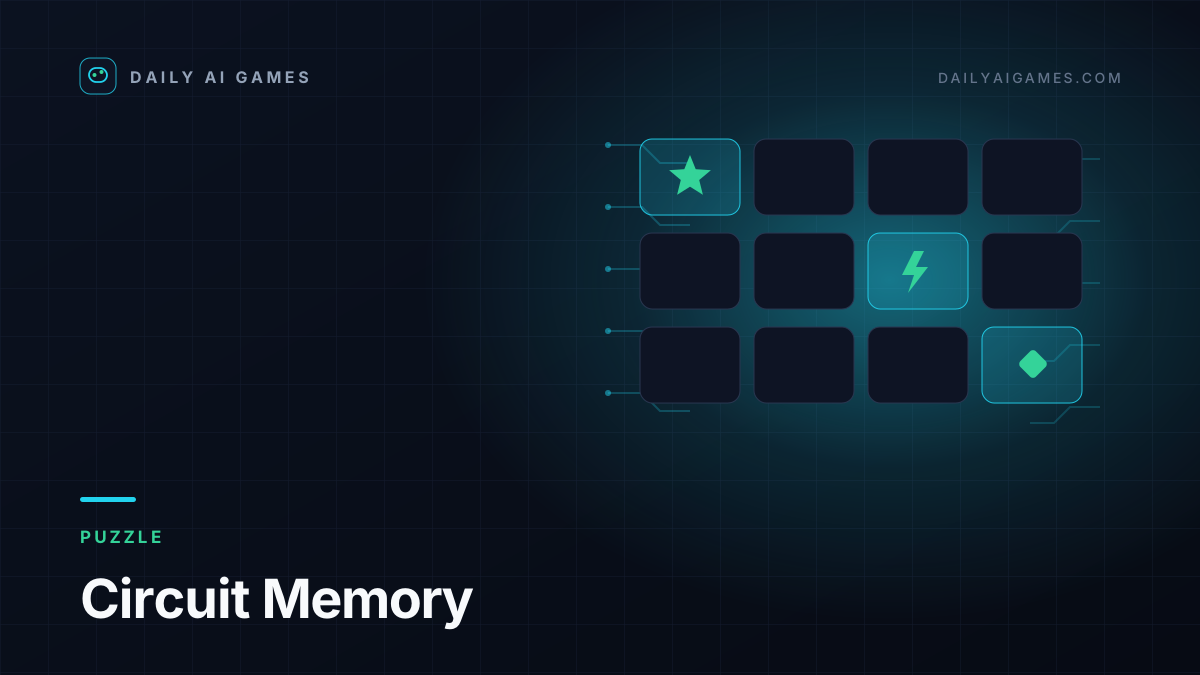
That is the job we have set for ourselves at Daily AI Games. We play the results, keep the ones with a real gameplay loop, and write down how they were made. If you want to see what a tuned prompt-to-game workflow can produce, start with Neon Serpent for arcade feel or Circuit Memory for a calmer puzzle loop. If you want to try the platform approach yourself, read our Google Playground tool guide and the first-game prompt we use to test it.
The platform race will be won on recommendation and taste, not raw generation speed. For creators, that means the differentiator is no longer “can AI build this?” but “is this worth a second run?”