Long Wind
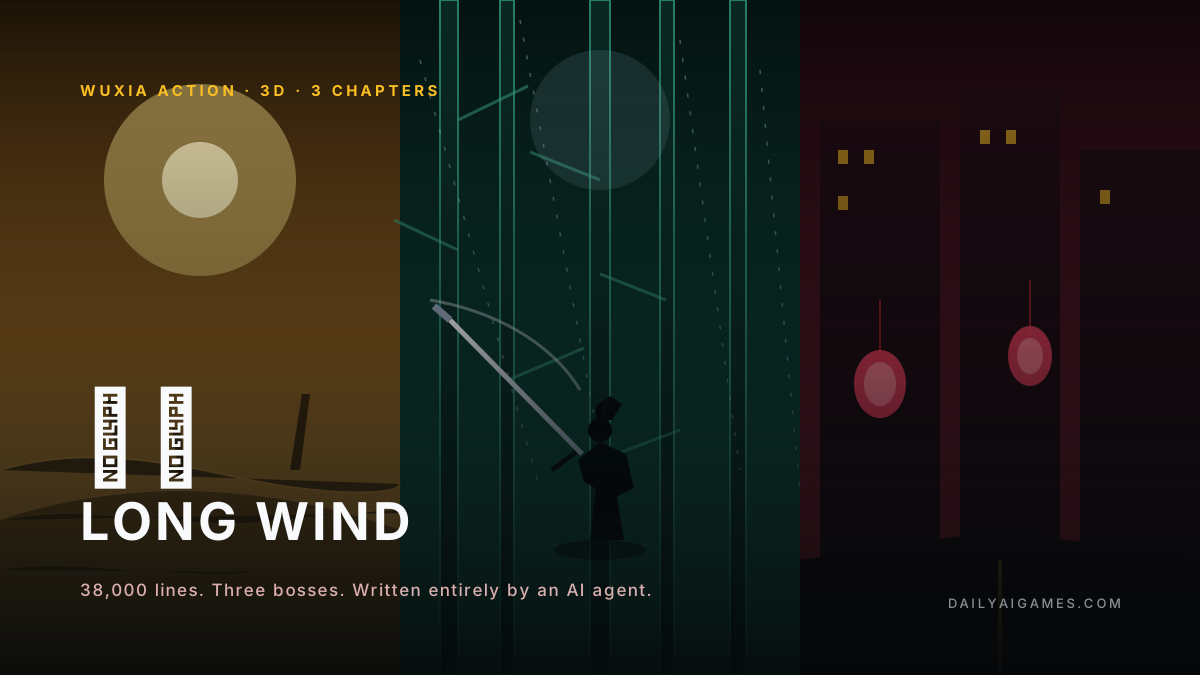
A three-chapter 3D wuxia action game written entirely by Claude Opus 5.5 — deflect, break posture and execute across grassland, bamboo forest and a lantern-lit street.
151 plays tracked on Daily AI Games
External game siteLong Wind is not hosted on Daily AI Games. The button above opens an independently operated, free browser game on GitHub Pages; its content, availability and controls are controlled by that site.
How to Play
Desktop: WASD moves, mouse controls the camera and lock-on, left mouse attacks with light strings, right mouse or a modifier performs heavy attacks, Shift guards, a timed guard press deflects, and Space dodges with invulnerability frames. F executes a posture-broken enemy. Touch controls appear automatically on mobile, with on-screen attack, guard and dodge buttons.
These are the controls for Long Wind. The external Long Wind version on GitHub Pages may use slightly different controls.
Game Preview
About Long Wind
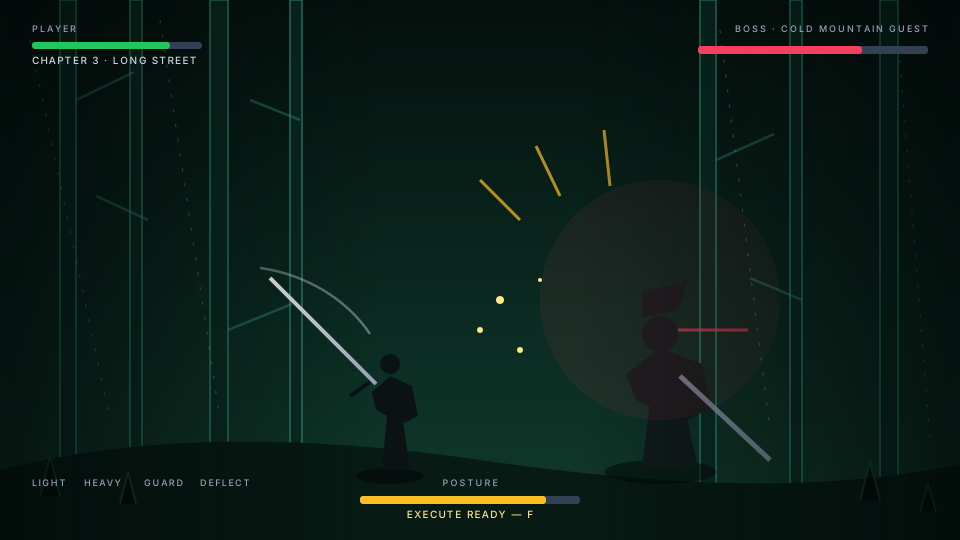
Long Wind — 长风 in Chinese — is a 3D wuxia action game built in Three.js and set across three chapters: a golden grassland, a bamboo forest in night rain, and a lantern-lit long street. You play a wandering swordsman working through bandit camps, patrols and duels, and each chapter closes on a named boss: the Broken Blade, the Night Owl and the Cold Mountain Guest. The tone is closer to a playable wuxia film than to a soulslike, but the combat borrows the vocabulary: light and heavy strings, guard, deflect, dodge with invulnerability frames, posture break and execution.
The combat is the reason to play. Guards absorb chip damage, a well-timed deflect turns an enemy swing into an opening, and a full posture bar lets you execute. Enemies come in four readable types — archers, shield bearers, spearmen and assassins — and each one asks for a different answer: close the gap on the archer, break the shield with heavy attacks, punish the spearman recovery, and survive the assassin flank. Bosses remix those patterns rather than inventing new rules, which makes the third chapter feel like a test of what you learned instead of a wall.
The production is the story. Every line of code was written by Claude Opus 5.5 running in Claude Code, roughly 38,000 lines of JavaScript and GLSL across about 151 files, with three.js as the only runtime dependency. The developer logged about 28 hours of wall-clock work and 19 hours active. Terrain, grass, bamboo, the old town, weather and crowd behaviour are procedural, character animation comes from Mixamo, and some props were generated with Tripo AI. There are no audio files at all: every hit, footstep and ambient sound is synthesized through WebAudio, which is why the game downloads in seconds despite three chapters of content.
It is not a finished commercial game. The English localisation is machine-assisted, the camera occasionally fights the bamboo, and the difficulty curve assumes some familiarity with action games. What it does prove is more interesting: an agent can hold a coherent combat system, a chapter structure, procedural environments and a working audio layer in one project and ship it as an MIT-licensed browser build. Long Wind is published on GitHub Pages and had 151 views and 78 stars on the repository at the time of writing. Play it for the deflections, then read the build notes — the process is the more valuable artifact.
How This Game Was Generated
Written entirely by Claude Opus 5.5 in Claude Code: about 38,000 lines of JavaScript and GLSL across roughly 151 files, with three.js as the only runtime dependency. The developer logged around 28 hours wall clock and 19 hours active work. Environments, grass, bamboo, the old town, weather and crowd behaviour are procedural; animation comes from Mixamo; some props were generated with Tripo AI. There are no audio files — every sound is synthesized with WebAudio. The project includes 30 headless tests and ships under the MIT licence, excluding third-party assets. At the time of writing it had 151 views and 78 GitHub stars.
The Prompt Behind This Game
Show the prompt used to generate Long Wind
Build a third-person 3D wuxia action game in ONE self-contained HTML file (inline CSS/JS). Three.js is the only runtime dependency; no external models, textures or audio files. The game has exactly three chapters and ends.

Chapter structure:
- Chapter 1: golden grassland, bandit camps, one mini-boss. Teach movement, light strings and guard.
- Chapter 2: bamboo forest at night in rain, patrols and ambushes. Teach deflect, dodge invulnerability frames and target priority.
- Chapter 3: a lantern-lit long street, duels and a final boss. Test everything at once.
- Each chapter closes on a named boss with a distinct silhouette and a one-line epithet: the Broken Blade, the Night Owl, the Cold Mountain Guest.
Combat state machine:
- Player states: idle, run, light attack chain, heavy attack, guard, deflect window, dodge, hitstun, execution. Transitions must be explicit; never nest attack logic inside render code.
- Guard absorbs chip damage. A deflect pressed within 120ms of impact negates damage and adds posture damage to the attacker. Missing the window by more than 120ms is a normal block.
- Dodge has 8-14 invulnerability frames; tune it so late dodges are punished and early dodges still work.
- Posture: every enemy has a posture bar that fills from deflects and heavy attacks. A full bar enables an execution prompt. Posture must decay when the enemy disengages.
Enemy archetypes:
- Four readable types: archer, shield bearer, spearman, assassin. Each needs a different answer and a clear telegraph colour.
- Encounters are data-driven: spawn tables with positions, patrol routes and aggression budgets. No encounter should be hard-coded in the update loop.
- Bosses remix the four archetypes rather than adding new rules. A boss should feel like an exam, not a new syllabus.
Camera and presentation:
- Lock-on camera with soft target switching, a shoulder offset, and collision-aware pull-in so bamboo and walls do not occlude the fight.
- Procedural environments: grass, bamboo, old-town roofs, rain and lanterns. Weather must be a toggleable system, not a baked scene.
- One colour script per chapter: gold, blue-green, warm red. Keep UI in a single ink-and-paper palette.
Audio and platform:
- No audio files. Synthesize sword hits, deflections, footsteps, rain and wind with WebAudio, and mix ducking so combat reads clearly.
- Desktop: WASD, mouse camera, light and heavy attack, guard, dodge, execute. Mobile: on-screen attack, guard and dodge with generous targets.
- Respect reduced motion by removing camera shake and hit-stop while keeping timing windows unchanged.
Testing:
- Write 30 headless checks: attack chain cancels, deflect window boundaries, dodge invulnerability duration, posture decay, boss phase transitions, and every chapter end trigger.
- Run a no-input simulation and confirm the player cannot soft-lock in any chapter.
Deliver in stages: movement and camera, then one enemy type, then the full combat state machine, then all four archetypes, then three chapters, then bosses. Print the timing table and the test report at the end.
Open in the prompt library for tips and variations
Similar AI Games
 Action Games
▶ 374 plays
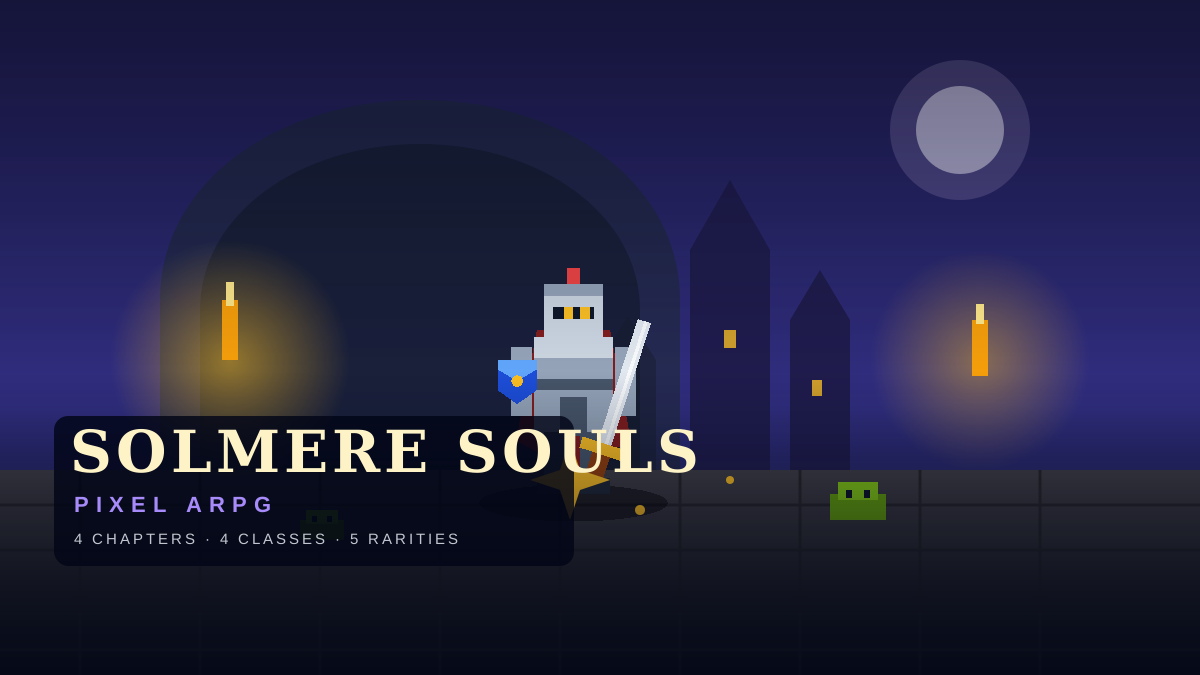
SOLMERE SOULS: Pixel ARPG
A pixel-art action RPG dungeon crawler with four classes, four chapters, soul-binding bosses and five loot rarities — built to be finished in a browser tab.
Play now
 Action Games
▶ 294 plays
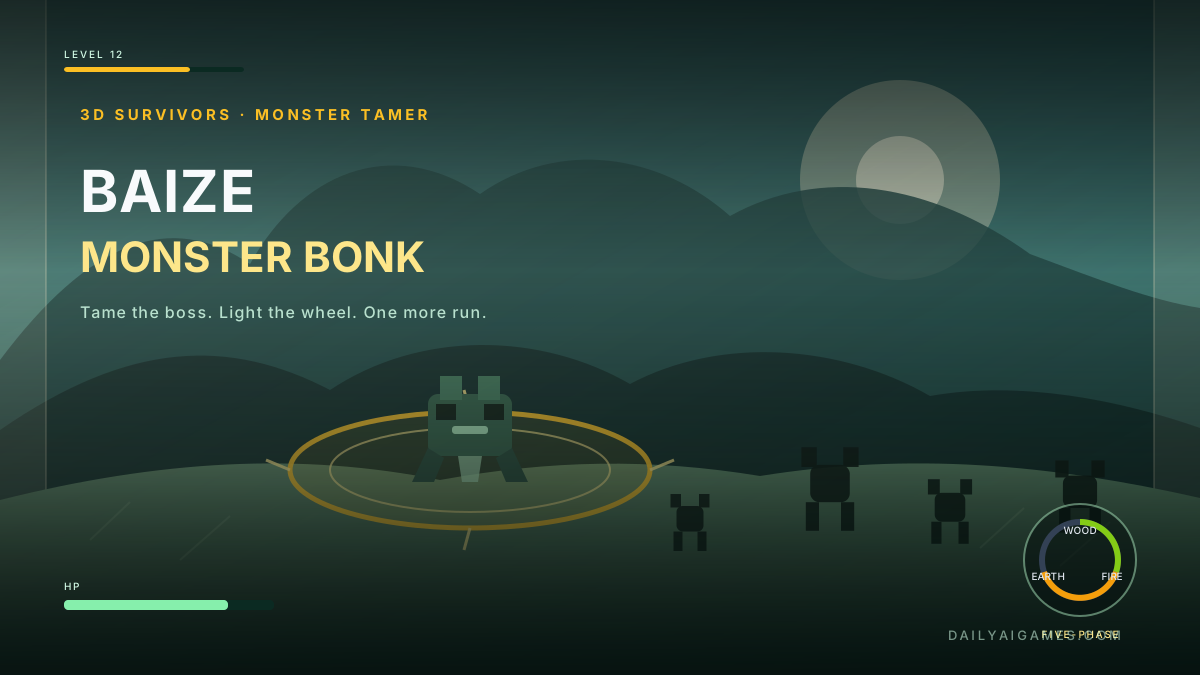
Baize Monster Bonk
A 3D survivors roguelite drawn from the Classic of Mountains and Seas — auto-attacking beasts, seal-ring taming and a five-element wheel that chains elements.
Play now
 Action Games
▶ 137 plays
MYCELIA
A 3D survivors-like where the only verb is walking. Every step grows a glowing fungal carpet that corrodes bugs, and the whole web can be detonated in one chain bloom.
Play now
 Action Games
▶ 1,303 plays
Driftwake
A 3D naval roguelite where your cannons only fire fore, aft and broadside — turn the hull to aim, dodge with an exploding wake, and fight eight warship bosses.
Play now
Articles About Long Wind
Nov 1, 2026
Long Wind: A Wuxia Action Game With 38,000 Lines of AI-Written Code
Long Wind is a three-chapter 3D wuxia action game with about 38,000 lines written by Claude Opus 5.5. Here is what the build proves — and where it still falls short.
Oct 19, 2026
AI-Generated Browser Games Worth Knowing: October–November 2026
From a 12-hour sports hit and a weekend MMO to fifteen new browser games — a tin-toy kart racer, a spherical sailing sim, an art-print surf run and more.
Oct 15, 2026
The 10 Best AI Games to Play Online Free
Ten AI-generated games you can play online free right now — arcade, puzzle, strategy and endless runners, all built from text prompts and playable in your browser.
