Open-world action / driving
Browser Open-World City Sandbox
Tested with AICodeWith · produced Taipei Rush
The Prompt
Build a browser open-world crime sandbox set in [CITY YOU KNOW]. This is a multi-file project, not a one-file demo: use Vite + TypeScript + Three.js (or a comparable WebGL renderer), and keep every asset generated in code or licensed for reuse. Do not copy brands, copyrighted characters or real company logos; parody names only.

World and scope:
- One walkable district of about 2 square kilometres, built from real street names and at least eight identifiable landmarks. Use a simple low-poly style, not photorealism.
- Streets support cars, scooters, traffic lights, crosswalks and sidewalks. At least 120 vehicles and 80 pedestrians active at once, recycled around the player.
- Interiors are out of scope except for one safehouse and one shop. Do not promise what the budget cannot finish.
Player and crime loop:
- Third-person movement on foot and in vehicles. Enter/exit any car, punch, sprint, and a five-level wanted system with police response that escalates from patrol cars to roadblocks.
- A 12-mission story about saving a family home from redevelopment, plus repeatable side jobs. Missions use checkpoints and fail states, not cutscenes.
- A minimap, a full map with mission markers, and a radio-style dispatch feed that reads the player’s last known location.
Presentation and performance:
- Graphics presets Auto/Low/Medium/High/Ultra. Target 60fps at Medium on integrated graphics, with a hard draw-distance budget and object pooling for traffic.
- Chinese and English UI from the same string table. Desktop keyboard/mouse first; touch controls are a second pass, not a launch blocker.
- Save progress in IndexedDB, version the save format, and write a migration path before the first public build.
Testing:
- Add a debug camera, a teleport menu and a “spawn 50 cars” stress test. Run the stress test on the lowest preset and report frame time, draw calls and memory.
- After the build, list what is simulated, what is faked, and what is missing.
Deliver in stages: playable on-foot movement first, then one car, then traffic, then police, then missions. Do not write the mission system before driving feels right.
What This Prompt Produces
Taipei Rush is the public proof that this scope can ship: one developer, about a month, 93 missions and a city built from real street names, reportedly for more than US$10,000 in AI tokens. The cited tool stack is unconfirmed, so treat the platform as a lead rather than a guarantee. The staging order is the part that matters — every successful large AI build we have seen ships one loop at a time.
Modification Tips
- Pick a city you can walk in your head. Specific landmarks and street names do more for the fantasy than a bigger map.
- Build the driving feel before the mission system; a city that is not fun to cross cannot be saved by story.
- Put a hard number on traffic and pedestrians, then pool them. Unbounded spawning is what kills browser frame rates.
- Keep every brand a parody and keep a rename plan. Taipei GTA became Taipei Rush after the lawyers noticed.
The Game This Prompt Produced
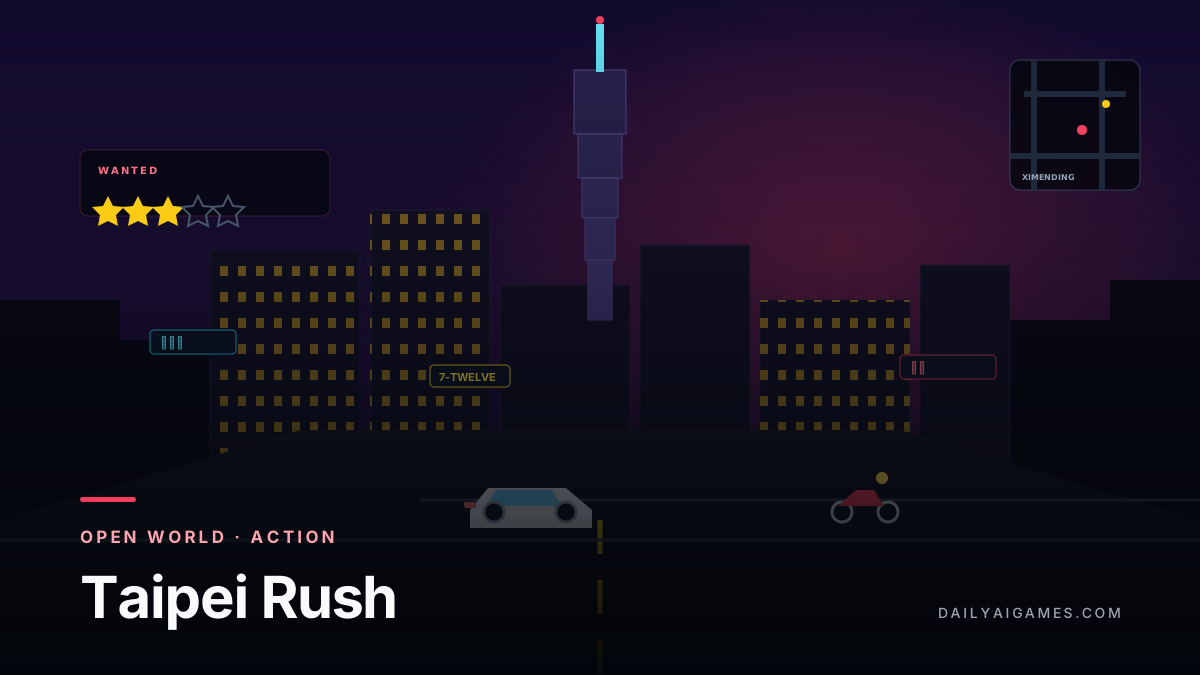
Want to try it? Open AICodeWith, paste the prompt, and you'll have a playable game in minutes. When you're happy with the result, submit it to Daily AI Games.
