Sailing / trading simulation
Spherical-Earth Sailing and Trading Game With Tavern Quests
The Prompt
Build a 3D sailing and trading game in ONE self-contained HTML file (inline CSS/JS). Three.js from one pinned CDN import is the only library; the world, ships, ports and UI are all procedural. No external models, textures or audio files.

World:
- A genuinely spherical Earth, not a flat map with a curved horizon. Render the globe with a low-poly ocean and coastlines, and let the player sail across it continuously with no loading screens.
- 114 ports placed on the sphere, each with a name, a culture, a market and a short description. Ports must be reachable; report any port with no viable wind route from its neighbours.
- Weather and mist bands that thicken as the player sails away from the starting region, so the horizon becomes a real navigational problem.
Sailing model:
- Sail-based movement: W raises sails, S reduces them, A/D steer, Space furls. Wind has a direction and strength shown on a small compass rose.
- Speed depends on sail area, point of sail and hull upgrades. Sailing into the wind is slow and must feel slow, not broken.
- Camera: orbit with drag, zoom with the wheel, and a horizon-level chase view that stays usable on a phone.
Economy:
- Each port buys and sells goods with drifting prices driven by simple supply, distance and local scarcity. Show enough price history that a player can plan a two-hop route.
- Small cargo hold so every purchase is a trade-off. Ship upgrades for hull, hold and sail area, bought with profit.
- No hidden fees and no random confiscation. Losing cargo should always be something the player could have seen coming.
Quests and story:
- Four treasure expeditions. Each starts with a written clue in a tavern, continues through one or two ports, and ends with a search along a stretch of open water and a keepsake for the collection. Clues must be solvable by reading, never by a waypoint marker.
- 42 illustrated taverns with 39 characters, full-size portraits and 163 short chapters of romance and friendship. Dialogue is optional and never blocks trading.
- A skippable first-voyage guide that teaches buying, selling, docking and upgrading in one crossing. Never force it twice.
UI and platform:
- Desktop: W/S sails, A/D steer, E dock and trade, M world map, C cargo, V camera, H guide.
- Mobile: on-screen helm, sail, dock, chart and guide buttons; tap a port on the chart to set a route with automatic navigation; a x1/x3 speed control for long crossings.
- Persistent saves in localStorage, plus cloud saves when a backend is available. Progress must survive a refresh.
- English default with a Simplified Chinese string table switchable in the options menu.
Testing and delivery:
- Write a headless trading bot and run 1,000 simulated voyages. Report: average profit per hour by route, routes that are strictly dominant, any port whose goods can never be sold profitably, and the share of voyages where the player would run out of money with no legal move.
- Fail the build if any port is unreachable, any clue has no solvable location, or a single route beats every other route by more than 40%.
Deliver in stages: spherical ocean and sailing first, then ports and docking, then the market, then upgrades, then taverns and quests, then the chart and saves. Print the port table and the economy report at the end.
What This Prompt Produces
MERIDIAN is the reference: a spherical Earth with 114 ports, drifting markets, four clue-driven treasure expeditions, 42 taverns and 163 story chapters, built with GPT-6 in ChatGPT. The sphere and the x1/x3 speed control are what make long voyages feel like voyages without wasting a lunch break.
Modification Tips
- Model the globe, not a scrolling texture. The curved horizon is the whole fantasy of a sailing game.
- Make clues readable, not marked. A treasure you can locate only by waypoint is a shopping list, not an expedition.
- Price history beats price tags. Two hops of context turn a market into a plan.
- Add a time-scale control. Long voyages are the point, but a x3 toggle is what makes them fit a browser session.
The Game This Prompt Produced
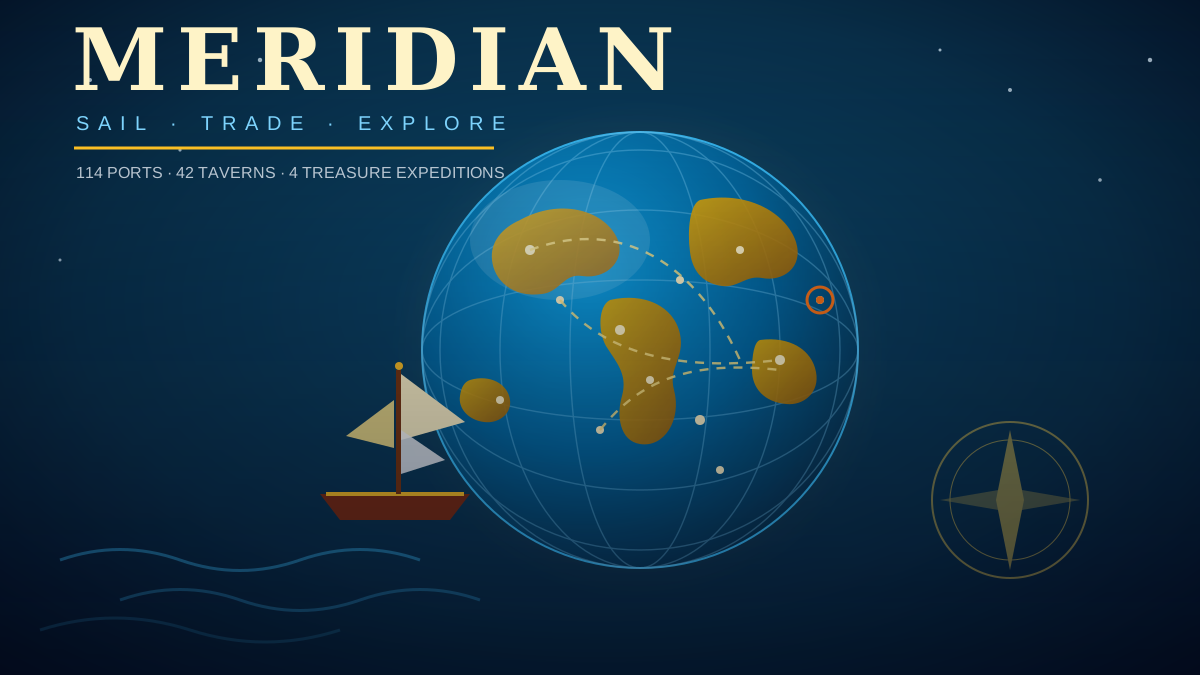
Want to try it? Open ChatGPT, paste the prompt, and you'll have a playable game in minutes. When you're happy with the result, submit it to Daily AI Games.
