Tree Appreciator
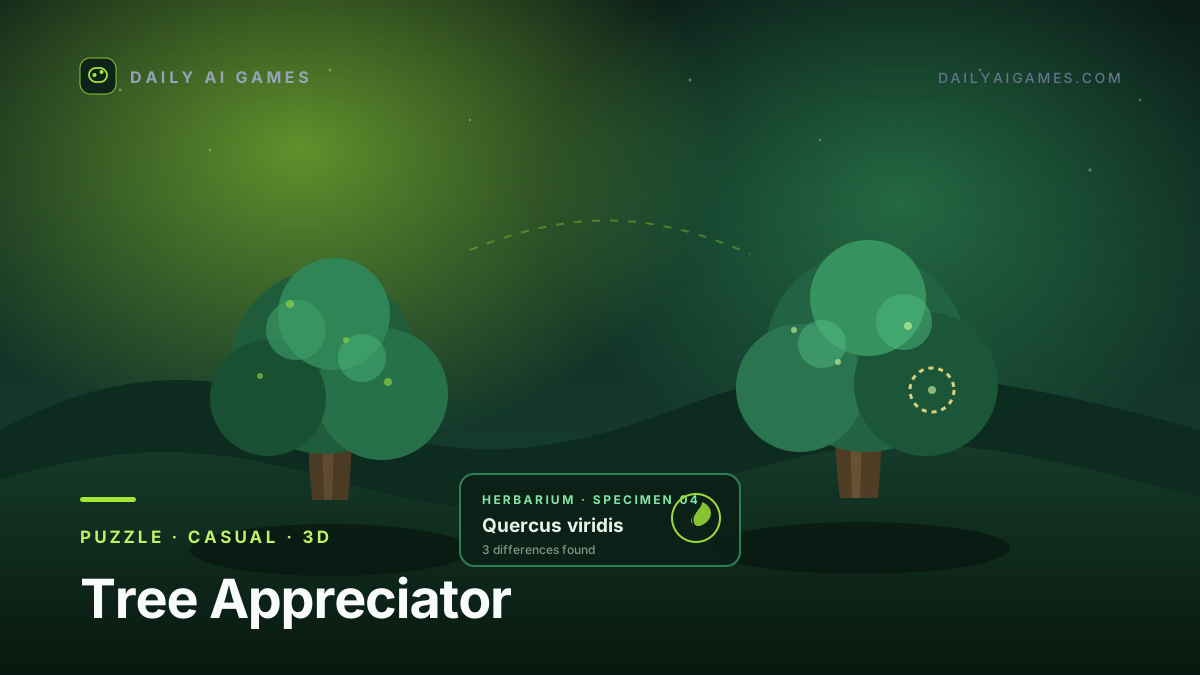
A calm spot-the-difference game with two procedurally grown 3D trees. Find the differences, collect herbarium entries, and take your time.
Tree Appreciator
Play on Simon WillisonOpens tools.simonwillison.net in a new tab · free · no download
0 plays tracked on Daily AI Games
External game siteTree Appreciator is not hosted on Daily AI Games. The button above opens an independently operated, free browser game on Simon Willison; its content, availability and controls are controlled by that site.
How to Play
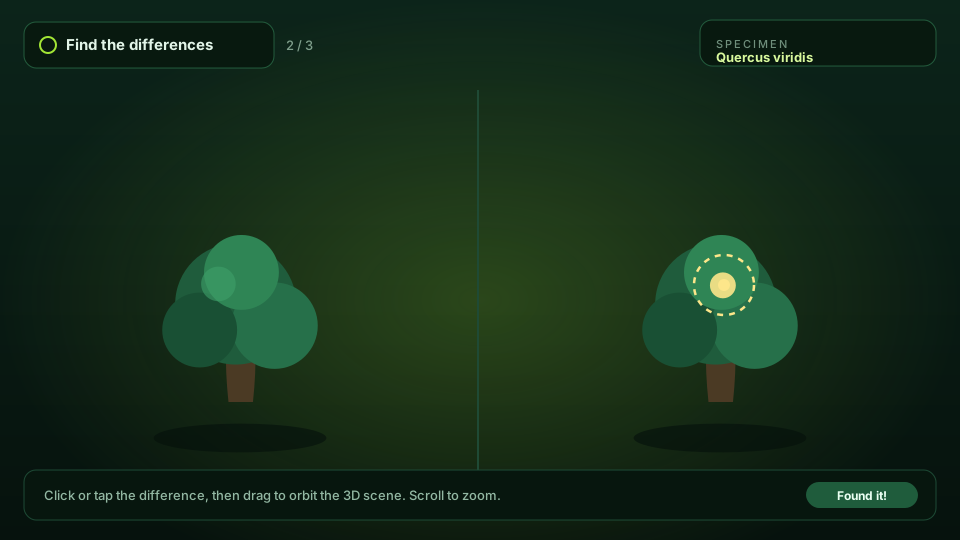
Tap or click a difference on either tree to notice it. Drag to orbit the pair and scroll or pinch to zoom. Use the hint button when you are stuck; each completed pair earns appreciation points, leaves and herbarium entries.
These are the controls for Tree Appreciator. The external Tree Appreciator version on Simon Willison may use slightly different controls.
Game Preview
About Tree Appreciator
Tree Appreciator is a slow spot-the-difference game with a twist: the two trees are grown procedurally from a seed, so every round is a fresh pair. Each tree is a 3D model rendered with Three.js, and the differences are small, physical things — a missing bough, a visiting bird, a branch that turns early. You tap a difference in either tree to notice it, drag to orbit the pair, zoom in to inspect the branches, and spend limited hints when a difference refuses to show itself. Completing a pair earns appreciation points, leaves and herbarium entries, which gives the game a gentle collection loop instead of a fail state.
The pace is the point. There is no timer, no leaderboard and nothing to lose, so the game works as a five-minute pause rather than a competition. The trees are beautiful in a quiet way, the camera lets you look at them from any angle, and the differences are designed to reward close looking rather than pixel hunting. Music, animation and achievements were added by the model without being asked for in detail, according to the developer, and they are what turn a technical demo into something that feels like a small product.
The build story is one of the cleanest examples of AI-assisted game development this month. Simon Willison made Tree Appreciator with a single prompt to Claude Opus 5.5 Max in the default Claude iPhone app — chat mode, not Claude Code. The prompt asked for a Three.js game called Tree Appreciator that shows two algorithmically generated trees and makes the mechanic about appreciating the differences between them, with the instruction to “think hard about how to make sure it is both fun and beautiful.” Claude worked for 3 hours and 7 minutes before returning the game, complete with music, animation and achievements.
It is free, runs in any modern browser, and works on desktop and mobile. Willison noted that telling the model to make sure the game is fun worked “uncomfortably well” — a useful data point for anyone who thinks prompt quality is mostly about technical specification. If you want a calm, unusual browser game, or a case study in what a single well-written prompt can produce, Tree Appreciator is worth a tab.
How This Game Was Generated
Made by Simon Willison with a single prompt to Claude Opus 5.5 Max in the default Claude iPhone app in chat mode, not Claude Code. According to Willison, the model worked for 3 hours and 7 minutes and returned the game with music, animation and achievements without those being specified in detail.
Similar AI Games
 Casual Games
▶ 1,730 plays
Star Tapper
Tap fading stars and build combos in this juicy casual game. Easy to learn, satisfying to master — free in your browser.
Play now
 Casual Games
▶ 310 plays
Deep Diver
Hold to sink, release to rise. Collect pearls and dodge mines in this one-thumb casual game — free in your browser.
Play now
 Memory Games
▶ 960 plays
Circuit Memory
A brain-training memory pairs game with glowing circuit symbols. Flip, match, and clear the board in as few moves as you can.
Play now
 Casual Games
▶ 0 plays
GeoSports
A daily sports geography game: five questions, one world map, and a score based on how close your pin lands. Free, no sign-up, about a minute per round.
Play now
Articles About Tree Appreciator
Oct 15, 2026
The 10 Best AI Games to Play Online Free
Ten AI-generated games you can play online free right now — arcade, puzzle, strategy and endless runners, all built from text prompts and playable in your browser.
Oct 12, 2026
Claude vs Gemini vs ChatGPT for Making Games
We build games with Claude, Gemini and ChatGPT daily. A hands-on comparison of code quality, iteration speed and which AI writes better game code.
Sep 28, 2026
What Are AI Generated Games? A Plain-English Guide
AI generated games are playable games built by AI models from text prompts. Here is what they are, how they are made, and where to play them free.
