Puzzle / match-3 roguelite
Match-3 Roguelite Where the Board Is the Combat System
The Prompt
Build a fantasy match-3 roguelite in ONE self-contained HTML file (inline CSS/JS, DOM or canvas, no libraries, no external images — draw every gem, item and portrait from code or inline SVG). No audio files; WebAudio only.

Board and combat:
- An 8x8 gem board with six gem types. Swap two adjacent gems; a line of three or more clears, everything above falls, and cascades resolve from the top down. Illegally swapping a gem that makes no line must animate back and cost nothing.
- The board is the attack bar. Clearing a line of a gem type fires that type's attack at the Champion. Cascades multiply the hit; a five-in-a-row or better charges a class skill. Nothing on the board is decorative.
- The Champion telegraphs a Signature Move one to three turns ahead with a named banner and a countdown on the board. The player answers it by clearing a specific gem type or by banking a shield with their class skill. An unanswered move must visibly hurt.
- No turn timer. Input is one action at a time and the board must never resolve while the player is mid-swap.

Run structure:
- 21 playable classes, defined as data, each with one passive, one class skill and a preferred gem type. The class must change which matches are worth chasing, not just the damage numbers.
- A branching map of 12 to 18 nodes across four node kinds: Fights, Events, Villages and Shops. Fights pay loot, Events and Villages offer risk decisions, Shops let the player spend gold. Show the next two nodes before committing.
- Peril: every new climb raises a global modifier that makes Champions hit harder or telegraph faster. Display the current Peril level on the map screen.

Loot:
- Three rarity bands: Uniques, Cursed items and socketed Shards. About one in six drops is Cursed: a strong upside with a real recurring cost (fewer moves, a locked gem type, damage on cascade). The cost must be stated on the card in plain language before it is equipped.
- Shards socket into gear and modify a single rule (for example "green matches also charge the class skill"). Cap sockets so a build cannot become all upside.
- Inventory is small and readable: six equipment slots, a three-item bag, and a compare panel that shows the delta before you equip.

Scoring and platform:
- A run ends when the player dies or finishes the map, and converts to a single Score: nodes cleared, Champions beaten, Peril level and remaining gold. Show a run summary that names the build that got you there.
- Desktop only is acceptable: mouse to swap gems and click Spells, items and menus. Keyboard shortcuts for the three most-used actions.
- Save the current run so a closed tab does not erase it, and never save mid-cascade.

Testing and delivery:
- Write a headless simulator that plays 500 runs with three policies: greediest cascade, most-defensive matching, and loot-first routing. Report: median nodes cleared, death rate per Peril level, share of runs where a Cursed item was equipped, and whether any of the 21 classes is strictly worse in all three policies.
- Fail the build if a Champion can be killed without ever answering a Signature Move, if a cascade can resolve out of turn order, or if any class has no board state it prefers.
Deliver in stages: board and swapping, then one Champion and the answer loop, then the map and node types, then loot and Cursed items, then the remaining classes, then Peril, scoring and the report. Print the class table and the simulator output at the end.
What This Prompt Produces
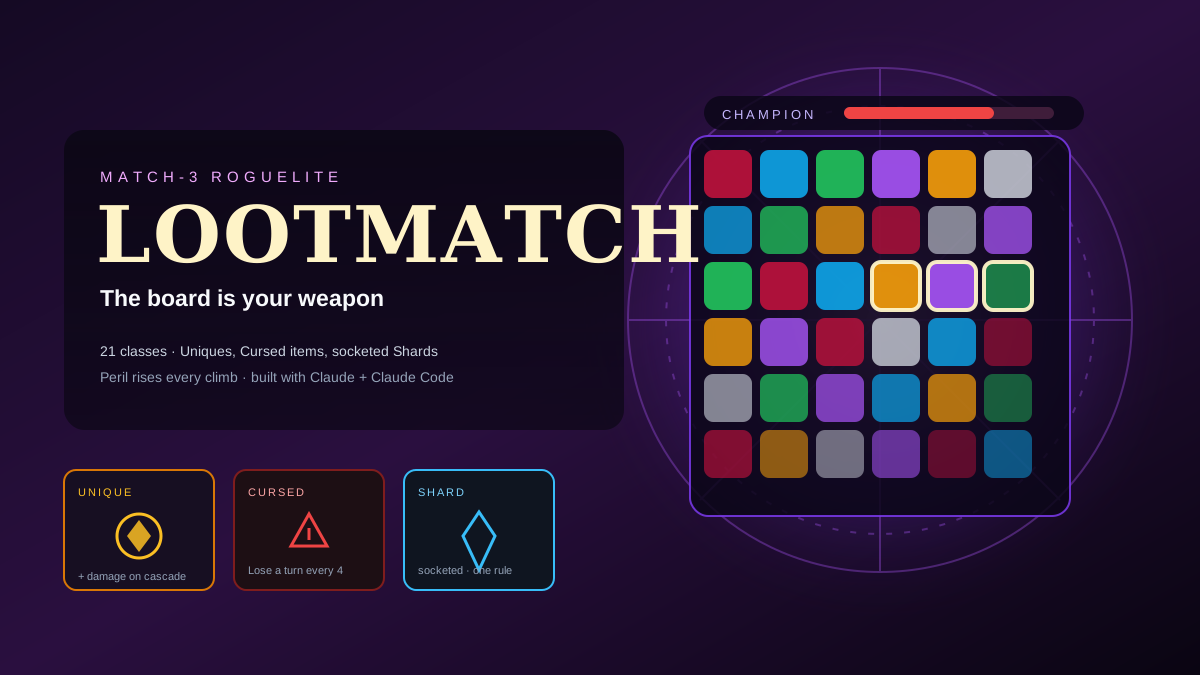
Lootmatch is the reference: 21 classes, a map of Fights, Events, Villages and Shops, Champions with Signature Moves, Uniques, Cursed items and socketed Shards, and Peril rising on every climb — built by Nanotyrannus Games with Claude and Claude Code. Asking for the board to be the attack bar is what stops it becoming a match-3 with a health bar bolted on.
Modification Tips
- Make the board the weapon. If a match only deals damage, the player is playing match-3 with extra steps.
- Let Cursed items state their bill in plain language on the card. A hidden cost reads as a bug, not as a trade-off.
- Give each class a preferred gem type. That single line turns 21 classes into 21 different boards.
- Put the Champion telegraph on the board, not in a log. Players plan around what they can see counting down.
The Game This Prompt Produced
Want to try it? Open Claude, paste the prompt, and you'll have a playable game in minutes. When you're happy with the result, submit it to Daily AI Games.
