Lootmatch
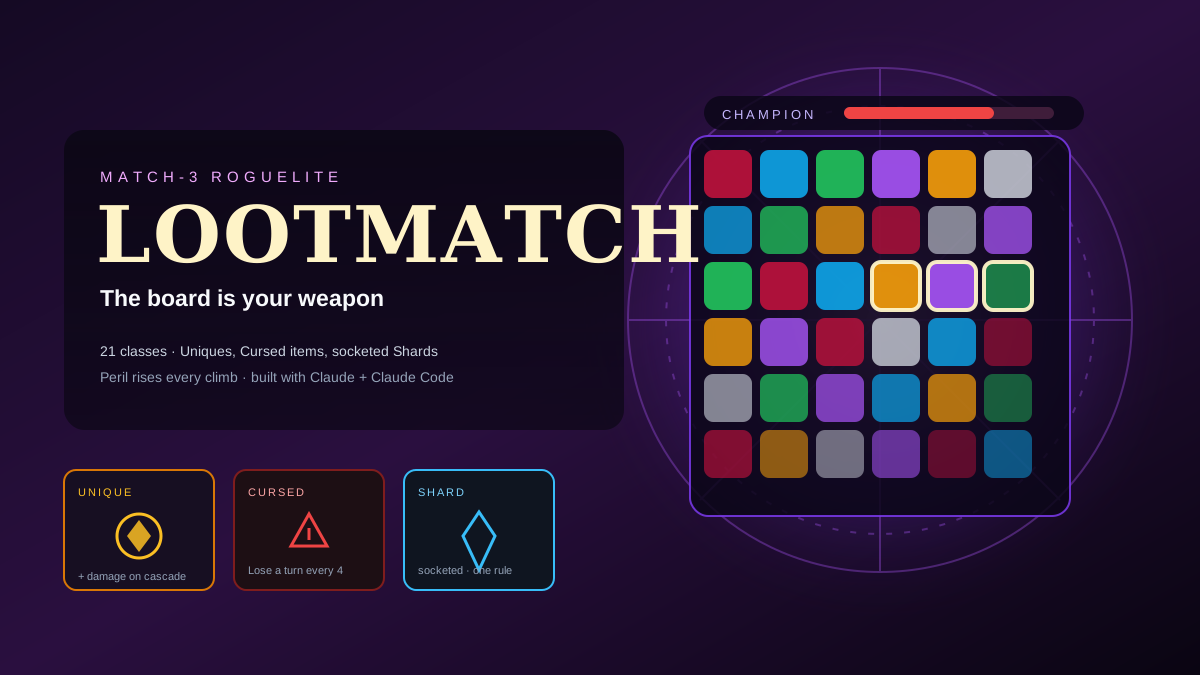
A fantasy match-3 roguelite: pick one of 21 classes, clear gems to strike Champions, dodge their Signature Moves and rebuild your build from Uniques, Cursed items and socketed Shards.
18 plays tracked on Daily AI Games
External game siteLootmatch is not hosted on Daily AI Games. The button above opens an independently operated, free browser game on AIGameShare; its content, availability and controls are controlled by that site.
How to Play
Desktop only: click or drag two adjacent gems to swap them and match a line. Click Spells, items and menus to use them. The game needs a mouse and a keyboard-capable browser; there is no touch build.
These are the controls for Lootmatch. The external Lootmatch version on AIGameShare may use slightly different controls.
Game Preview
About Lootmatch
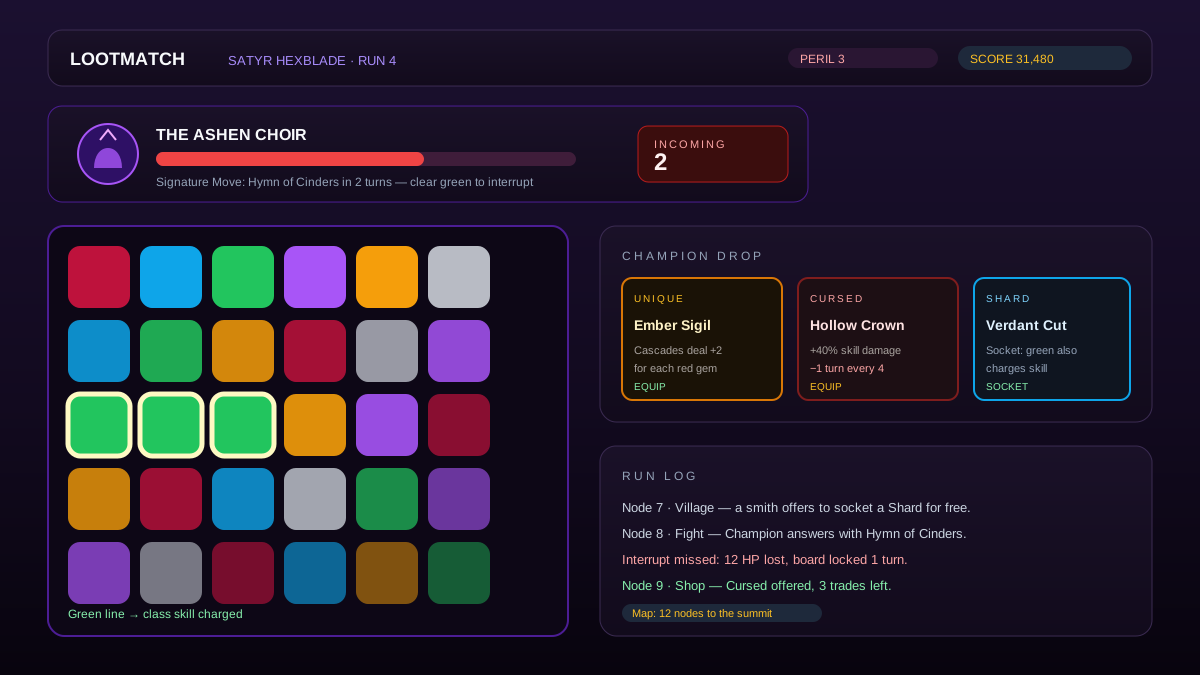
Lootmatch answers a question match-3 games rarely ask: what if the board were a combat system instead of a score multiplier? You pick one of 21 classes, walk a map of fights, Events, Villages and Shops, and every fight is resolved by matching gems to strike a Champion while dodging the Signature Moves it telegraphs. The board still behaves like a match-3 board — swap two adjacent gems, clear the line, watch the cascade — but the cascades are ammunition now, and the thing across the table is trying to kill you between them.
The loot is where the roguelite lives. Champions drop Uniques, Cursed items and Shards that socket into your gear, so a run is not a matter of clearing a fixed board faster, it is a matter of assembling a kit that survives the next node. Cursed items are the interesting half of that: the genre’s best trade-offs are the ones you take because the upside arrives now and the bill arrives later, and a match-3 frame makes that bill easy to read, because every extra turn the curse costs you is a turn the Champion gets to use a Signature Move.
The map is a small economy rather than a corridor. Fights give gear, Events and Villages give decisions, Shops give you somewhere to spend what the fights produced, and the run ends in a single Score that the leaderboard keeps. Every new climb raises Peril, so the same early nodes stop being a formality — the pressure is not a longer run, it is a shorter tolerance for a bad board.
The class list is the replay engine. Twenty-one classes is far more than one run needs, and that is the point: the class you pick decides which matches are worth chasing, which is a different question from which matches are available. Combine that with random drops and the run-to-run variance comes from your build rather than from the gem colours alone, which is exactly the lever a roguelite needs.
Lootmatch was created by Nanotyrannus Games and built with Claude and Claude Code, and it is desktop-only — mouse to swap gems, click for Spells, items and menus. At the time of writing it had 18 plays and six hours and sixteen minutes of tracked play on AIGameShare, an average of roughly 21 minutes per play, which is the strongest engagement figure of any game published on the platform that week. The top two scores on its leaderboard were 49,599 and 15,895.
How This Game Was Generated
Created by Nanotyrannus Games and built with Claude and Claude Code. A fantasy match-3 roguelite: 21 classes, a map of fights, Events, Villages and Shops, Champions with telegraphed Signature Moves, and loot in the form of Uniques, Cursed items and socketed Shards. Peril raises the stakes on every climb and the run ends in a leaderboard score. Desktop only. At the time of writing it had 18 plays and 6h 16m of tracked play on AIGameShare — about 21 minutes per play — with a top score of 49,599.
The Prompt Behind This Game
Show the prompt used to generate Lootmatch
Build a fantasy match-3 roguelite in ONE self-contained HTML file (inline CSS/JS, DOM or canvas, no libraries, no external images — draw every gem, item and portrait from code or inline SVG). No audio files; WebAudio only.

Board and combat:
- An 8x8 gem board with six gem types. Swap two adjacent gems; a line of three or more clears, everything above falls, and cascades resolve from the top down. Illegally swapping a gem that makes no line must animate back and cost nothing.
- The board is the attack bar. Clearing a line of a gem type fires that type's attack at the Champion. Cascades multiply the hit; a five-in-a-row or better charges a class skill. Nothing on the board is decorative.
- The Champion telegraphs a Signature Move one to three turns ahead with a named banner and a countdown on the board. The player answers it by clearing a specific gem type or by banking a shield with their class skill. An unanswered move must visibly hurt.
- No turn timer. Input is one action at a time and the board must never resolve while the player is mid-swap.

Run structure:
- 21 playable classes, defined as data, each with one passive, one class skill and a preferred gem type. The class must change which matches are worth chasing, not just the damage numbers.
- A branching map of 12 to 18 nodes across four node kinds: Fights, Events, Villages and Shops. Fights pay loot, Events and Villages offer risk decisions, Shops let the player spend gold. Show the next two nodes before committing.
- Peril: every new climb raises a global modifier that makes Champions hit harder or telegraph faster. Display the current Peril level on the map screen.

Loot:
- Three rarity bands: Uniques, Cursed items and socketed Shards. About one in six drops is Cursed: a strong upside with a real recurring cost (fewer moves, a locked gem type, damage on cascade). The cost must be stated on the card in plain language before it is equipped.
- Shards socket into gear and modify a single rule (for example "green matches also charge the class skill"). Cap sockets so a build cannot become all upside.
- Inventory is small and readable: six equipment slots, a three-item bag, and a compare panel that shows the delta before you equip.

Scoring and platform:
- A run ends when the player dies or finishes the map, and converts to a single Score: nodes cleared, Champions beaten, Peril level and remaining gold. Show a run summary that names the build that got you there.
- Desktop only is acceptable: mouse to swap gems and click Spells, items and menus. Keyboard shortcuts for the three most-used actions.
- Save the current run so a closed tab does not erase it, and never save mid-cascade.

Testing and delivery:
- Write a headless simulator that plays 500 runs with three policies: greediest cascade, most-defensive matching, and loot-first routing. Report: median nodes cleared, death rate per Peril level, share of runs where a Cursed item was equipped, and whether any of the 21 classes is strictly worse in all three policies.
- Fail the build if a Champion can be killed without ever answering a Signature Move, if a cascade can resolve out of turn order, or if any class has no board state it prefers.
Deliver in stages: board and swapping, then one Champion and the answer loop, then the map and node types, then loot and Cursed items, then the remaining classes, then Peril, scoring and the report. Print the class table and the simulator output at the end.
Open in the prompt library for tips and variations
Similar AI Games
 Puzzle Games
▶ 479 plays
Interrogation Room Komiya
A Japanese-only browser detective puzzle by Dragon Quest creator Yuji Horii. Catch a suspect in four lies before his lawyer arrives, using 20 moves and five pieces of evidence.
Play now
 Puzzle Games
▶ 263 plays
ROLLBACK
A time-loop horror mystery in a locked office. Talk to WREN, gather evidence, and try to reach one of eight endings before the night resets.
Play now
 Puzzle Games
▶ 2,650 plays
Merge Cubes
A 2048-style merge puzzle with glowing cubes. Swipe to slide, merge matching numbers, and chase that 2048 tile.
Play now
 Action Games
▶ 752 plays
CINDERDEEP: Falling Sand Roguelike
A falling-sand roguelike where every pixel of the cave is simulated. Burn, freeze, dissolve and flood your way through five depths with a four-spell wand.
Play now
Articles About Lootmatch
Nov 21, 2026
Lootmatch: The Match-3 Roguelite Where the Board Is the Attack Bar
Lootmatch turns match-3 into combat: 21 classes, telegraphed Champion moves, Cursed items and socketed Shards, and a leaderboard that rewards the build you assemble.
Oct 19, 2026
AI-Generated Browser Games Worth Knowing: October–November 2026
From a 12-hour sports hit and a weekend MMO to fifteen new browser games — a tin-toy kart racer, a spherical sailing sim, an art-print surf run and more.
Oct 15, 2026
The 10 Best AI Games to Play Online Free
Ten AI-generated games you can play online free right now — arcade, puzzle, strategy and endless runners, all built from text prompts and playable in your browser.
