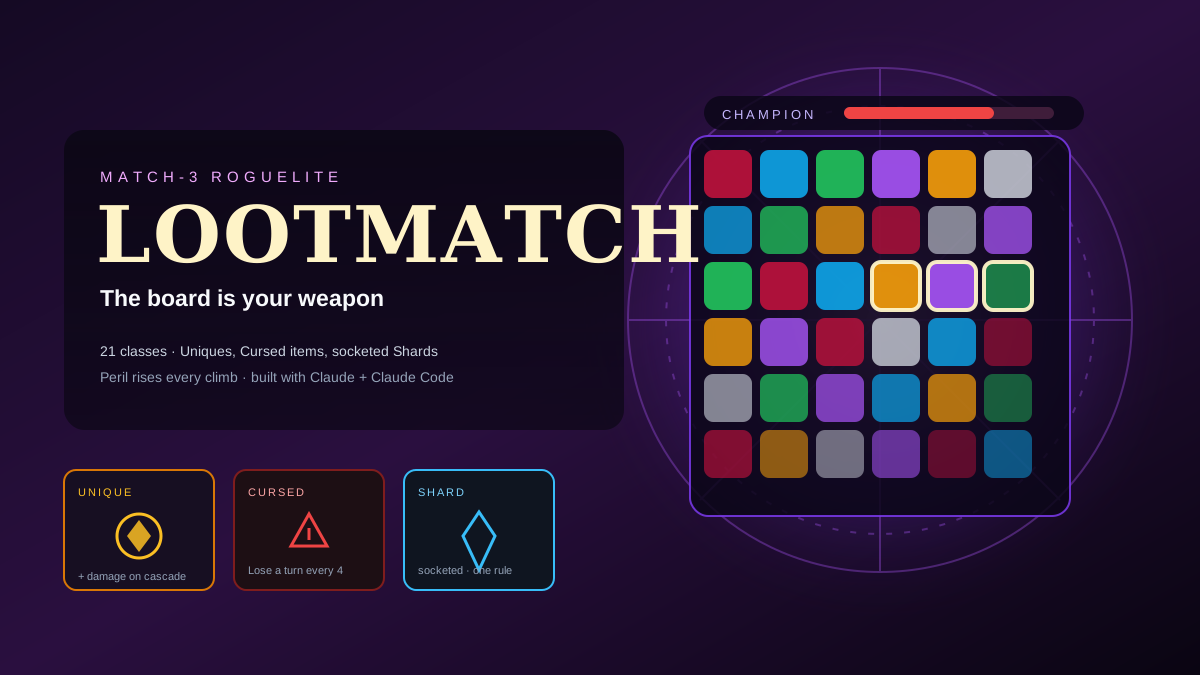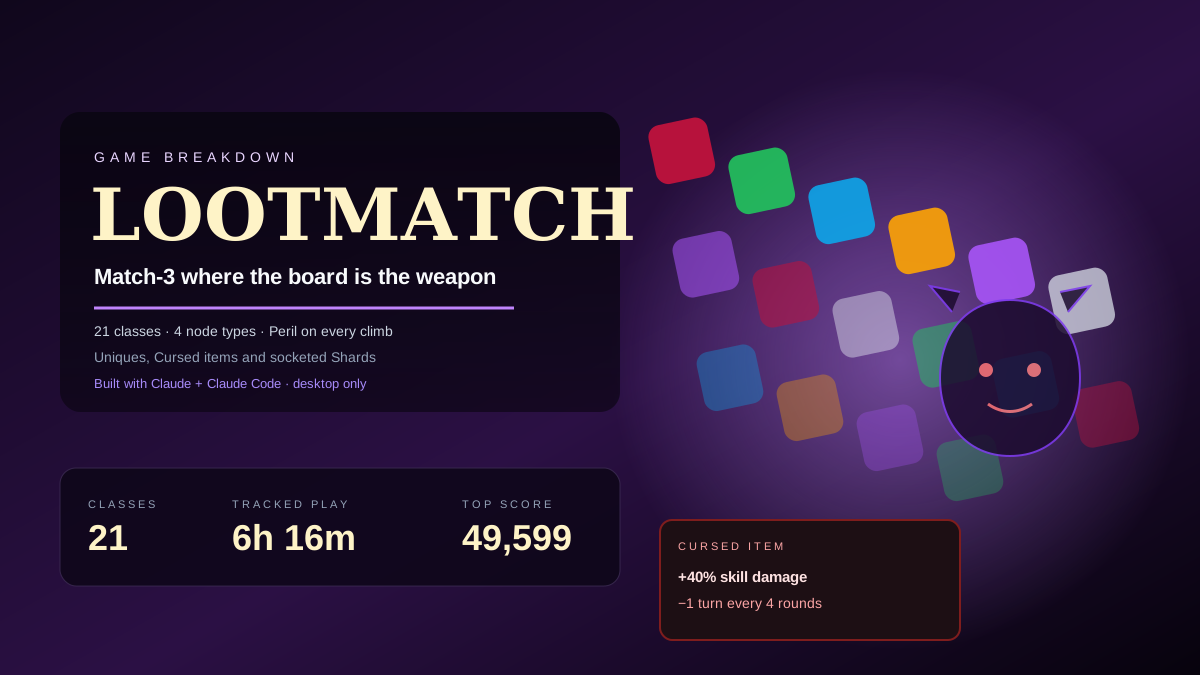
Match-3 is the most conservative genre in browser games. The board is the same, the gems are the same, and the only question a designer usually asks is how loud the cascade should sound. Lootmatch asks a different one: what if the board were the weapon, and something across the table were trying to kill you between your turns?
The answer is a fantasy roguelite where clearing a line is an attack, a Champion telegraphs its Signature Moves, and the loot you pick up rewrites which matches are worth chasing. It is a small, strange, very specific game, and it is the most interesting thing anyone has done with a match-3 board in a browser this month.
What Lootmatch actually is
You pick one of 21 classes and walk a map made of four node types: fights, Events, Villages and Shops. Fights are resolved on a gem board — you swap adjacent gems, match three or more, and the clear strikes the Champion. Champions do not sit still and take it. Each one has Signature Moves, and the game tells you they are coming; the skill is in dodging them while still keeping enough board pressure to end the fight.
Between fights, the loot does the work. Champions drop three kinds of gear: Uniques, Cursed items, and Shards that socket into what you already have. Every new climb raises Peril, which raises the stakes of the same early nodes. A run ends in a Score, and a leaderboard keeps it. At the time of writing the top two scores were 49,599 and 15,895 — a gap wide enough to suggest that the scoring rewards a plan, not just a lucky cascade.
That is the whole design, and it is more than it looks. The reason is that all four systems — board, Champion, loot, map — pull on the same resource: the turns you spend.
The turn is the currency
Most match-3 games treat a turn as free. You clear, the board refills, you clear again. Nothing is spent except time, which is why the genre so often feels like a screensaver with a score attached.
Lootmatch makes the turn expensive by putting an opponent in it. If a Champion is winding up a Signature Move, then every match you make has two jobs: damage the thing in front of you, and answer the thing it is about to do. A cascade that would be excellent against a passive health bar can be the wrong cascade if it clears the gem type you needed for the answer.
That single change re-prices the entire board. You stop looking for the biggest line and start looking for the line that pays for the next two turns. It is the same mental shift that makes a deckbuilder interesting: the question is not “what is my best card” but “what is my best card right now, given what is coming”.
It also fixes the genre’s oldest problem, which is that a losing board feels like bad luck. When a run ends in Lootmatch you can usually name the turn that did it — the cascade you took instead of the answer, the Signature Move you ate because you were greedy. That is a much better feeling than watching the board refuse to give you a move.
Cursed items are the best idea in the game
The loot has three bands, and the middle one is where the design gets interesting. Uniques are straightforward power. Shards are modification — they change one rule, which is how a build starts to feel like a build rather than a pile of stats. Cursed items are the trade.
A Cursed item gives you something strong and charges you for it, repeatedly. That is the oldest trick in roguelike design and it works for a reason: it converts a decision about power into a decision about risk tolerance. What makes it land here is the frame. In a match-3 game, a recurring cost is easy to understand, because the player already counts turns. “You lose a turn every few rounds” is not an abstraction in this genre; it is the exact thing the whole game is made of.
The design test for a Cursed item is whether the player can state the bill out loud. If the card says what it costs in plain language, taking it feels like a gamble. If the cost is hidden in a modifier the player has to infer, taking it feels like a bug report waiting to happen.
Twenty-one classes is a statement about replay
Twenty-one classes is far more than one run needs. A tight roguelite could ship four and be fine. The number matters because of what a class does here: it decides which matches are worth chasing.
That is a subtler job than “this class does more red damage”. If a class has a preferred gem type, then the board is no longer a neutral field of equal opportunities — it is a field with a bias, and the bias changes when you change class. Two players looking at the same board should want different swaps. That is what turns a class list into replay value instead of a character-select screen with different numbers.
The same logic applies to the map. Fights, Events, Villages and Shops are not four flavours of the same node; they are four ways to convert a run into a build. Shops need gold, fights produce gear, and Events and Villages are where a run gets a shape it did not plan for. Peril then makes the shape matter, because the same node at a higher Peril asks a different question.
Where it is thin
The first limitation is access. Lootmatch is desktop-only — mouse to swap gems, click for Spells, items and menus, no touch build. For a site where most games run on a phone in portrait, that is a real restriction, and it is worth knowing before you open it on a tablet.
The second is volume. Twenty-one classes is a lot of surface for a small team to balance, and a leaderboard with two scores on it is a leaderboard that has not been stress-tested yet. The run-to-run variance that makes a roguelite worth replaying will only show up once more people have climbed the same map.
Neither of those is fatal. The engagement numbers, though, are genuinely good: 18 plays and six hours and sixteen minutes of tracked play on AIGameShare at the time of writing, which works out to roughly 21 minutes per play. For a browser game published two days earlier, that is the strongest attention signal of anything released that week.
What to copy if you build one
- Put an opponent in the board. A match-3 with a health bar is still a match-3. A match-3 with a telegraphed threat is a game.
- Make the turn expensive. If nothing is spent by clearing, nothing is decided by clearing.
- Write Cursed items in plain language. The cost has to be legible on the card, not discovered three fights later.
- Give every class a bias. A class should change which matches you want, not just how hard they hit.
- Let the map be an economy. Fights, shops, events and villages should each convert a run into a build in a different way.
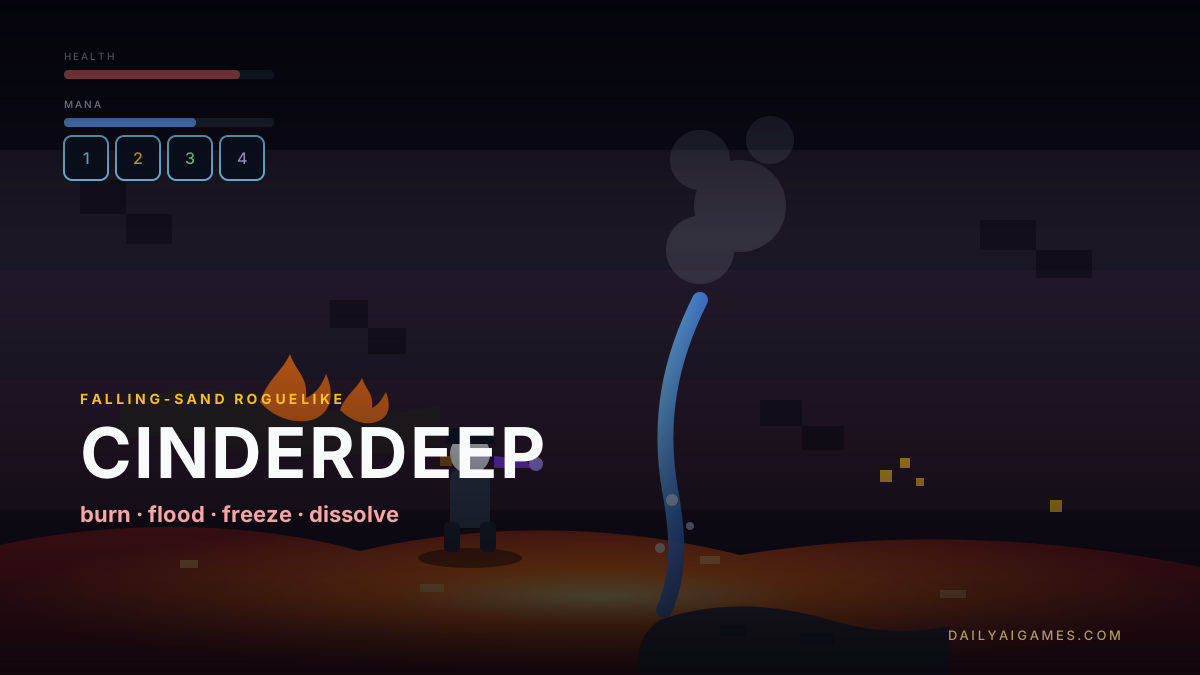
Our match-3 roguelite prompt specifies the board-as-attack-bar rule, the Champion telegraph, 21 data-driven classes, Peril and the four node types as fixed requirements with failure conditions, so you can regenerate a cousin of this game in an afternoon. If you want to see how far a familiar board can be pushed, Merge Cubes is the site’s pure logic case, and CINDERDEEP is the closest thing here to Lootmatch’s build-a-run structure.
Verdict
Lootmatch is the rare match-3 that earns the word roguelite. The board is not a score generator, it is the combat system; the loot is not a stat list, it is a set of trades; and the 21 classes exist to make the same board look different depending on who is standing at it. It is desktop-only and it is two days old, so treat the balance as a promise rather than a fact. But the idea underneath it is finished, and it is the best argument we have seen for treating the most conservative genre in browser games as a place to experiment.
FAQ
Is Lootmatch free to play?
Yes. It runs in the browser on AIGameShare with no download and no account.
Can you play Lootmatch on a phone?
No. The current build is desktop-only and needs a mouse to swap gems and click menus. There is no touch version.
What are Signature Moves?
Telegraphed attacks from a Champion. You are expected to dodge them by answering them on the board while still dealing damage, rather than trading hits until one side runs out of health.
How long is a run?
Short. The game is built for one-to-five-minute sessions per the listing, but the tracked average on AIGameShare at the time of writing was about 21 minutes per play, which suggests players are chaining runs.
Who made it?
Nanotyrannus Games, built with Claude and Claude Code, published on AIGameShare on 19 November 2026.