Most browser climbing games are jumping games with a vertical background. You press up, the character sticks to a wall, and the only thing being tested is how well you can read a gap. Titan Climb: The Bellkeeper is not that. Its subject is the rope — the cast, the swing, the release, and the long second afterward when you are in the air with nothing attached and your own momentum deciding where you land.
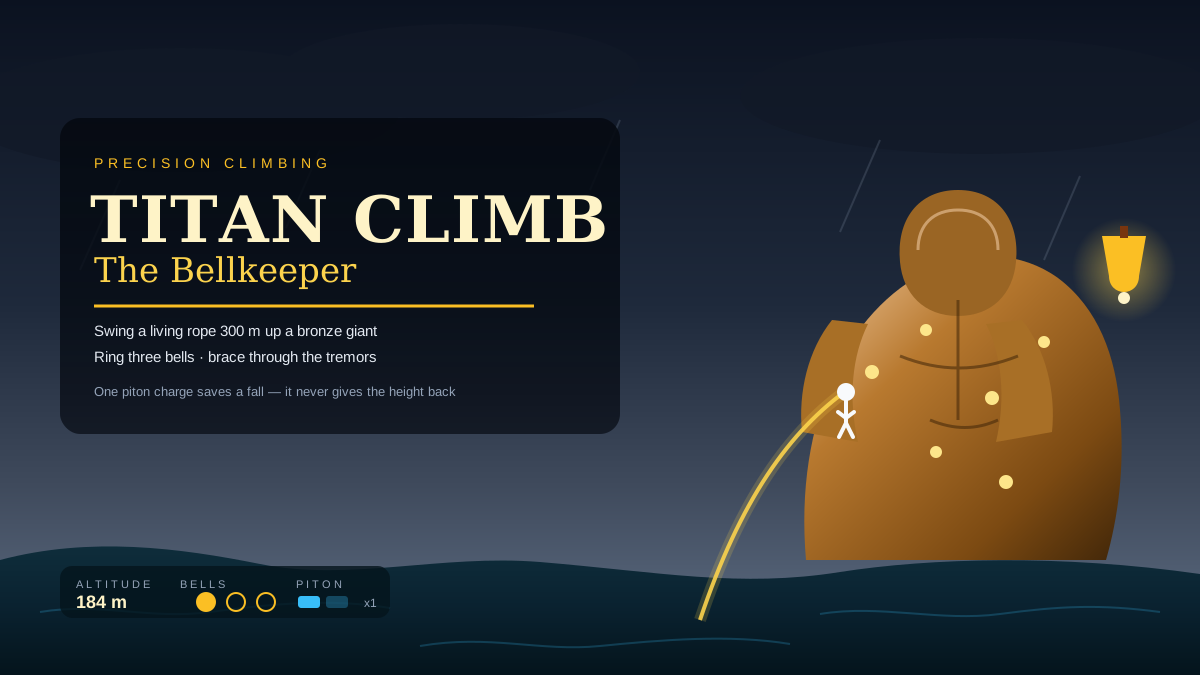
The setup is a 300-metre bronze giant standing in a storm sea. You climb it, and the climb is the game.
The climb has three jobs, not one
A good vertical game needs a reason to go up, and Titan Climb supplies one that is not “reach the top”. Three enormous bells hang at intervals on the giant, and ringing all three is the objective: the boats below need them to steer home. The summit is not the goal and may not even be reachable in a single ascent, which is a quietly clever decision — it means the level designer can use the whole body of the giant without having to make the last ten metres a boss.
Between the bells, the giant gives you three kinds of structure: ordinary holds, crumbling amber shortcuts, and the tremors that run through the whole climb on a rhythm.
The amber shortcuts are the most legible risk in the game. They are optional, they are faster, and they break shortly after you touch them. Taking one skips a stretch of climbing and commits you to whatever comes next — there is no going back to the hold that crumbled behind you. The tremors work the other way: they are not optional, they are on a schedule, and the answer is a held input — brace — that you have to be on the rope for. Miss it and the climb takes you off the line.
Together those two hazards divide the climb into two different kinds of attention. Amber asks a routing question at the moment you see it. Tremors ask a timing question you can prepare for. A short game that can alternate between those two is a short game that does not get boring in three minutes.
The rope is a two-stage gesture
The core interaction is small and physical, and it is worth walking through because it is the whole design.
You cast the rope at a hold. It attaches. Now you are a pendulum: gravity pulls you, the rope constrains you, and leaning changes the arc. At the top of the swing you release, and the swing becomes distance. In the air you can steer — but only sideways. You cannot add height, which means the swing has to have already earned the height before you let go.
That constraint is what makes the game a skill game rather than a timing game. If you could steer upward in the air, every bad release would become a recoverable one, and the rope would stop being the thing that decides your altitude. Because you cannot, the cast and the release are the only two moments where the climb is actually won or lost, and the steering in between is about arriving with your body pointed at the next hold.
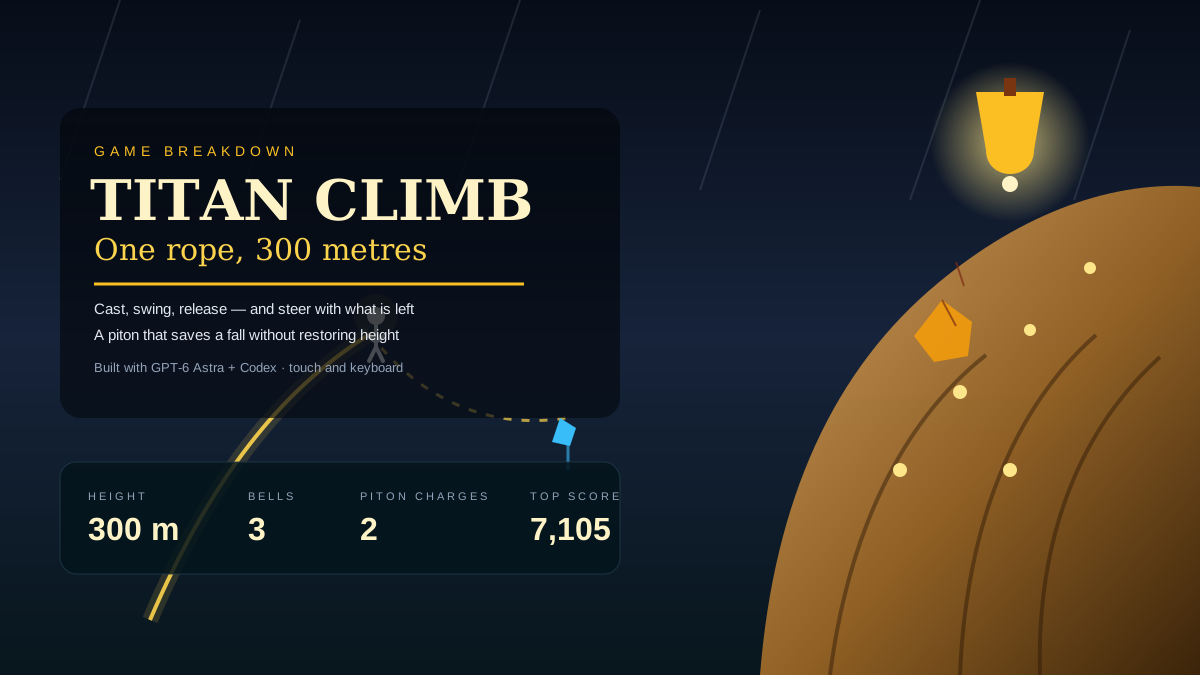
The piton hook is the exception that proves the rule. You have a limited number of charges, and firing one arrests a fall and reattaches you to the last valid hold. It does not give the height back. It saves the run at the cost of the progress you already made, which is exactly the right trade for a browser game: failure becomes a tax instead of a restart.
That distinction — a recovery move that does not undo the mistake — is the most portable idea in the game, and the one most worth stealing. Recovery mechanics get designed as generosity, and generosity is how a game loses its own tension.
What the giant is for
The structure is doing more than providing scenery. A 300-metre body gives the designer three ingredients that a flat wall does not: distance to pace the bells, a silhouette to read holds against, and surfaces that can change character as you climb.
The storm sea underneath is part of the same idea. Looking down has to be frightening for the climb to mean anything, and the sea does that job without a single line of tutorial text. The visual language of the game — a bronze figure in weather, holds that glow, amber that crumbles — is legible at speed, which matters because the entire loop is played at speed.
Then, once you have cleared it, the game asks for the same climb again under a Storm ascent: same geometry, worse weather, and a shorter warning before the tremors. It is the cheapest second act in game design and one of the most honest — nothing new is added, your tolerance for what already exists is what changes.
Desktop-only? No — this one travels
Unlike a lot of the recent desktop-first builds on AIGameShare, Titan Climb works on both desktop and phone, and the touch scheme is not an afterthought. Tap a glowing hold or swipe and release to leap; on a rope, drag to lean, release to cast, drag again to steer. The Hook button fires the piton, Brace is held through a tremor, and pulling down at a bell rings it.
That matters because the game’s core gesture — cast, hold, release — maps naturally onto a thumb. A rope game with a bad touch build is a desktop game with a phone version attached; this one reads like it was designed for both.
On keyboard, arrows or WASD choose a grip and steer, Space leaps and releases, X hooks, Shift braces, P pauses and M toggles sound. It is a small enough control set that nothing needs a menu.
Where it is thin
The honest limitation is scale. At the time of writing the game had 24 plays and 13 minutes of tracked play on AIGameShare, with a top ascent score of 7,105. That is a build measured in hours, not a climb that a community has spent a weekend learning, and a precision game’s real difficulty curve only appears once people have failed at it a few hundred times.
The second is that the rope can be fussy on a small screen. Precision climbing lives or dies on whether the player can tell a missed cast from a badly aimed one, and at phone width the difference between the two is a few pixels of a glowing hold. It is the kind of thing that a tuning pass fixes and a review cannot.
Neither stops the game from being worth the tab. It is short, it is specific, and it has a mechanic — the one-save piton — that most games of this size never think to add.
What to copy if you build one
- Constrain the recovery move. A grapple that restores height deletes the fall, and the fall is the game.
- Make the shortcut crumble. A shortcut that stays put is not a choice, it is the route.
- Warn before the hazard, never during it. A tremor needs a tell the player can act on.
- Split the hazards into routing and timing. One asks where you go, the other asks when you commit; alternating them keeps a three-minute climb from flattening out.
- Reuse the geometry for the second ascent. Same wall, worse weather is enough.
Our rope-swinging climb prompt writes the pendulum physics, the two-charge piton, the crumbling amber holds, the tremor rhythm and the Storm ascent as fixed requirements with failure conditions, including a headless climber that has to prove the hard ascent is beatable. If you want other vertical games on the site, Pixel Jump is the pure jump-physics case and SkyHop is the momentum case.
Verdict
Titan Climb: The Bellkeeper is a climbing game that understands the climb is a physics problem with a rescue clause. The rope makes every release a decision, the piton makes every fall a cost, and the amber and the tremors keep the middle of the ascent from becoming a ladder. It is new, it is small, and its leaderboard has exactly one name on it — which is a good reason to go put a second one there.
FAQ
Is Titan Climb: The Bellkeeper free to play?
Yes. It runs in the browser on AIGameShare, free, with no download or account.
Does it work on a phone?
Yes. Touch controls cover the whole loop: tap or swipe to leap, drag to lean and steer, tap Hook to fire the piton, hold Brace through tremors and pull down at a bell.
What happens if you miss a cast?
You fall. The piton hook can arrest the fall and reattach you to your last valid hold, but it does not restore height, so the progress you lost stays lost.
How long does a climb take?
A run is built for roughly one to five minutes. The listed average play time on AIGameShare was under a minute at the time of writing, consistent with players retrying short attempts.
Who made it?
nilni, built with GPT-6 Astra and Codex, published on AIGameShare on 17 November 2026.