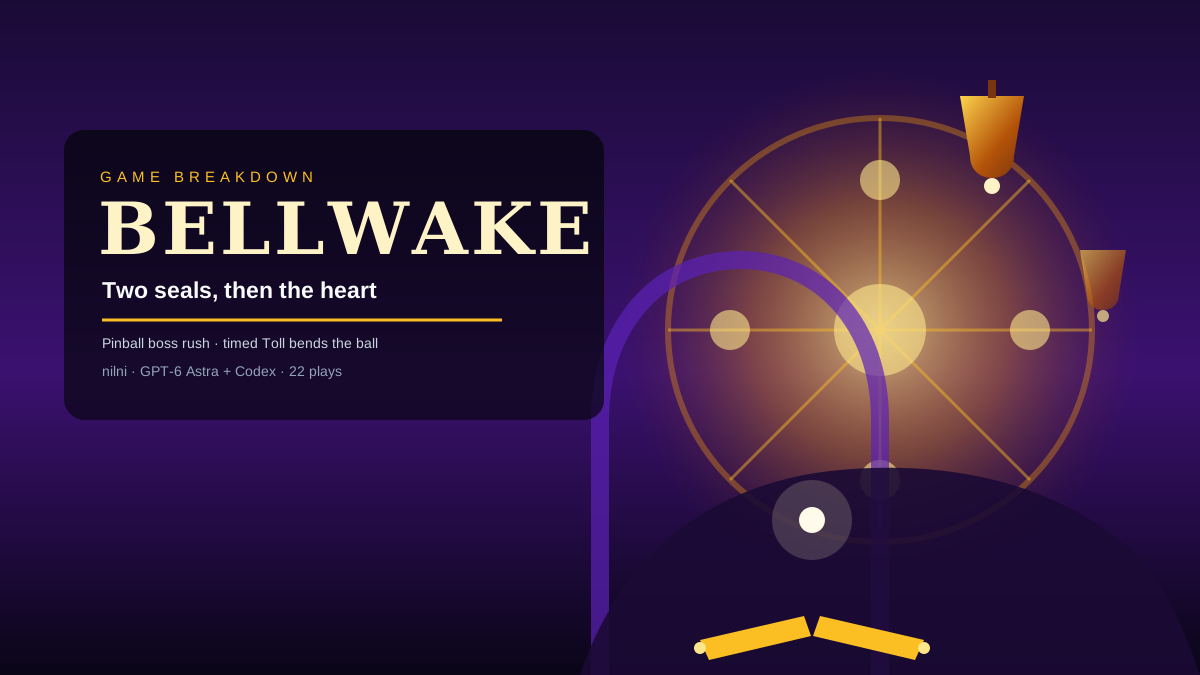
Pinball has never needed a reason. You flip, the ball stays alive or it does not, and the score keeps a record of how long you managed it. Bellwake: Pinball Boss Rush adds a reason anyway: three bells in a pixel-art cathedral have gone silent, and each one is guarded by something that would rather you did not ring it.
The result is a pinball table with a plot, and — more importantly — with an order. You are not hitting whatever is in front of you until a number gets big. You are working through a sequence, and the sequence is what makes the table readable.
Seal, seal, heart
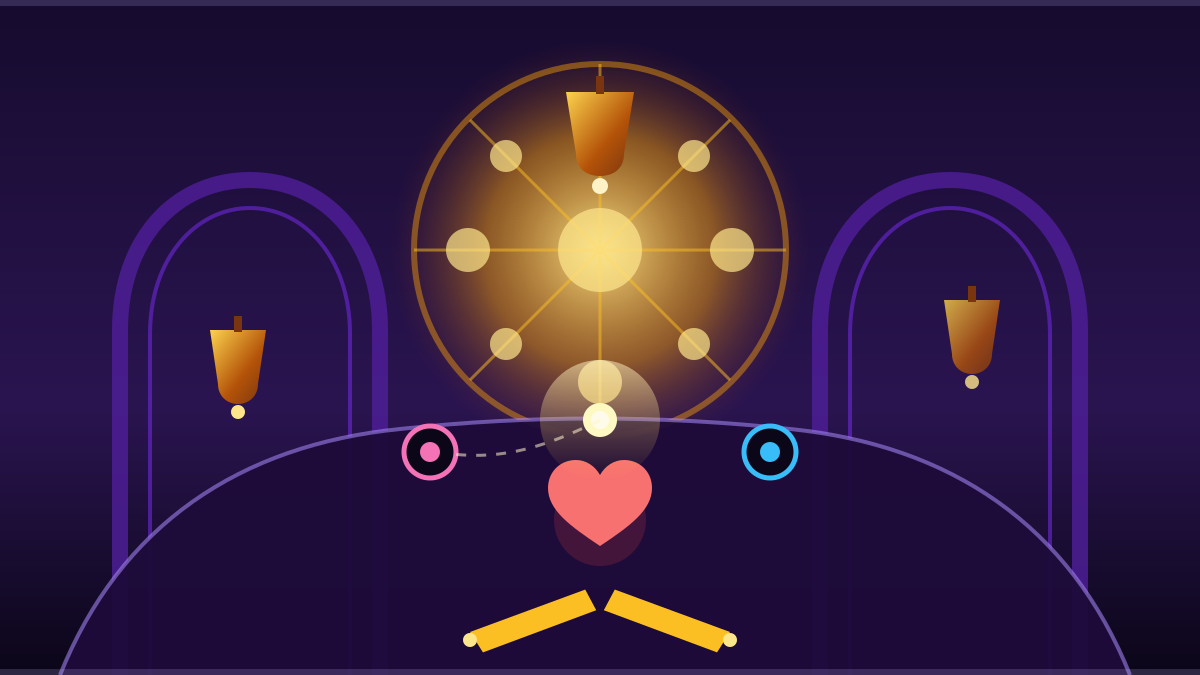
Each guardian is protected by two seals. Ring the first, ring the second, and the guardian’s heart opens. Strike the heart and it falls. Miss the window and the heart closes, and you are back to flipping a white-hot clapper around a cathedral that is trying to feed it to the drain.
That is a small rule with a large effect on how a run feels. Standard pinball is a sequence of opportunities — the table offers, you accept or fumble. Bellwake is a sequence of stages. There is a before-the-seals phase, an exposed-heart phase, and a between-guardians phase, and each one asks for a different kind of care.
The before phase is exploration: find both seals without donating the ball to the outlanes. The heart phase is execution: you have a small number of shots and a closing window, so every flip is expensive. The between phase is recovery, and it is the only part of the run where you can afford to be calm.
The Toll is a nudge with a clock attached
Bellwake’s signature mechanic is the Toll. A diamond on the table flashes on a rhythm, and pressing on the flash bends the ball in midair for a moment.
It is a beautiful little idea because of what it refuses to do. It will not save a ball that is already past the flippers. It will not aim for you. What it does is adjust a shot that is going to miss by a few degrees — enough to clip a seal you were about to pass, not enough to turn a bad flip into a good one.
That narrowness is the point. Pinball assists usually fail in one of two directions: they remove the drain (and the game with it) or they are so weak nobody uses them. A small midair bend sits in the useful middle. It is a skill expression rather than a safety net, and because it is tied to a visual cue rather than a cooldown bar, learning its rhythm is a real thing to practise.
Space still does the ordinary nudge, which is the honest pinball answer to a bad bounce. The Toll is what you use when the bounce was fine and the aim was not.
Three guardians, one hierarchy
The sequence runs bronze to crown. The Vesper Owl opens the table, the antlered Briarhart takes the middle, and the crowned Eclipse Wyrm closes it.
The game does not explain what each guardian does to the layout, and that is deliberate — discovering how a table changes under a new guardian is a large part of the appeal. What the names do give you is a hierarchy. An owl, a stag, a crowned wyrm: that is a progression from watcher to beast to sovereign, and the metalwork follows it, bronze to antler to crown.
It also gives the run a shape that survives failure. Losing on the Wyrm feels different from losing on the Owl, and the end of a run tells you something specific about where your table-reading broke down rather than just how long you lasted.
The last ball is the clock
The clock is your ball count, and it is the oldest and best tension device in the genre.
Bellwake leans on it harder than a normal table because the heart window sits on top. On your last ball, with one seal left and the heart about to open, the game has converted a pinball table into a countdown without adding a countdown. That is exactly the situation pinball was invented to produce, and giving it a narrative reason — a bell that has to be rung before you run out of tries — makes the pressure legible to someone who has never played a real table.
Runs are short, one to five minutes, which suits the format. A boss rush that overstays its welcome stops being a rush.
Controls and the phone table
On desktop, left and right arrows or A/D flip, Space nudges, and pressing on the diamond flash fires a guided Toll. P pauses, M toggles audio and H opens help.
On touch, you tap the sides of the table or use the on-screen flipper buttons, with a Toll button in the centre. Splitting the screen into left and right halves is the right call for a two-flipper game: it keeps both thumbs on the glass instead of hunting for a pad, and it means the Toll button does not sit under a thumb that needs to flip.
Two pinball builds, published the same day
Bellwake is one half of a pair. On 17 November 2026 the same creator published Glasswake Pinball, a stained-glass table in a moonlit atelier, and comparing them is the fastest way to see what Bellwake is doing.
| Bellwake | Glasswake | |
|---|---|---|
| Look | Pixel-art cathedral | Stained glass, moonlit atelier |
| Guardians | Vesper Owl, Briarhart, Eclipse Wyrm | Lantern Moth, Briar Stag, Sun Heron |
| Gate | Two seals, then an exposed heart | Jewel seals open each heart |
| Assist | Timed Toll bends the ball midair | Overhead wire ramp, fivefold multiplier |
| Unlock | The three-bell run | Nightglass, a double-score challenge |
Glasswake is the more decorative of the two, and it does things Bellwake does not — a guardian whose seal regrows, a final guardian with moving wings and two balls to place, an ordered trick-shot challenge after the story. Bellwake is the more stripped-back design: one table language, three fights, and a single mechanic that rewards timing.
For a browser game, that pair is a useful artefact. It shows the same creator testing two answers to the same brief in public, on the same day, with the same underlying idea: seals open a heart, and the heart is the only thing that actually matters.
Where it is thin
The obvious limitation is volume. Three guardians is a short campaign, and once you know where the seals sit, the discovery loop that carries the first few runs is spent. At the time of writing the game had 22 plays and nine minutes of tracked play on AIGameShare — a build that is hours old, not a table that has been tuned by a community.
The second limitation is feedback. Pixel pinball lives or dies on whether the ball’s path is readable at speed, and a small table with a lot of light on it can get busy during a heart window. Glasswake solves part of this with a strong colour hierarchy; Bellwake’s cathedral is prettier than it is legible in the busiest moments.
Neither problem is fatal. Both are the kind of thing a version 1.2 fixes.
What to copy if you build one
- Give the table an order. A target that only opens after another target is hit turns pinball into a structure without changing the physics.
- Make the assist narrow. A midair bend that cannot rescue a dying ball adds skill instead of removing failure.
- Tie the assist to a visual rhythm. A flashing cue is learnable; a cooldown bar is bookkeeping.
- Let the ball count be the clock. You do not need a timer to create urgency, and a timer would ruin the genre’s best feeling.
- Keep runs short. One to five minutes is the right budget for a boss rush in a tab.
Our pinball boss rush prompt lays out the two-seal gate, the exposed-heart window, the Toll and a three-guardian progression as fixed numbers with failure conditions. If you like pixel combat with a boss at the end of every stretch, SOLMERE SOULS and CINDERDEEP are the closest things on this site.
Verdict
Bellwake: Pinball Boss Rush is a pinball table that understands the genre’s real subject — not score, but sequence under pressure. The seals give a run a shape, the Toll gives the player one honest assist, and the last ball gives the whole thing a clock. It is small, it is new, and it is the most interesting use of a pinball table we have seen in a browser this month.
FAQ
Is Bellwake free to play?
Yes. It runs in the browser on AIGameShare with no download, on desktop and mobile.
How do you beat a guardian?
Ring both seals around it to expose its heart, then hit the heart before the window closes. Missing the heart closes it again and you must re-ring the seals.
What does the Toll do?
Pressing on the diamond’s flash bends the ball slightly in midair. It adjusts a shot that is about to miss; it cannot rescue a ball that has already passed the flippers.
Can you play it on a phone?
Yes. Tap either side of the table to flip, or use the on-screen flipper buttons, and tap the centre Toll button.
Who made it?
nilni, built with GPT-6 Astra and Codex, published on AIGameShare on 17 November 2026.