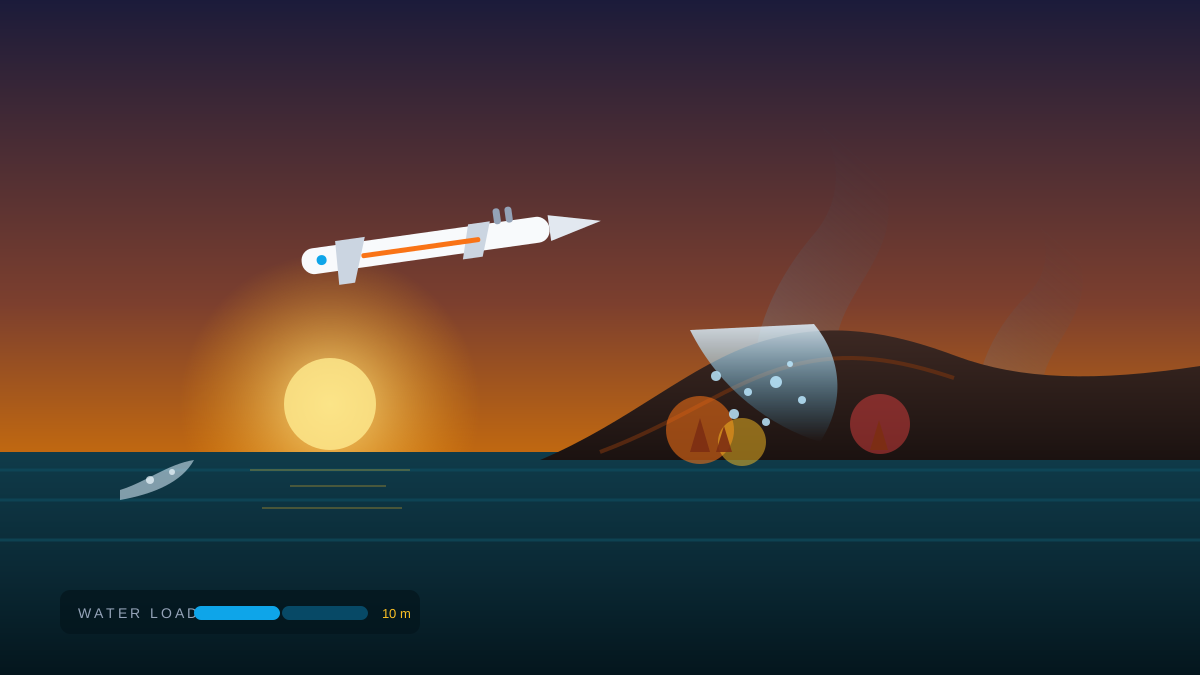
Most flying games in a browser tab are about the flying. Firefighting Plane 3D: Pelican Reach is about the water. You fly a twin-prop tanker, you line up a burning cedar grove, you release — and then you have to go get more water, and the trip back is where the game actually lives.
That is a strange thing to build and a good thing to play, because it turns a job with a satisfying ending into a loop with a cost. Every drop has to be paid for with a low pass over the sea, and the fire keeps working while you are away.
The loop is fill, fly, drop, repeat
The sortie structure is small and clear. You carry two water loads. Skimming the sea below ten metres refills the tanks, and everything else is approach and release. Three coastal sectors hold six fire sites between them, and saving all six unlocks the Red Flag sortie: eight fires at once, with crosswinds that shift and push both the smoke and the aircraft.
That is the entire game, and it does not need more. The interesting part is that the two halves of the loop test different skills. The drop is a line-up problem — pick the approach, hold it steady, release before the grove passes under the nose. The refill is a nerve problem — get low, stay low long enough for the tanks to fill, and climb out without burying a wingtip in the swell.
Because the two halves are different, you cannot optimise one and coast. A beautiful drop is worthless if you arrive with empty tanks. A perfect refill is worthless if you then fly a sloppy approach and dump half your load on unburnt ground.
Ten metres is a design decision, not a number
The refill threshold is the single most important line in the game, and it is worth thinking about why.
Ten metres is low. It is low enough that the water takes up most of the lower screen, low enough that the horizon tilts when you bank, low enough that any correction feels expensive. If the game let you refill at fifty metres, the return leg would become a menu you fly through. At ten, it becomes a manoeuvre.
There is a second effect that is easy to miss. A low refill makes altitude a currency rather than a state. You spend height to fill, and you spend the fill to fight the fire, and the exchange rate between the two is the skill curve. Players who climb immediately after the scoop arrive at the fire with full tanks and no energy. Players who stay in the weeds a beat longer arrive with full tanks and a better line, if they get away with it.
Navigator mode is the tutorial nobody calls a tutorial
The game ships with two ways to fly an approach. You can hand the heading to a navigator and concentrate purely on the release, or take the controls and carve the approach yourself.
This is a smart split, and not just as an accessibility feature. Pinpointing the release point is the part of an aerial drop that is genuinely hard to teach — it depends on speed, altitude, and where the fire sits relative to the nose. Letting the autopilot hold the heading isolates that one variable so a new player can learn what a good release feels like before they have to also learn what a good turn feels like.
Then the same mode becomes a scoring decision. Manual approaches can be tighter, which means fewer wasted loads, which means fewer trips back to the sea. The game never tells you which mode to use; it just makes the manual one worth the effort once you can fly it.
Three sectors, six sites, one finale
Progression is gated by sites, not by time. You fly the three coastal sectors, save six fires, and the Red Flag sortie opens.
The Red Flag sortie is where the design shows its teeth: eight fires at once, winds that shift, and a fire load that no single aircraft can service quickly. In practice that means triage. You will not save everything, so the question becomes which grove to sacrifice and whether the answer changes when the wind moves. That is a real decision, and it is the kind of decision most browser games avoid because it produces a loss the player can see coming.
It also gives the game a natural ending. The finale is not a boss with a health bar; it is the same loop you have been practising, run at a temperature where the loop starts to break.
Controls and the phone build
On desktop, A/D banks, W/S climbs and dives, Space drops, E selects a fire from the chart, G toggles the navigator, M mutes and P pauses. The aircraft has momentum, so every correction has a tail, and a tidy approach starts a long way from the fire.
On a phone, dragging the view flies the plane and a Drop water button handles the release. That is a sensible compromise for a game about holding a line: a virtual stick would fight your thumb, while dragging the view maps the same instinct — point the nose where you want to go — onto the only input a phone really has.
Two builds of one idea
Pelican Reach is not alone. On 17 November 2026 the same creator published Firefighting Plane: Last Light, a pixel-art build of the same premise, and the pair is more interesting than either one on its own.
| Pelican Reach | Last Light | |
|---|---|---|
| View | 3D | Pixel art, side-on |
| Steering | A/D banks | A/D sets throttle |
| Release | Space drops a load | Hold Space to release water |
| Goal | Six sites, then eight fires with crosswinds | Three coasts, 27 people, lighthouse deadline |
| Finale | Red Flag sortie | Crosswind shift |
The differences are the interesting part. Pelican Reach makes you manage a heading, which turns every approach into a geometry problem. Last Light makes you manage throttle, which turns the same job into a timing problem — you are always deciding whether to spend speed now or save it for the climb. Neither is the “correct” version. They are two answers to the same question, published on the same day, and the fact that both exist makes the premise easier to judge.
What AI got right, and where it is thin
The impressive part is the loop. Two loads, a ten-metre refill and a fire that does not wait is a coherent design, and it survives contact with a keyboard. The aircraft feels like weight rather than a cursor, the navigator/manual split is genuinely useful, and the finale escalates the right variable — workload, not difficulty.
The thin part is content. Six sites and a single finale is a short campaign, and once you can fly a clean low pass the challenge curve flattens. At the time of writing the game had 24 plays and 23 minutes of tracked play on AIGameShare, with runs billed at one to five minutes; if those two counters mean what they say, most players are still on their first approach, which is fair for a build this new.
There is also a presentation cost to the 3D choice. A pixel build can put a whole burning coast on screen and keep it readable. A 3D build has to spend its budget on the horizon and the smoke, and there are moments when the fire you are trying to hit is smaller than the HUD.
What to copy if you build one
- Make the resource the hard part. The water, not the fire, is the antagonist. That single inversion gives a small game a long loop.
- Put a number on the risk. “Below ten metres” is a rule the player can feel. “Fly low” is not.
- Split flying from aiming. A navigator mode lets new players learn one skill at a time without a tutorial screen.
- Gate the finale on competence, not on time. Six saved sites is a better key than six minutes played.
- Let the wind be visible in the smoke. If the player can read the crosswind from the world, the HUD can stay quiet.
If you want to build this yourself, our aerial firefighting prompt spells out the two-load tanker, the ten-metre refill, the six-site unlock and the eight-fire crosswind finale as fixed numbers with failure conditions. For a different kind of flying, SKYHOP does stunts in a flying car, and MERIDIAN is the other browser sim on this site that is really about navigation.
Verdict
Firefighting Plane 3D: Pelican Reach is a small, specific sim with one good idea: the drop is easy, the refill is not. It will not hold you for a week, and it does not need to. It is the rare browser flying game where the most interesting thing on screen is the trip back to the water.
FAQ
Is Firefighting Plane 3D free?
Yes. It runs in the browser on AIGameShare with no download or account, on desktop and mobile.
How do you refill the water tanks?
Fly below ten metres over the sea and hold the pass long enough for both loads to fill. Climbing out early leaves you with a partial load.
What is the Red Flag sortie?
It is the finale, unlocked after saving six fire sites. You face eight fires at once with shifting crosswinds.
Can you play it on a phone?
Yes. Drag the view to fly and tap Drop water to release. The chart is tappable for selecting a fire.
Who made it?
nilni, built with GPT-6 and Codex, published on AIGameShare on 17 November 2026.