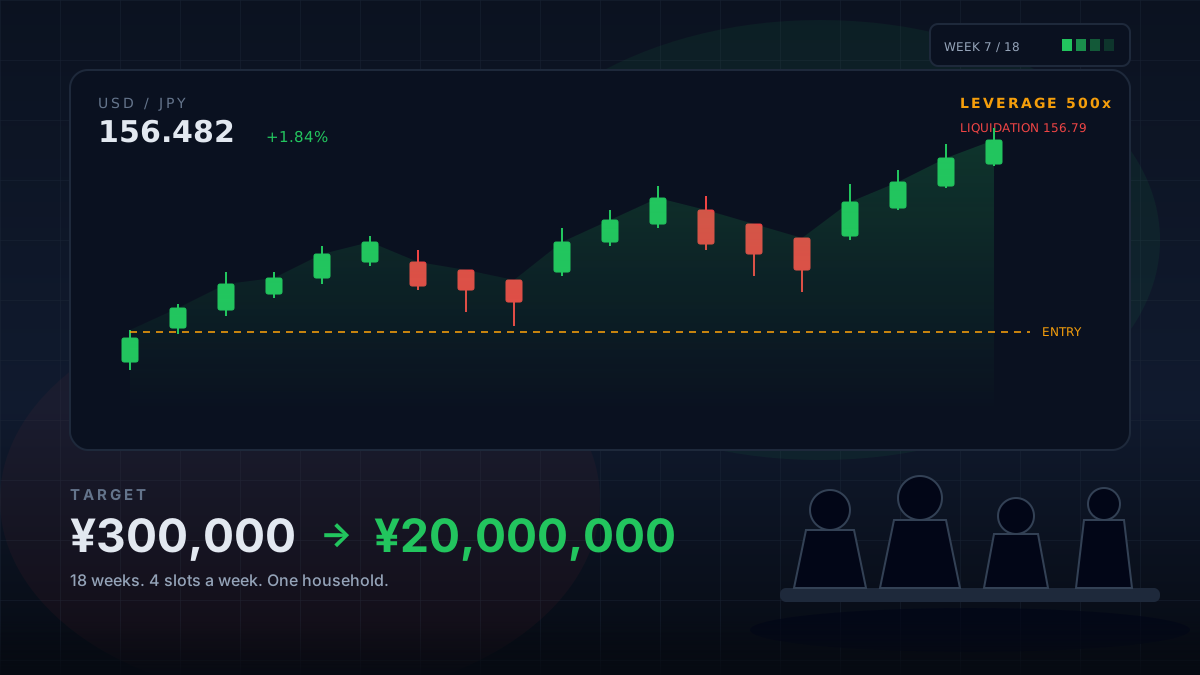
Most trading games are power fantasies with a spreadsheet attached. You start with nothing, read the chart, and the only thing at risk is a number. Honest Money Is Boring, Right? is a different kind of game. It gives you 18 weeks to turn ¥300,000 into ¥20,000,000, and then it makes the cost of trying visible: every trade takes a time slot, and every time slot you spend at the chart is a slot you did not spend with the people around you.
At the time of writing it had 34 plays and 1 hour 23 minutes of tracked play on AIGameShare, with an average session of about two minutes. That short average is not a lack of content. It is the rhythm of the design: four decisions a week, eighteen weeks, and a run that you can finish in a handful of minutes and then immediately want to restart with a different risk profile.
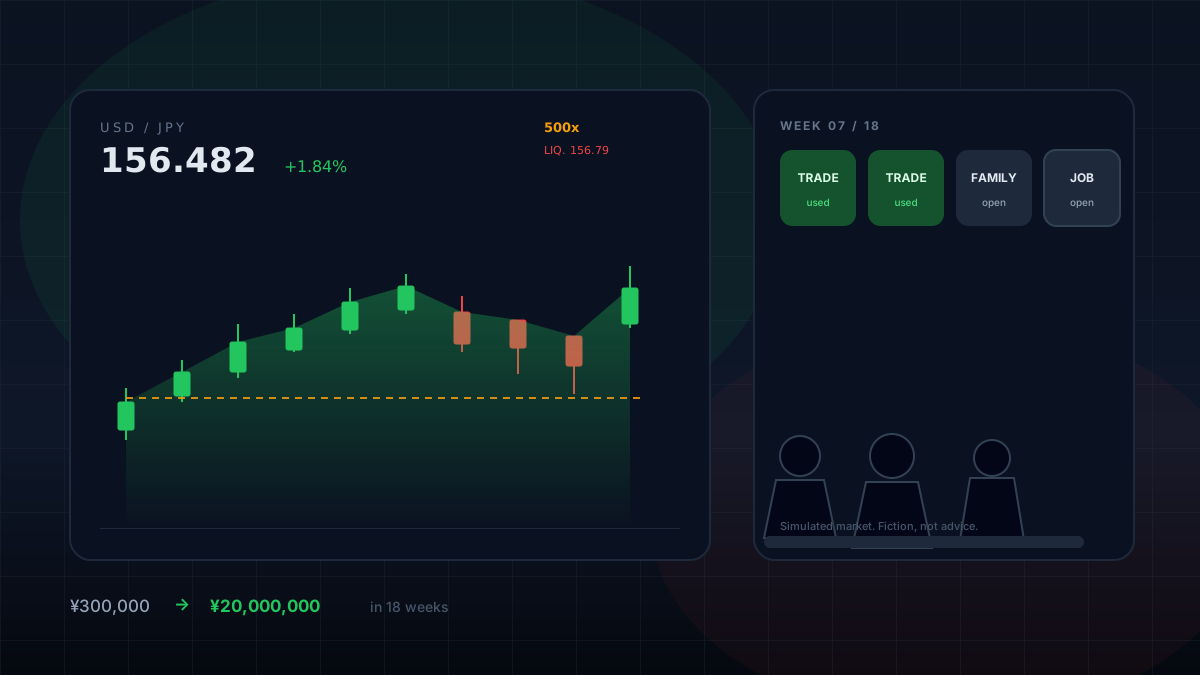
Four slots a week is the whole game
Each week has four time slots. A slot can be spent watching the chart, opening a Buy or Sell position, adjusting leverage, closing a position, taking an odd job, looking for another way, or being with family. That is the entire action budget, and it is the smartest decision in the build.
A trade is not free. Neither is dinner. If you want to chase a position, you are choosing not to take the odd job that pays the rent, or not to be home when someone needs you. The game does not need a morality meter to make that point; the calendar does it for you.
Leverage is the second pressure. You can trade the simulated USD/JPY market with up to 500x, and the game shows the liquidation price before you confirm. That means a bad week is not a random punishment. It is a decision you made with the numbers in front of you, which is exactly what makes it feel like your fault.
The market is a story engine, not a simulation
The chart is a seeded random walk with visible regimes: trend, chop and shock. There are no hidden odds. You can see the candles, your entry, your leverage, your liquidation price and your balance at all times, and the seed is visible, so a run is technically reproducible.
But the market is not the point. The point is what it does to the household. Family and friends have their own stories and skills, and the way you lose changes who stays. That line on the store page is the most important sentence in the game: the way you lose changes who stays. It means a blown account is not a game-over screen. It is a different ending, with a different house and a different set of people in it.
The relationship system is driven by time rather than dialogue choices. You do not pick “be kind” from a menu; you pick the slot. That makes the narrative feel earned in a way that choice-based games often miss. You cannot talk your way out of not being there.
A roguelite in a suit
Structurally, the game is a roguelite. Eighteen weeks is a run. Four slots a week is the action budget. Different endings, achievements and a survival mode unlock after the first completion, and the survival mode gives the systems a harder test.
That structure is what makes the short sessions work. A two-minute average is not someone bouncing off the game; it is someone playing a week or two, closing the tab, and coming back to make the next decision. It fits the browser better than a long-form trading sim would, and it fits the subject: leverage is a game of short, consequential choices, not a game of sitting and watching.
The presentation supports that. The pixel-art UI is readable at phone width, the chart is one candle series and one position line, and there are no decorative indicators to mislead you. The whole script is localised into Japanese, Chinese, Korean and English, which is unusual for a game this small and signals that the team expected an international audience.
What AI got right, and where it is thin
Honest Money Is Boring, Right? was created by KadmonSAMA and built with Claude Sonnet 5.5 and Claude Code. The impressive part is the economy of design. Time as currency, loss as ending, relationships as a consequence of scheduling — those are three interlocking rules, and the game resists adding a fourth. That restraint is rare in AI-assisted projects, which often pile on systems because generating more is cheap.
The limits are real. The market model is simple, and anyone who has actually traded will see the seams. The relationship arcs are short, and the pixel portraits do not carry as much character as the writing wants them to. The game is also careful — perhaps too careful — about its subject: it repeatedly reminds you that this is fiction and not advice, which is the right call but does dampen the fantasy.
What remains is a genuinely unusual browser game: a leverage sim that is really about time, and a story about money that is really about who is still at the table when the week ends.
What to copy if you build one
Our narrative trading sim prompt is the reusable version of this build. The decisions worth stealing:
- Charge a time slot for every trade. It turns a spreadsheet into a life-choice game.
- Show liquidation before confirmation. Leverage is only interesting when the loss is legible in advance.
- Write losses as endings, not failures. “Who stays” is a stronger consequence than a game-over screen.
- Drive relationships with scheduling, not dialogue menus. Time is harder to fake than a kind line.
- Localise the script early. A wall of English text will not fit a phone even if the buttons do.
If you like games where the economy is the story, MERIDIAN builds a trading loop out of sailing, ports and tavern clues. If you want a different kind of run-based game with persistent progression, SOLMERE SOULS is a pixel ARPG built around a three-hit finisher window.
Verdict
Honest Money Is Boring, Right? is the most interesting simulation I have played this week, and the least interested in teaching you how to trade. It uses the language of finance to ask a simpler question: what are you willing to miss for a number on a screen? The answer changes depending on how you spend your four slots, and that is why the game is worth a second run.