Honest Money Is Boring, Right?
An 18-week USD/JPY trading sim with 500x leverage, four time slots a week and a family who remembers every loss — multiple endings included.
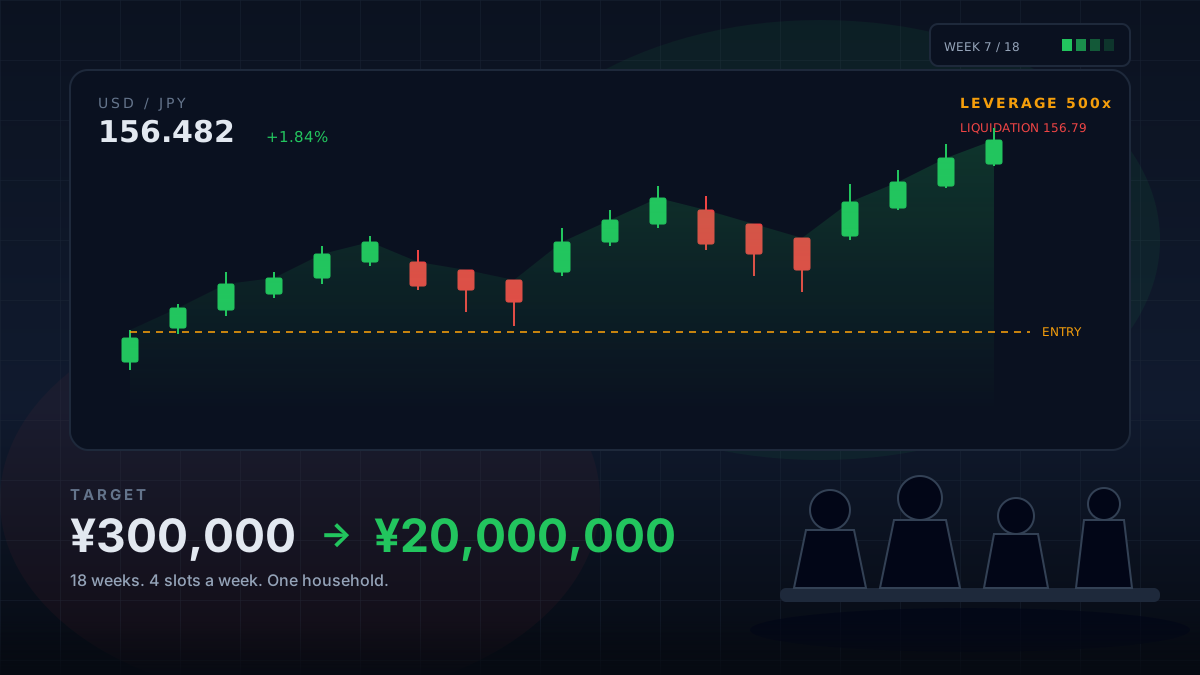
Honest Money Is Boring, Right?
Play on AIGameShareOpens aigameshare.com in a new tab · free · no download
34 plays tracked on Daily AI Games
External game siteHonest Money Is Boring, Right? is not hosted on Daily AI Games. The button above opens an independently operated, free browser game on AIGameShare; its content, availability and controls are controlled by that site.
How to Play
Tap or click buttons and sliders to watch the chart, open a Buy or Sell position, choose leverage, close a trade, or spend a time slot with family, on an odd job or looking for another way. Every week has four slots; the run lasts 18 weeks.
These are the controls for Honest Money Is Boring, Right?. The external Honest Money Is Boring, Right? version on AIGameShare may use slightly different controls.
Game Preview
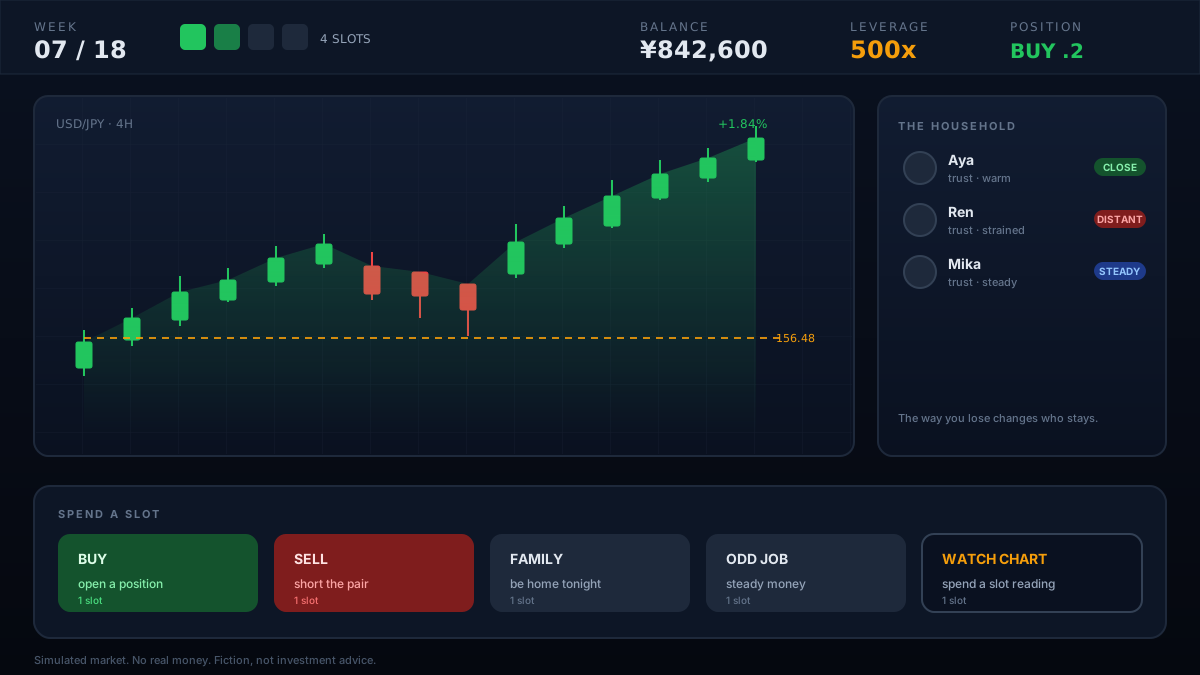
About Honest Money Is Boring, Right?
Honest Money Is Boring, Right? is a browser simulation about turning ¥300,000 into ¥20,000,000 in 18 weeks, and it is much less interested in the money than in what the money does to the people around you. You trade a simulated USD/JPY market with up to 500x leverage. Every week has four time slots. You can watch the chart, open a Buy or Sell position, set leverage and close it, or spend a slot with family, take an odd job, or look for another way to make the week work.
That slot economy is the whole design. A trade is not a free action; it costs the same block of time as dinner with your family. Leverage is not a difficulty slider either. It is a way to compress months of consequence into one candle, and the game is honest about the result: the way you lose changes who stays. Family and friends have their own stories and skills, and the relationships decay or deepen based on the weeks you spend with them rather than on a single dialogue choice.
The structure is a roguelite in a suit. Eighteen weeks is a run, four slots a week is the action budget, and different endings, achievements and a survival mode give you a reason to start again with a different risk profile. Losing is not a game-over screen; it is a different ending and a different household. The game is available in Japanese, Chinese, Korean and English and can be played entirely with taps or clicks, which makes it one of the few narrative sims that genuinely fits a phone.
It is also careful about its subject. The store page labels the market as simulated, states that no real money is involved, and warns that the story contains debt, loss and separation. That framing matters: this is a game about leverage as a life choice, not a trading tutorial. Honest Money Is Boring, Right? was created by KadmonSAMA and built with Claude Sonnet 5.5 and Claude Code. At the time of writing it had 34 plays and 1 hour 23 minutes of tracked play on AIGameShare, with an average of about two minutes per play — short sessions, which is exactly how a four-slot week should feel.
How This Game Was Generated
Created by KadmonSAMA and built with Claude Sonnet 5.5 and Claude Code. The game simulates an 18-week USD/JPY market with up to 500x leverage and four time slots per week. Family and friends have their own stories and skills, the way you lose changes who stays, and different endings, achievements and a survival mode support replay. It ships in Japanese, Chinese, Korean and English with touch and mouse controls. The page labels the market as fiction, not investment advice. At the time of writing it had 34 plays and 1 hour 23 minutes of tracked play on AIGameShare.
The Prompt Behind This Game
Show the prompt used to generate Honest Money Is Boring, Right?
Build a narrative trading simulation in ONE self-contained HTML file (inline CSS/JS, Canvas or DOM). No libraries, no external assets, no network calls. The market is fictional and the game must say so on the title screen.

Premise:
- The player has 18 weeks to turn a small starting balance into a large target in a simulated currency pair. The exact numbers are tuning constants at the top of the file.
- The real subject is not the market. It is the household: family and friends react to every win and loss, and the way the player loses changes who stays.
- Include a clear content note for debt, loss and separation. No real money, no investment advice, no links to brokers.
Week and slot structure:
- Every week has four time slots. A slot can be spent watching the chart, opening a Buy or Sell position, adjusting leverage, closing a position, taking an odd job, looking for another way, or being with family.
- A trade costs a slot. So does dinner with family. The action budget is the whole design; never give the player a free trade.
- Positions resolve against a simulated price path with visible candles. Leverage up to 500x compresses the outcome; show liquidation risk before the player confirms.
- After each week, resolve relationship events based on time spent and recent losses. People have short arcs and personal skills that unlock new slot options.
Market model:
- A seeded random walk with occasional regimes (trend, chop, shock). Seed is visible and replayable. No hidden odds.
- Show a price chart, current position, entry, leverage, liquidation price and account balance at all times.
- Make the chart readable at phone width. One candle series, one position line, no decorative indicators.
Narrative and endings:
- At least six endings determined by final balance, relationships and which slots the player protected. A loss is an ending, not a generic game-over.
- Achievements and a survival mode unlock after the first completed run.
- Family and friends must have names, portraits made from code, and at least three short scenes each.
Controls and platform:
- Tap or click buttons and sliders. No text entry. Every action reachable with one thumb.
- Localise the full script into Japanese, Chinese, Korean and English. Keep line lengths phone-friendly.
- Save the run to localStorage after every week; allow one resume.
Testing and delivery:
- Write a headless simulator that plays 2,000 runs with three policies: all-in high leverage, balanced, and family-first. Report: ending distribution, median final balance, bankruptcy rate, share of weeks with no legal move, and whether any policy strictly dominates.
- Fail the build if any policy can reach the target in under four weeks, if a player can be left with no legal action, or if the family-first policy cannot reach at least one non-financial good ending.
Deliver in stages: week and slot loop first, then the market and one position, then leverage and liquidation, then relationships, then all endings, then localisation. Print the tuning table and the policy report at the end.
Open in the prompt library for tips and variations
Similar AI Games
 Action Games
▶ 294 plays
Baize Monster Bonk
A 3D survivors roguelite drawn from the Classic of Mountains and Seas — auto-attacking beasts, seal-ring taming and a five-element wheel that chains elements.
Play now
 Action Games
▶ 752 plays
CINDERDEEP: Falling Sand Roguelike
A falling-sand roguelike where every pixel of the cave is simulated. Burn, freeze, dissolve and flood your way through five depths with a four-spell wand.
Play now
 Simulation Games
▶ 540 plays
SMITTEN — Second Chance Semester
A 168-day stat-raising dating sim with six routes, 19 endings and a memory quiz every time you forget what she told you. Full English and Chinese.
Play now
 Action Games
▶ 137 plays
MYCELIA
A 3D survivors-like where the only verb is walking. Every step grows a glowing fungal carpet that corrodes bugs, and the whole web can be detonated in one chain bloom.
Play now
Articles About Honest Money Is Boring, Right?
Nov 17, 2026
Honest Money Is Boring, Right? A 500x Leverage Sim With a Family in the Room
An 18-week USD/JPY trading game where every trade costs a time slot and every loss changes who stays. We break down its slot economy, relationship system and multiple endings.
Oct 19, 2026
AI-Generated Browser Games Worth Knowing: October–November 2026
From a 12-hour sports hit and a weekend MMO to fifteen new browser games — a tin-toy kart racer, a spherical sailing sim, an art-print surf run and more.
Oct 15, 2026
The 10 Best AI Games to Play Online Free
Ten AI-generated games you can play online free right now — arcade, puzzle, strategy and endless runners, all built from text prompts and playable in your browser.
