Simulation / narrative strategy
18-Week Leverage Trading Sim With a Family and Multiple Endings
Tested with Claude · produced Honest Money Is Boring, Right?
The Prompt
Build a narrative trading simulation in ONE self-contained HTML file (inline CSS/JS, Canvas or DOM). No libraries, no external assets, no network calls. The market is fictional and the game must say so on the title screen.

Premise:
- The player has 18 weeks to turn a small starting balance into a large target in a simulated currency pair. The exact numbers are tuning constants at the top of the file.
- The real subject is not the market. It is the household: family and friends react to every win and loss, and the way the player loses changes who stays.
- Include a clear content note for debt, loss and separation. No real money, no investment advice, no links to brokers.
Week and slot structure:
- Every week has four time slots. A slot can be spent watching the chart, opening a Buy or Sell position, adjusting leverage, closing a position, taking an odd job, looking for another way, or being with family.
- A trade costs a slot. So does dinner with family. The action budget is the whole design; never give the player a free trade.
- Positions resolve against a simulated price path with visible candles. Leverage up to 500x compresses the outcome; show liquidation risk before the player confirms.
- After each week, resolve relationship events based on time spent and recent losses. People have short arcs and personal skills that unlock new slot options.
Market model:
- A seeded random walk with occasional regimes (trend, chop, shock). Seed is visible and replayable. No hidden odds.
- Show a price chart, current position, entry, leverage, liquidation price and account balance at all times.
- Make the chart readable at phone width. One candle series, one position line, no decorative indicators.
Narrative and endings:
- At least six endings determined by final balance, relationships and which slots the player protected. A loss is an ending, not a generic game-over.
- Achievements and a survival mode unlock after the first completed run.
- Family and friends must have names, portraits made from code, and at least three short scenes each.
Controls and platform:
- Tap or click buttons and sliders. No text entry. Every action reachable with one thumb.
- Localise the full script into Japanese, Chinese, Korean and English. Keep line lengths phone-friendly.
- Save the run to localStorage after every week; allow one resume.
Testing and delivery:
- Write a headless simulator that plays 2,000 runs with three policies: all-in high leverage, balanced, and family-first. Report: ending distribution, median final balance, bankruptcy rate, share of weeks with no legal move, and whether any policy strictly dominates.
- Fail the build if any policy can reach the target in under four weeks, if a player can be left with no legal action, or if the family-first policy cannot reach at least one non-financial good ending.
Deliver in stages: week and slot loop first, then the market and one position, then leverage and liquidation, then relationships, then all endings, then localisation. Print the tuning table and the policy report at the end.
What This Prompt Produces
Honest Money Is Boring, Right? is the reference: 18 weeks, four slots per week, up to 500x leverage on a simulated USD/JPY market, family and friends with their own stories, and endings shaped by how you lose, built with Claude Sonnet 5.5 and Claude Code. Time is the real currency.
Modification Tips
- Charge a time slot for every trade. It turns a spreadsheet into a life-choice game.
- Show liquidation before confirmation. Leverage is only interesting when the loss is legible in advance.
- Write losses as endings, not failures. "Who stays" is a stronger consequence than a game-over screen.
- Localise the script early. A wall of English text will not fit a phone even if the buttons do.
The Game This Prompt Produced
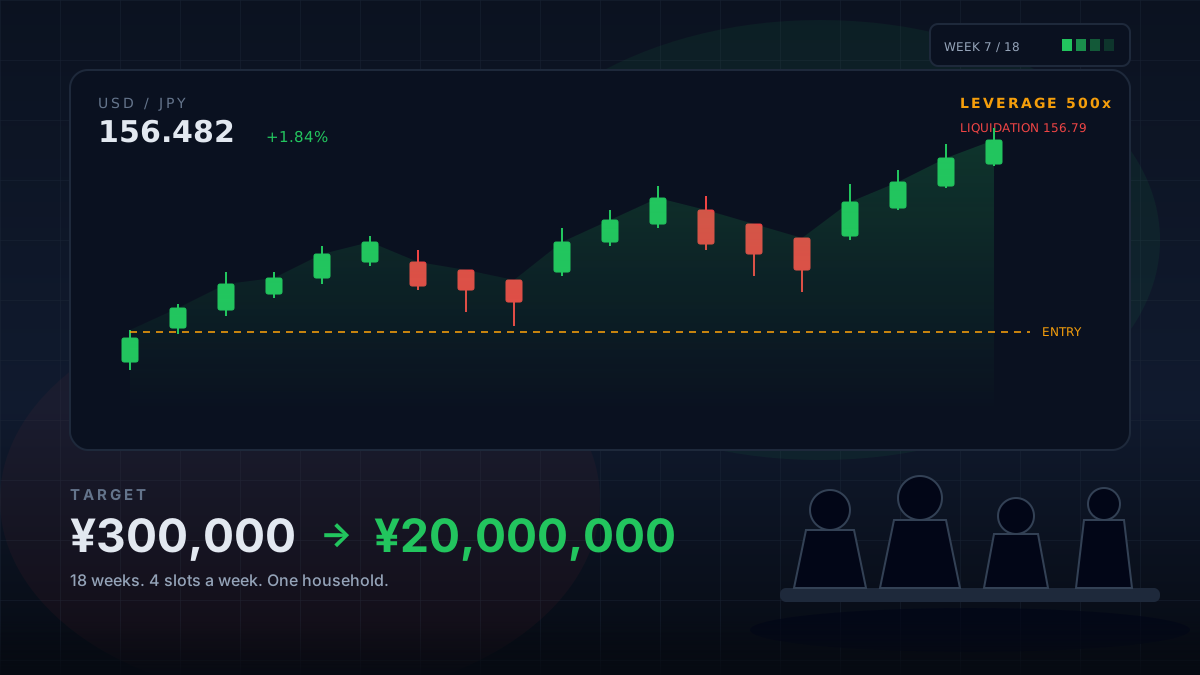
Want to try it? Open Claude, paste the prompt, and you'll have a playable game in minutes. When you're happy with the result, submit it to Daily AI Games.
