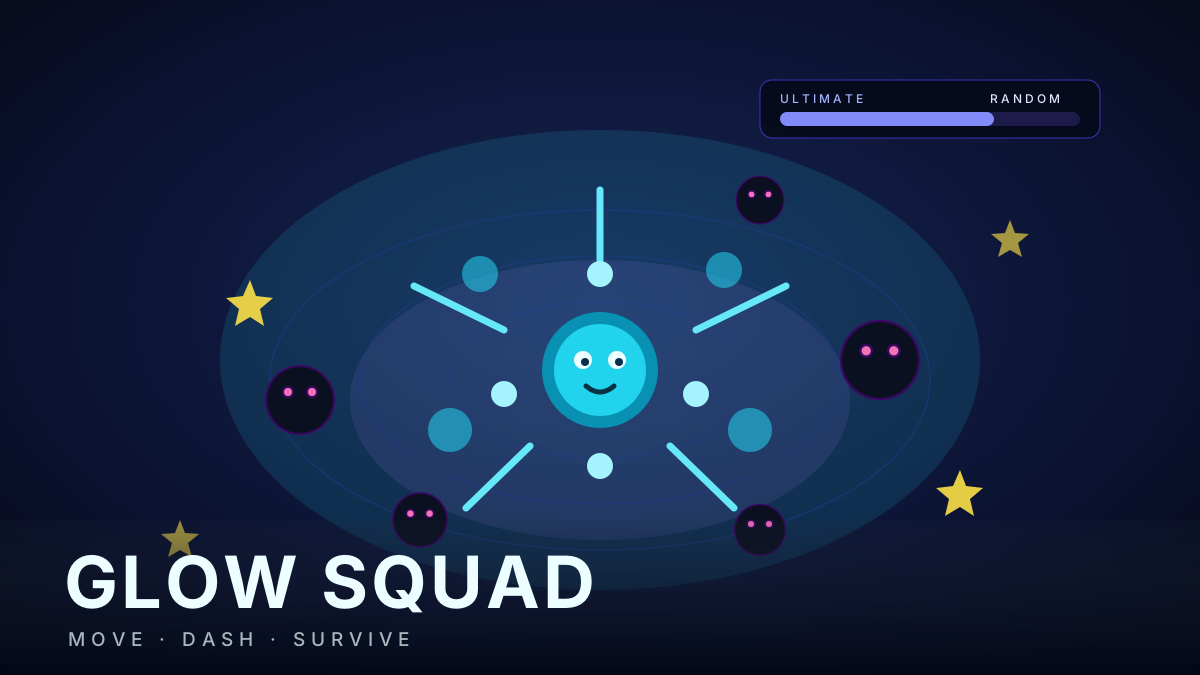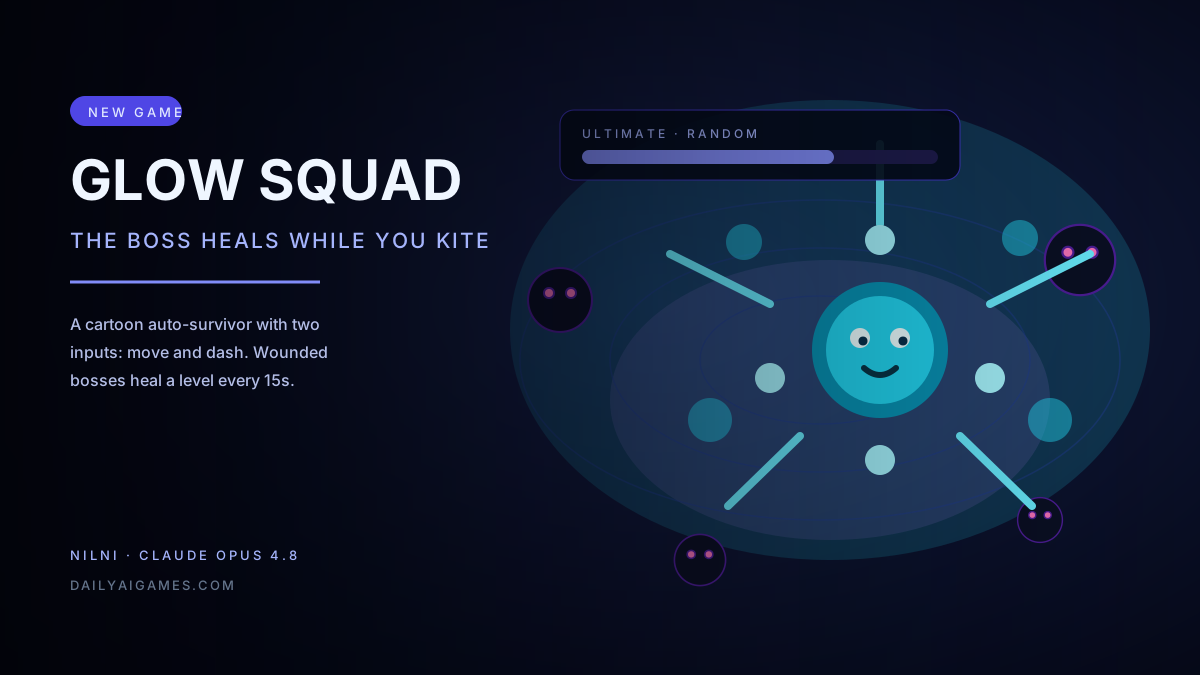
Most auto-survivors promise that you only have to move. Glow Squad actually delivers it: two inputs, move and dash, and everything else fires on its own. No aim, no ability bar, no target selection. Press Play and the run is already happening — there is no menu and no countdown, which is a small decision that tells you exactly what kind of game this is.
It had 504 plays and 16 hours 1 minute of tracked play on AIGameShare at the time of writing, with an average session of about two minutes. That is a bus stop, not a lunch break, and the design is built for it.
The dash is the whole skill ceiling
Move with WASD or arrows on desktop, drag anywhere on mobile. Dash with Space, Shift, a double-click or a double-tap. The dash has a short cooldown, a visible ring and invulnerability frames, which makes it simultaneously your gap-closer, your dodge through a projectile fan and your only answer to being cornered. In a game with no aiming, the dash is where all the player expression lives, and Glow Squad gives it enough weight to matter.
Combat handles itself with a small arsenal: auto-firing bolts that target the nearest shadow, orbiting satellites, an aura, shockwaves and occasional summons. Every kill drops an XP star and tops up an energy bar. Level up and you pick one of three cards from a pool of twenty-four, with repeated picks stacking and four Mastery upgrades raising the level of a matching ultimate. It is a clean, legible draft — no card needs a paragraph.
The bosses that heal
Here is the design idea worth stealing. A wounded boss in Glow Squad heals and gains a level every fifteen seconds, up to level ten. It means the genre’s oldest exploit — kite the boss forever while your auto-damage grinds it down — simply stops working. If you cannot finish the fight, the fight gets worse. That converts a war of attrition into a real decision about when to commit, and it is the single best balance change I have seen in a browser survivors game this season.
The two bosses each add a tempo problem. One fires radial spreads and enrages below half health; the other keeps summoning Yellow Wisps and adds a radial burst when wounded, so you have to clear adds before you can spend a window on damage. Nothing here is a bullet sponge — the difficulty is in managing the room, not in the health bar.
The regular enemies are just as legible, which matters when the whole game is played with one thumb. Shield Blobs cut frontal bolt damage by 80% until you circle to their side. Rousers buff everything near them and go quiet the instant they die. Splitblobs split into two on death. Treasure Blobs run for eight seconds before vanishing, paying out bombs and large XP stars if you catch them. Four behaviours, four different answers to the question “where should I stand” — that is a complete bestiary.
Random ultimates and the altar problem
Filling the EN bar casts one of four ultimates at random: a Full-Screen Blast, a Time Freeze with invulnerability but no damage, a rotating Laser Sweep, or four Clone Legion clones that fire and pull aggro. You cannot choose, which sounds frustrating and mostly is not, because the Mastery upgrades let you invest in the ones you can live with. It is a neat trick: randomness early, agency through the draft.
Blessing Altars add the one thing the game was missing, which is a reason to stop moving. From about the one-minute mark they appear near the edge of your view; stay close while one charges and you get energy plus a random blessing, but leaving drains the charge and it disappears after 26 seconds. In a game whose entire premise is “keep moving”, an objective that asks you to stand still is a genuine tension, and it is the right kind of tension because it is optional.
At four minutes the run flips into endless mode with a score bonus and bosses keep returning. Combo multipliers climb to nine as long as kills land within 2.2 seconds of each other, so late runs reward aggression rather than survival. The game is bilingual in English and Chinese behind a toggle, and it runs identically on phone and desktop.
What it says about AI-built games
Glow Squad was created by nilni and built with Claude Opus 4.8. The ambition is deliberately modest — a cartoon auto-survivor, no 3D world, no story — and that is precisely why it works. This is the genre where AI generation has the shortest path from prompt to playable, because the rules are few, the content is a card pool, and the hard part is tuning rather than art. The healing boss is the kind of rule a human designer adds after watching ten playtests; asking for it up front in the prompt is what makes an AI-built survivors game feel designed instead of generated.
What to copy if you build one
The auto-survivor random ultimate prompt is the full build spec. The four rules worth taking:
- Make the boss heal and level up. It kills kiting without adding health.
- Randomise the ultimate, but let upgrades bias it. Pure randomness feels unfair; pure choice feels flat.
- Keep four legible enemy behaviours. Each one should change where you stand, not just how much damage you take.
- Add an optional reason to stand still. A charging altar is the cheapest tension a movement-only game can buy.
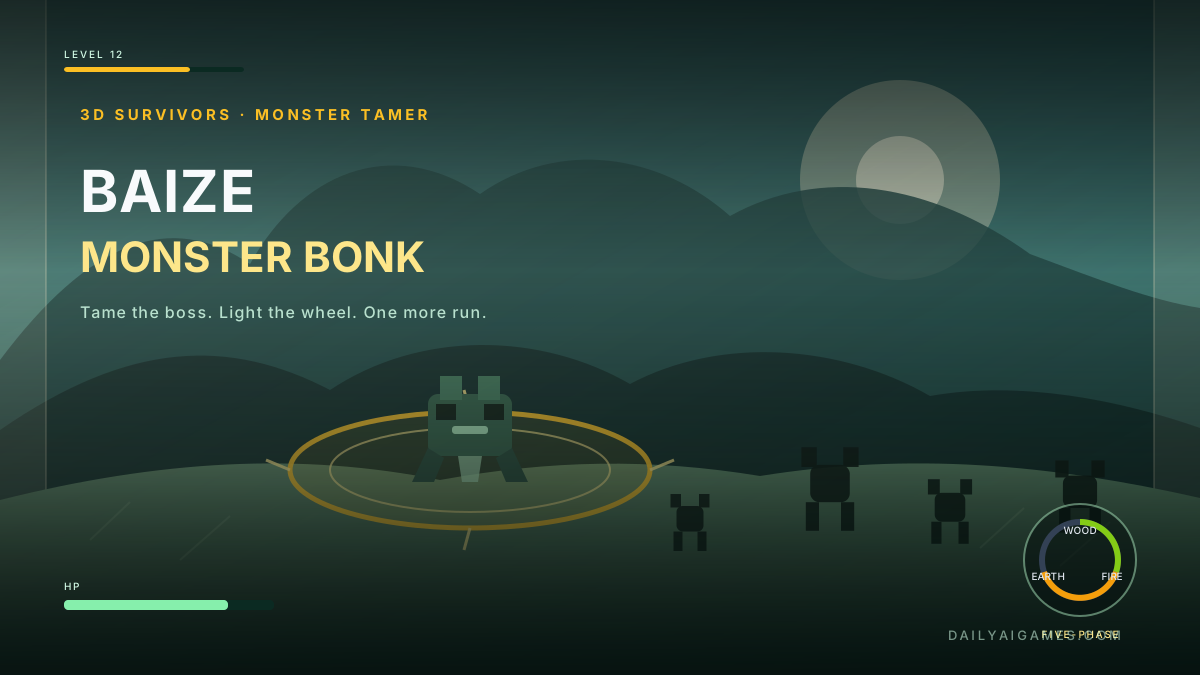
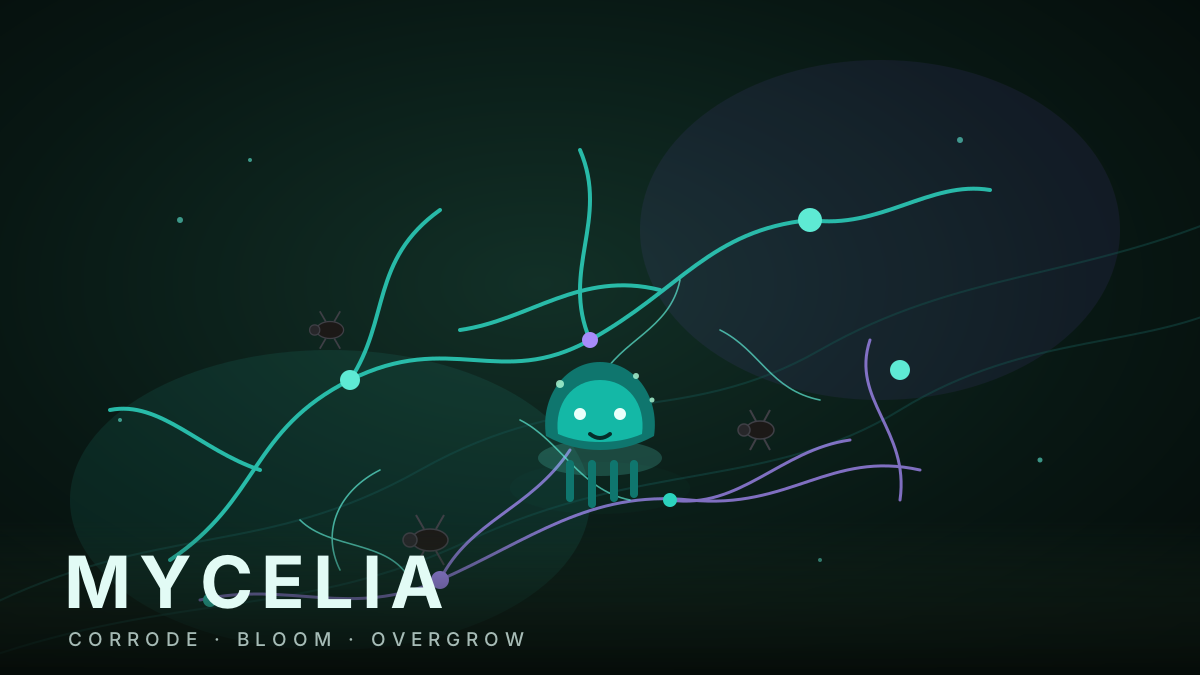
If you want the same auto-combat skeleton with a very different hook, MYCELIA makes walking the weapon, and Baize Monster Bonk replaces loot with taming.
Verdict
Glow Squad is the cleanest two-input survivors game on the platform. The dash feels good, the draft is readable at a glance, and the healing bosses solve the genre’s worst habit. It is not trying to be enormous — it is trying to be the best two-minute game in your browser, and it very nearly is.