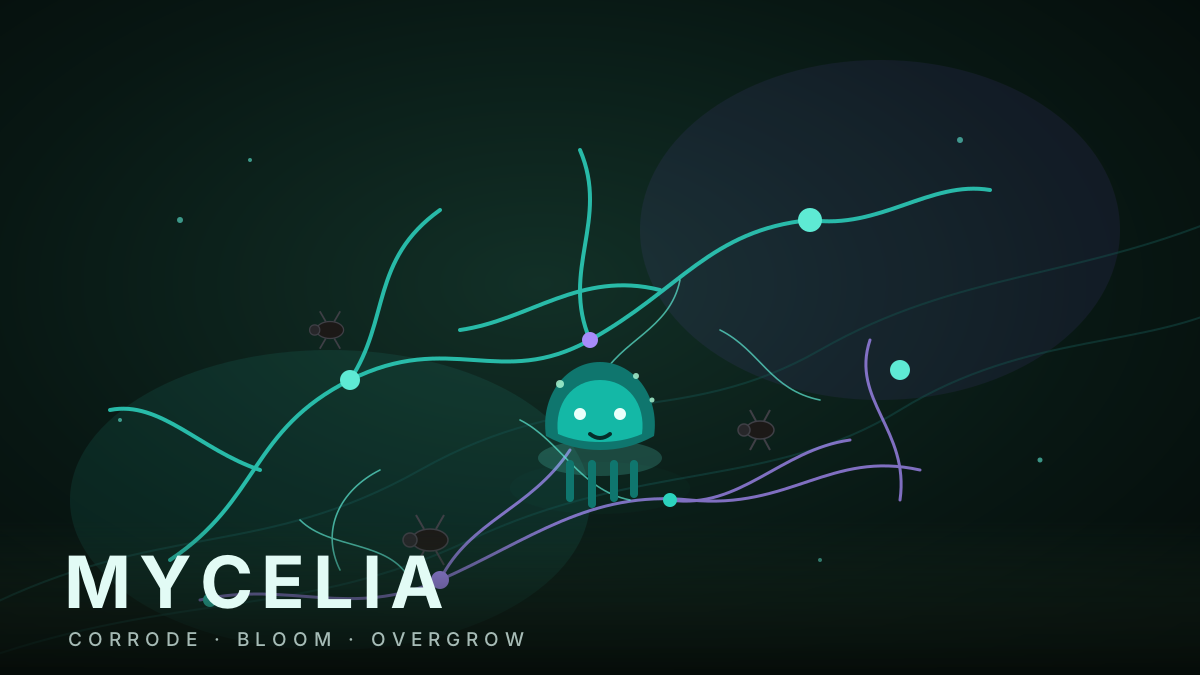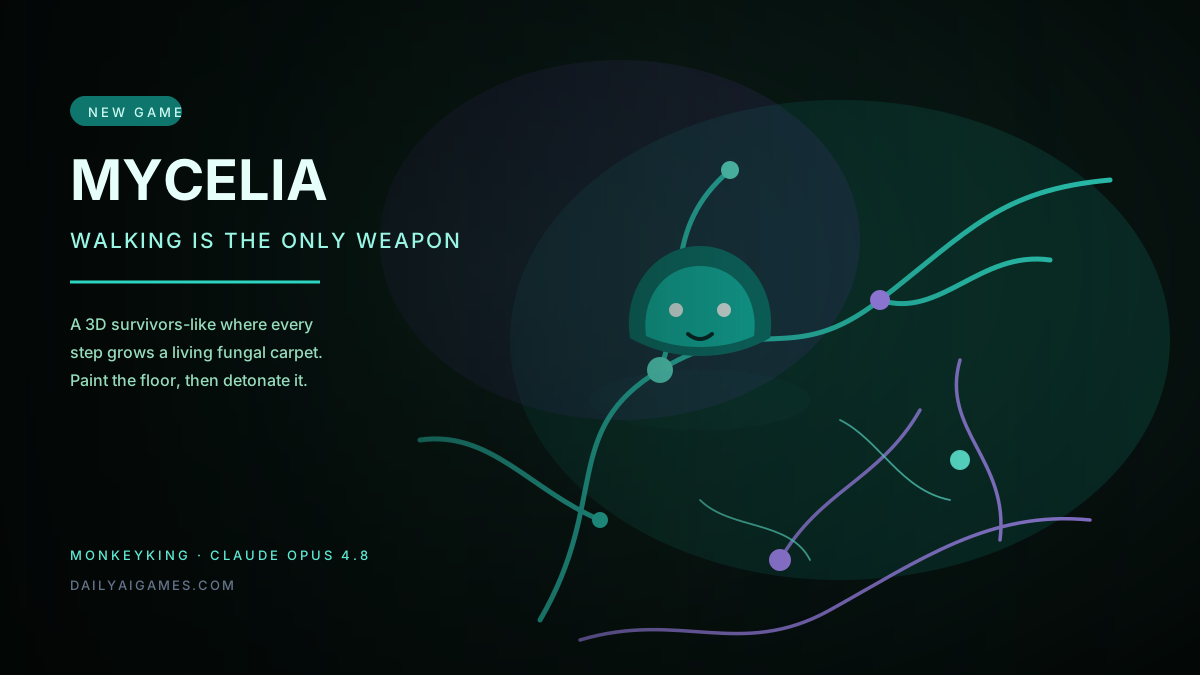
Survivors games have spent three years adding verbs. Aim here, dash there, reroll this, banish that. MYCELIA takes the opposite bet: it removes every verb except walking, and then makes walking carry the entire game. You are a fungal spore in a bioluminescent humus layer, and the trail you leave behind is the weapon, the arena and the score.
At the time of writing it had 137 plays and 14 hours 28 minutes of tracked play on AIGameShare. The raw play count is modest, but the average session is about four minutes — long for a browser survivors game, and the number that matters here, because it means players are not bouncing off the first minute.
The trail is the level
Every step paints a tile of mycelium. Young tiles glow violet; after a couple of seconds they mature to teal, and any bug standing on mature carpet starts to corrode. That single rule changes the emotional shape of the genre. You are not running away from the horde — you are laying a floor for it, then walking somewhere else and watching it die on the way.
The carpet is a connected graph, not a texture. That distinction is what makes the second half of the idea work: a detonation propagates through connected mature tiles, so one pulse can bloom across an entire web at once. Weave a loop, lure a column of ants into it, and set off the whole thing. Gaps in your trail stop the chain, which turns route planning into the actual combat skill.
Two constraints keep it honest. The carpet caps at about 900 tiles, and the oldest withers first, so circling the same patch stops being a strategy. And the carpet has counterplay: slugs smear slime that erases it, some bosses wipe whole sections, wasps fly over it, and pillbugs resist corrosion. Every enemy in the game has a clear relationship to the floor, which is the best bestiary design I have seen in a browser survivors game this year.
Movement as level design
The best way to describe MYCELIA is that it is a tower-defence game where the towers are the path you already walked. Ants and centipedes chase you in straight lines, so a U-shaped trail is a trap and a spiral is a kill corridor. Standing still is never safe because the carpet only advances when you do.
Weapons exist to cover the trail’s weaknesses, not to be the damage. Luminous Pulse spreads a nova through the web, Spore Burst fires at the nearest bug while the carpet matures, Puffball lobs a bomb that seeds new carpet where it lands, Sporewire chains lightning between carpeted targets, Acid Cap shreds armour, and Spore Wall raises a living barrier that corrodes what touches it. Reach level eight on a weapon and own its matching passive and it evolves. There are twelve weapons, twelve passives, and reroll and banish charges to shape the draft.
Species work the same way as starting builds in a good roguelite. Green Cap grows carpet 10% faster, Violet Glow gets bigger detonations, Cordyceps turns kills into friendly spores, Puffball retaliates when hurt, Blightcap trades health for corrosion damage, and Honey Fungus creeps outward on its own. Five biomes follow the floor from Leaf Litter to The Overgrowth, each with its own bug mix and a multi-phase boss around the fifteen-minute mark. Campaign, endless mode and a daily seed give you three different reasons to start again, and biomass buys permanent upgrades on a mutation tree.
What it says about AI-built games
MYCELIA was created by monkeyking and built with Claude Opus 4.8. What is notable is not the model but the design discipline: one verb, one resource, one counterplay table. That is exactly the shape an AI-assisted build can hold together at scale, because the rules are few enough to state, test and debug. The 900-tile cap and the connected-graph detonation are also the kind of constraints a model tends to leave out unless the prompt demands them — and they are the two rules that stop the game from collapsing.
The result is a survivors game you can play with one thumb, with no aim stick, no ability bar and no tutorial. Drag anywhere to move on a phone, WASD on desktop, and the game plays itself around you. If the genre has been waiting for a genuinely new verb, this is the first convincing candidate in months.
What to copy if you build one
Our fungal carpet survivors prompt covers the whole structure. The decisions worth stealing:
- Make the trail a graph, not a texture. Chain reactions only feel earned if a visible gap can break them.
- Cap the resource and decay it oldest-first. Without a cap, the optimal play is to circle one safe patch forever.
- Give every enemy a relationship to the terrain. Walking on it, flying over it, erasing it — the bestiary writes itself.
- Never add an aim button. The moment you do, the game becomes a weaker version of ten other survivors clones.
If you like a survivors game built around a single unusual rule, Baize Monster Bonk does the same thing with taming, and CINDERDEEP does it with simulated matter.
Verdict
MYCELIA is the most interesting survivors design on AIGameShare right now, and it earns that with subtraction rather than addition. The first minute teaches corrosion, maturation and the chain detonation without a single line of tutorial text, and the fifteen-minute boss gives the run a shape that most browser survivors never find. Start with Green Cap, build a funnel instead of a loop, and kill every slug you see.