Space exploration / simulation
Seamless Browser Space Sim (WebGL/WebGPU)
Tested with Claude · produced Anomnomnomaly
The Prompt
Build a seamless browser space-exploration game as ONE self-contained HTML file plus a tiny optional server (inline assets, no game libraries).

World and flight:
- A compressed solar system: one star, at least nine planets and six moons, with real relative scale faked at render time so the player can fly between them without loading screens.
- Seamless transition from orbit to surface approach: no level loads, no cuts. Use floating origin or camera-relative rendering to avoid float precision jitter.
- Flight model: WASD or hold-to-fly, Space to boost, right-drag or Q/E to turn, scroll to zoom, hold S to descend from orbit. Touch equivalent: hold to fly, second finger to boost.
- Planets are procedurally generated from a seed using pixel-art textures generated at runtime from code; no external image files.
Rendering and performance:
- Prefer WebGPU with a WebGL fallback. Target 60fps on a mid-range laptop and 30fps on a recent phone.
- Budget draw calls and texture memory explicitly; print a performance budget table in the README.
- Include a photo mode that pauses input and hides the HUD.
Persistence and multiplayer:
- Make it installable as a PWA with an offline mode that still allows system exploration.
- Optional multiplayer: an authoritative server holds shared world state, clients send position/actions at a low tick rate. If the server is unavailable, fall back to solo play without an error wall.
- Accounts and saved state are explicitly resettable during beta; show that warning in the UI.
UI:
- A HUD with current body, distance in AU, speed, and a system map. Minimal text, no external fonts.
- Keyboard/mouse on desktop, touch controls on mobile, both reachable one-handed.
After the code, print the scene graph (star, planets, moons), the LOD strategy, and the three biggest performance risks.
What This Prompt Produces
Separating "seamless flight" from "shared world" is what keeps scope honest — solo play must work first, multiplayer second. Anomnomnomaly on this site is a real solo-developed example of the same architecture, with AI used on infrastructure rather than art.
Modification Tips
- Build the seamless flight and one planet before adding the rest of the system.
- Use a floating origin early; retrofitting it after jitter appears is painful.
- Treat the server as optional from the first commit — offline mode is the fallback.
- Budget texture memory before generating planets; procedural pixel art is easy to overdraw.
The Game This Prompt Produced
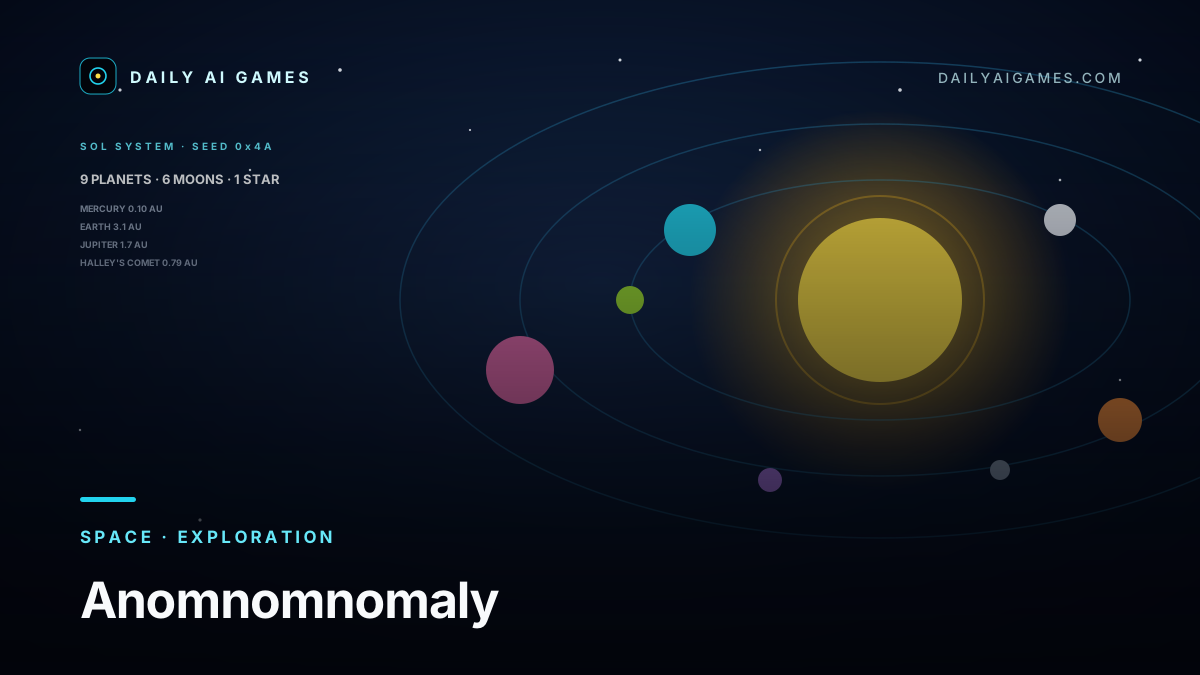
Want to try it? Open Claude, paste the prompt, and you'll have a playable game in minutes. When you're happy with the result, submit it to Daily AI Games.
