Gaffer
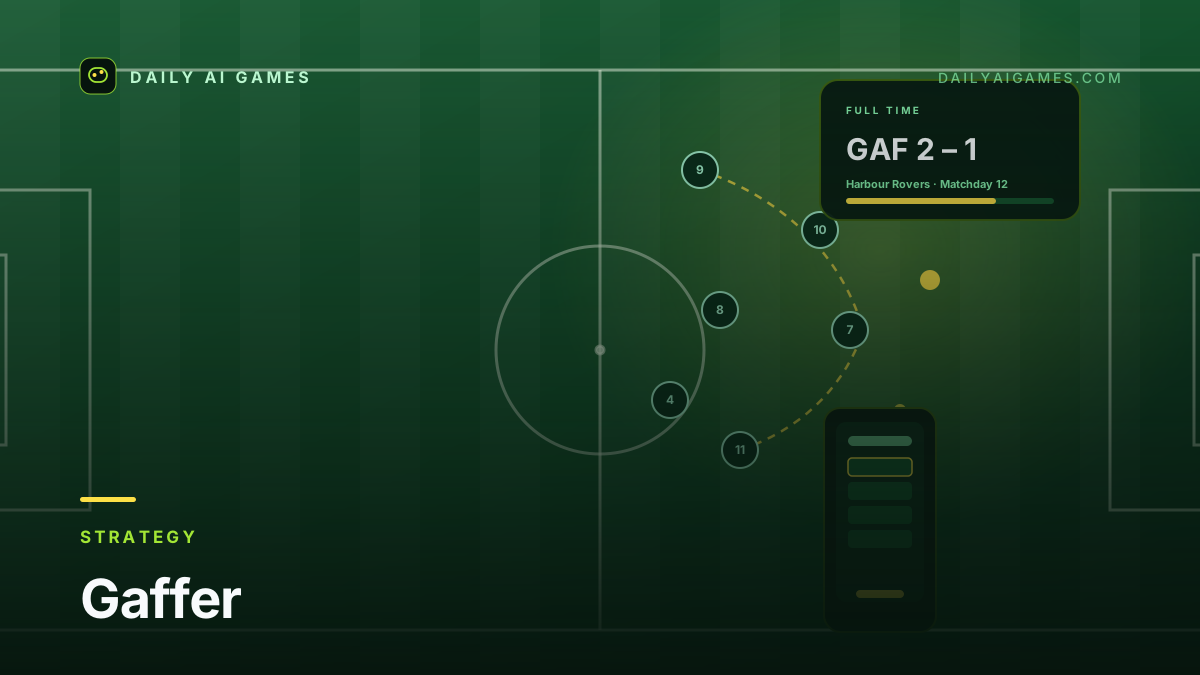
A mobile-first football management game: one fictional club, one season, five-minute sessions — built by an unattended Claude Code pipeline.
0 plays tracked on Daily AI Games
External game siteGaffer is not hosted on Daily AI Games. The button above opens an independently operated, free browser game on GitHub Pages; its content, availability and controls are controlled by that site.
How to Play
Built for touch: tap through the squad, tactics and table screens, set your line-up and approach, then play the next fixture. It also works with a mouse in a desktop browser. Sessions are designed to fit into a few minutes, so you can make one decision and leave.
These are the controls for Gaffer. The external Gaffer version on GitHub Pages may use slightly different controls.
Game Preview
About Gaffer
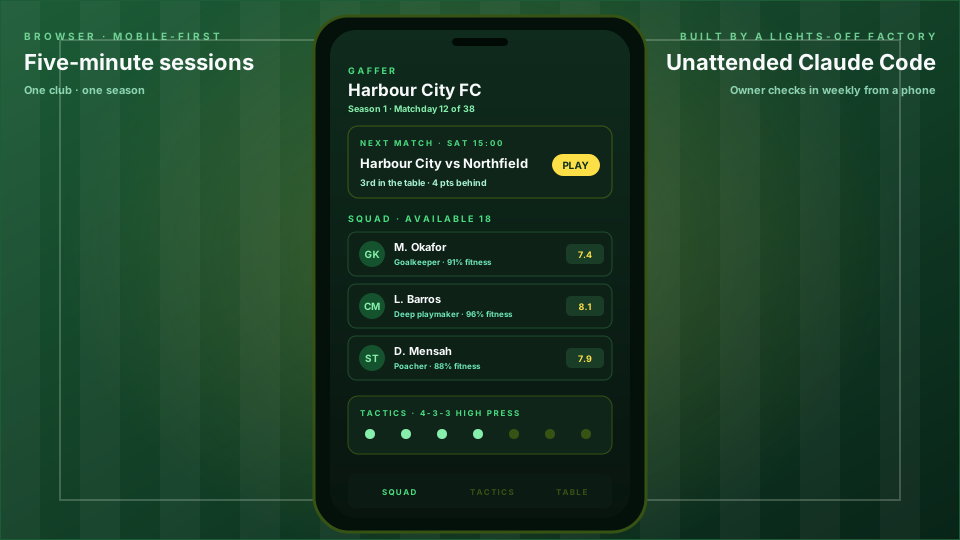
Gaffer is a football management game designed for a phone and a spare five minutes. You take charge of one fictional club for a single season, pick your squad, set the tactics and work through matchdays in short sessions rather than marathon sittings. The interface is built mobile-first: the squad list, next fixture and tactical setup are all reachable with a thumb, and the whole game runs in a browser tab with no download or account.
It is also one of the most unusual build stories on the site. Gaffer is produced by a “lights-off” software delivery pipeline: an unattended Claude Code factory, governed by nWave, builds the game one story at a time from scheduled GitHub Actions runs. The owner checks in roughly once a week, from a phone. Planning runs write the stories and technical decisions, reviewer agents critique them, and a story only counts as done when its protected black-box scenarios pass on main. Merge gates cover lint, types, tests, locked paths, append-only rules, test counts, diff size, story regression, a phone-viewport smoke test and an AI reviewer that can block a change. There is even a kill switch controlled by an issue label or a config flag.
That process matters to players because it explains the game’s shape: small, testable features that arrive steadily rather than one giant launch. The test suite is part of the product, not an afterthought, and the mobile viewport is checked on every merge. For anyone curious about autonomous software delivery, the repository is as interesting as the game — the roadmap and architecture decisions are committed alongside the code, and the factory is explicitly designed not to read issue or pull-request text for instructions.
Gaffer will not replace a full football manager sim, and it does not pretend to. What it offers is a focused, fast season with a clear loop and a phone-first interface — the kind of game you can open on a commute, make one decision, and close again. It is free, it runs in the browser, and it is a genuinely useful case study in what happens when an AI coding pipeline is given guard rails, a roadmap and a weekly human check-in instead of a single prompt. If you like football tactics, management games or autonomous build experiments, put it on your list.
How This Game Was Generated
Built by an unattended Claude Code factory governed by nWave, from scheduled GitHub Actions runs. Planning and reviewer agents write and critique the stories, while protected black-box tests, lint, type checks, a phone-viewport smoke test and an AI reviewer act as merge gates. The owner checks in about once a week from a phone.
Similar AI Games
 Casual Games
▶ 310 plays
Deep Diver
Hold to sink, release to rise. Collect pearls and dodge mines in this one-thumb casual game — free in your browser.
Play now
 Casual Games
▶ 0 plays
GeoSports
A daily sports geography game: five questions, one world map, and a score based on how close your pin lands. Free, no sign-up, about a minute per round.
Play now
 Strategy Games
▶ 0 plays
World of ClaudeCraft
A free, open-source browser MMORPG with nine classes, 14 zones, quests, parties, PvP, dungeons and raids. Seeded by Claude, then finished by a volunteer community.
Play now
 Strategy Games
▶ 0 plays
Crimson Oath
A free SNES-style JRPG with two chapters, four heroes and FF6-style ATB battles. Every sprite and song is generated in code, and it runs in your browser.
Play now
Articles About Gaffer
Oct 17, 2026
How Much Does an AI Game Cost? Honest Breakdown
How much does an AI game cost to make? Honest breakdown: free AI tiers vs paid plans, your time, hosting and domains — real numbers from a team making games daily.
Oct 16, 2026
How to Publish an AI Game Online: Free Hosting Guide
How to publish an AI game online for free: hosting on Cloudflare Pages, itch.io, GitHub Pages and Netlify, plus a quick SEO checklist for game pages.
Oct 15, 2026
The 10 Best AI Games to Play Online Free
Ten AI-generated games you can play online free right now — arcade, puzzle, strategy and endless runners, all built from text prompts and playable in your browser.
