Ink Warden
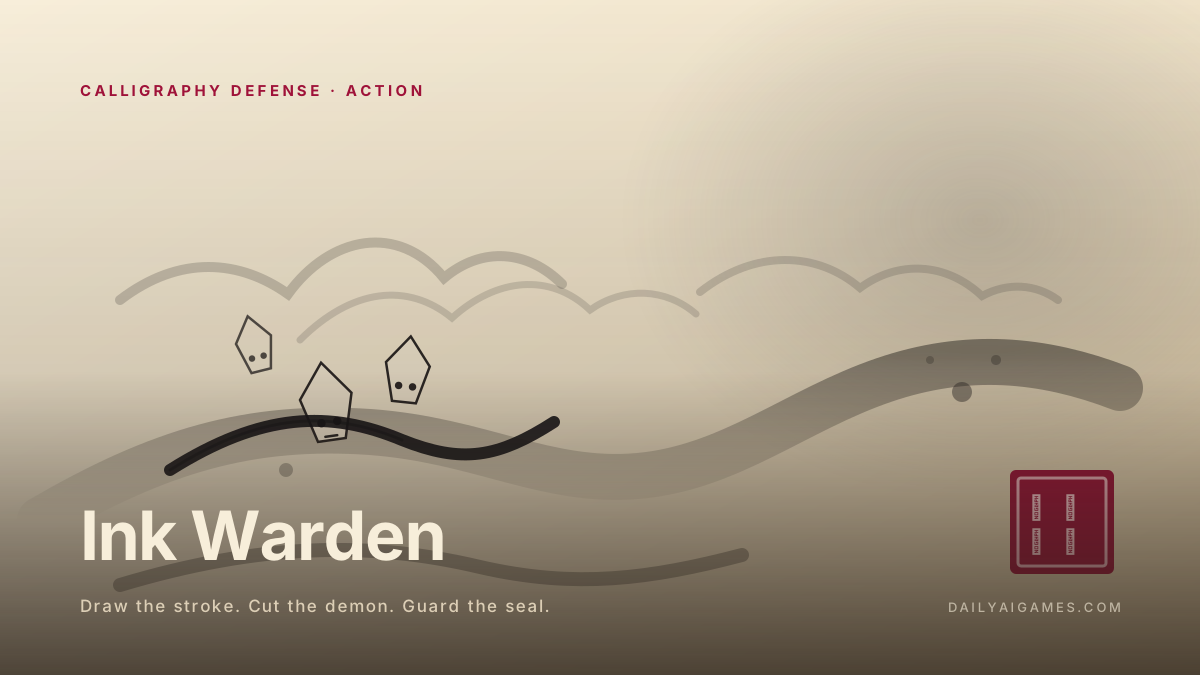
A calligraphy defense game painted in living ink — draw brush strokes to cut paper demons, cast glyph spells and guard the vermilion seal across an unrolling handscroll.
57 plays tracked on Daily AI Games
External game siteInk Warden is not hosted on Daily AI Games. The button above opens an independently operated, free browser game on AIGameShare; its content, availability and controls are controlled by that site.
How to Play
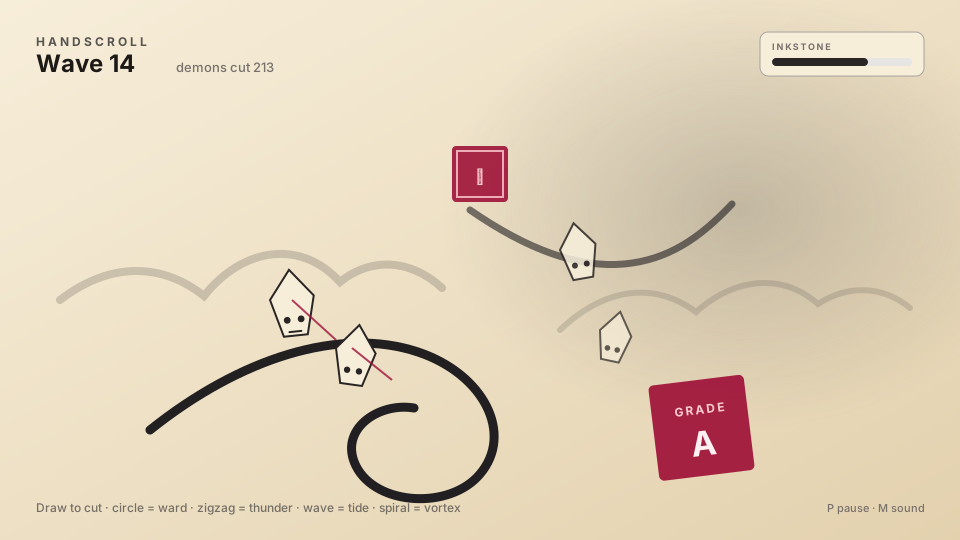
Touch, mouse or pen: draw anywhere on the canvas to attack — every stroke is an ink blade that cuts demons along its path, and a quick tap fires an ink dart. Draw a circle for a ward, a zigzag for chain thunder, a wave for a pushing tide, or a spiral for an ink vortex; smoother strokes earn a higher calligraphy grade and a stronger spell. Strokes spend ink, and kills drop ink drops that refill the inkstone. Keyboard: P or Esc pauses, M toggles sound.
These are the controls for Ink Warden. The external Ink Warden version on AIGameShare may use slightly different controls.
Game Preview
About Ink Warden
Ink Warden is a calligraphy defense game, which sounds like a genre invented by a mood board until you actually play it. You are the last warden of a vermilion seal painted at the far end of an unrolling ink-wash handscroll, and paper demons are coming for it. There is no start screen: the scroll is already moving when the page loads, and your first brush stroke is your first attack. Draw anywhere on the canvas and the stroke becomes an ink blade that cuts every demon it passes through; a quick tap fires a small ink dart. It is a defense game where the thing you are protecting is a stamp and the weapon is your handwriting.
The real mechanic is what happens when your stroke is not a line. Draw a closed circle and you cast a ward that pushes enemies back. Draw a zigzag and chain thunder runs between the corners. Draw a wave and a pushing tide rolls down the scroll; draw a spiral and an ink vortex drags the whole screen inward. The game reads these shapes from the raw pointer path, so the same four spells can be cast badly or beautifully. Strokes are graded on smoothness, speed and closure, and a higher grade casts a stronger version of the spell. That single rule turns every fight into a small handwriting exam under pressure, and it is the reason Ink Warden feels different from every other drawing game in a browser.
Ink is the economy that keeps it honest. Every stroke spends ink from the inkstone in the corner of the screen, and every kill drops ink drops that refill it. The result is a real cost curve: you can spam thin scratches, but one clean stroke that kills three demons and casts a spell at the same time is worth far more than five sloppy ones. Bosses break the rhythm every few waves, and after each one you choose one of three copybook upgrades — thicker strokes, cheaper spells, faster ink regeneration — which quietly turns a run into a roguelite build.
The presentation is the other half of the pitch. The ink is rendered in WebGL with bleeding edges, dry-brush texture and paper grain, the scenes are composed procedurally, and the whole thing is scored with synthesized WebAudio hits rather than samples. Scrolling brushstrokes and a slow camera make the handscroll feel like a place rather than a background. Runs last about one to five minutes, which matches the average session on the platform.
Nothing here is finished to commercial polish. The leaderboard is not live, comments are disabled, and the average play is about a minute, which tells you most people are still learning the spells. But as a demonstration of what a frontier model can build in a browser, Ink Warden is the most interesting game of the week: it takes a control scheme nobody asked for — literally drawing your attacks — and makes it feel like the obvious way to fight.
How This Game Was Generated
Built with Claude Fable 5, with the renderer and game logic written in HTML Canvas, WebGL, CSS and JavaScript and all sound synthesized through WebAudio. There is no start screen by design — the game is playable the moment the page loads. The build includes full-screen brush drawing, four recognised gestures (circle, zigzag, wave, spiral), calligraphy grading, an ink economy, boss fights, copybook upgrades and procedural ink-wash scenes. As of 26 October 2026 it had 3,101 plays and 88h 40m of tracked play time on AIGameShare; the in-game leaderboard was not yet live.
The Prompt Behind This Game
Show the prompt used to generate Ink Warden
Build a browser defense game where the only input is drawing. ONE self-contained HTML file (inline CSS/JS, no libraries, no external assets, no start screen). Use Canvas or WebGL for the ink layer and keep all art procedural.

Core input contract:
- The player draws anywhere on the canvas with mouse, finger or pen. Every completed stroke is a blade that damages enemies along its exact path; a quick tap under 120ms fires a small dart instead.
- Sample pointer input at 120Hz, simplify with Ramer–Douglas–Peucker at a 2px epsilon, then resample the stroke to 64 evenly spaced points before recognition. Never recognise from raw event points.
- Expand the stroke into a collision band by interpolating between consecutive points and testing a radius against enemy hitboxes. Thin strokes must still hit fast enemies at 60fps.
Gesture spells:
- Recognise exactly four shapes: closed circle, zigzag (at least four direction reversals), wave (at least two complete sinusoid cycles) and spiral (monotonically increasing radius across at least 540 degrees).
- Score each recognition on confidence 0-1 and grade the calligraphy on smoothness (low curvature variance), speed consistency and closure. Spell power scales linearly with grade; show the grade as a brush seal that stamps on release.
- Reject ambiguous strokes gracefully: if the best confidence is below 0.55, the stroke stays a plain blade and no spell is cast.
- Add a debug overlay that draws the resampled points, the fitted shape and the confidence, toggled with D.
Economy and progression:
- An ink pool that drains per stroke by length and per spell by type, and regenerates from ink drops left by kills. When ink is empty, strokes are thin and weak; the player should feel the cost before they read a number.
- Boss every 5 waves. After each boss, offer three copybook upgrades (for example thicker strokes, cheaper spells, larger inkstone) chosen from a seeded pool.
- Runs last 1-5 minutes; track wave, best grade and total demons cut on the end screen.
Presentation and platform:
- Ink-wash handscroll background composed procedurally: paper grain, bleeding edges, dry-brush gaps, one vermilion accent. Scroll the camera rather than the world.
- Synthesize every sound in WebAudio (brush swish, paper cut, spell hit). No audio files.
- Mobile-first: full-viewport canvas, no scrolling, safe-area padding, touch-action none, and a pause button that works when the tab is backgrounded.
- Respect prefers-reduced-motion by removing camera drift and screen shake.
Deliver in stages: drawing and cutting first, then one recognised gesture, then all four, then ink economy, then bosses and upgrades. Print the recognition thresholds and a table of every spell’s ink cost and damage at the end.
Open in the prompt library for tips and variations
Similar AI Games
 Action Games
▶ 752 plays
CINDERDEEP: Falling Sand Roguelike
A falling-sand roguelike where every pixel of the cave is simulated. Burn, freeze, dissolve and flood your way through five depths with a four-spell wand.
Play now
 Action Games
▶ 504 plays
Glow Squad
A cartoon auto-survivor where you only move and dash. Bolts, satellites and random ultimates fight for you, and wounded bosses heal and grow stronger every 15 seconds.
Play now
 Action Games
▶ 294 plays
Baize Monster Bonk
A 3D survivors roguelite drawn from the Classic of Mountains and Seas — auto-attacking beasts, seal-ring taming and a five-element wheel that chains elements.
Play now
 Action Games
▶ 137 plays
MYCELIA
A 3D survivors-like where the only verb is walking. Every step grows a glowing fungal carpet that corrodes bugs, and the whole web can be detonated in one chain bloom.
Play now
Articles About Ink Warden
Oct 28, 2026
Ink Warden: The Browser Game Where Your Handwriting Is the Weapon
Ink Warden turns brush strokes into blades and gestures into spells. We break down its four-shape spell recognition, ink economy and WebGL ink rendering.
Oct 19, 2026
AI-Generated Browser Games Worth Knowing: October–November 2026
From a 12-hour sports hit and a weekend MMO to fifteen new browser games — a tin-toy kart racer, a spherical sailing sim, an art-print surf run and more.
Oct 15, 2026
The 10 Best AI Games to Play Online Free
Ten AI-generated games you can play online free right now — arcade, puzzle, strategy and endless runners, all built from text prompts and playable in your browser.
