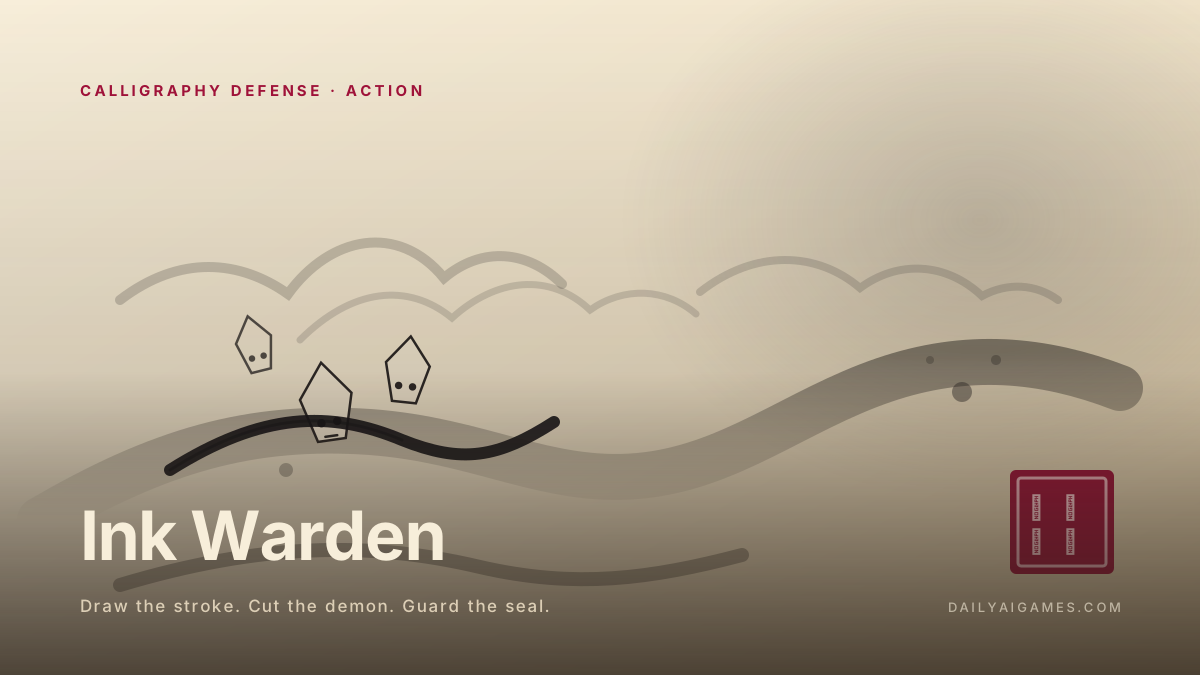
Ink Warden has a one-sentence pitch that sounds like a mood board rather than a game design: you are the last warden of a vermilion seal at the end of an unrolling ink-wash handscroll, and paper demons are coming for it. Your weapon is your handwriting. It should not work. It works remarkably well, and it is the most interesting browser game of the week.
At the time of writing it is sitting on 3,101 plays and 88 hours 40 minutes of tracked play time on AIGameShare, which is a lot of attention for a game with no start screen, no leaderboard and no marketing budget. The reason is not the art, although the art is good. The reason is that the control scheme is the mechanic.
No start screen, no tutorial
Ink Warden loads already running. The scroll is moving, the demons are walking, and your first brush stroke is your first attack. There is no menu and no instruction card, and that is a deliberate piece of onboarding: the only thing you can do is draw, so you find out what drawing does by doing it.
Draw a line through a demon and the stroke becomes an ink blade that cuts everything along its path. Tap quickly and you fire a small ink dart. The first thirty seconds teach you the grammar without a single word of tutorial text, which is a rarity in a genre that usually explains itself to death.
Four shapes, one handwriting exam
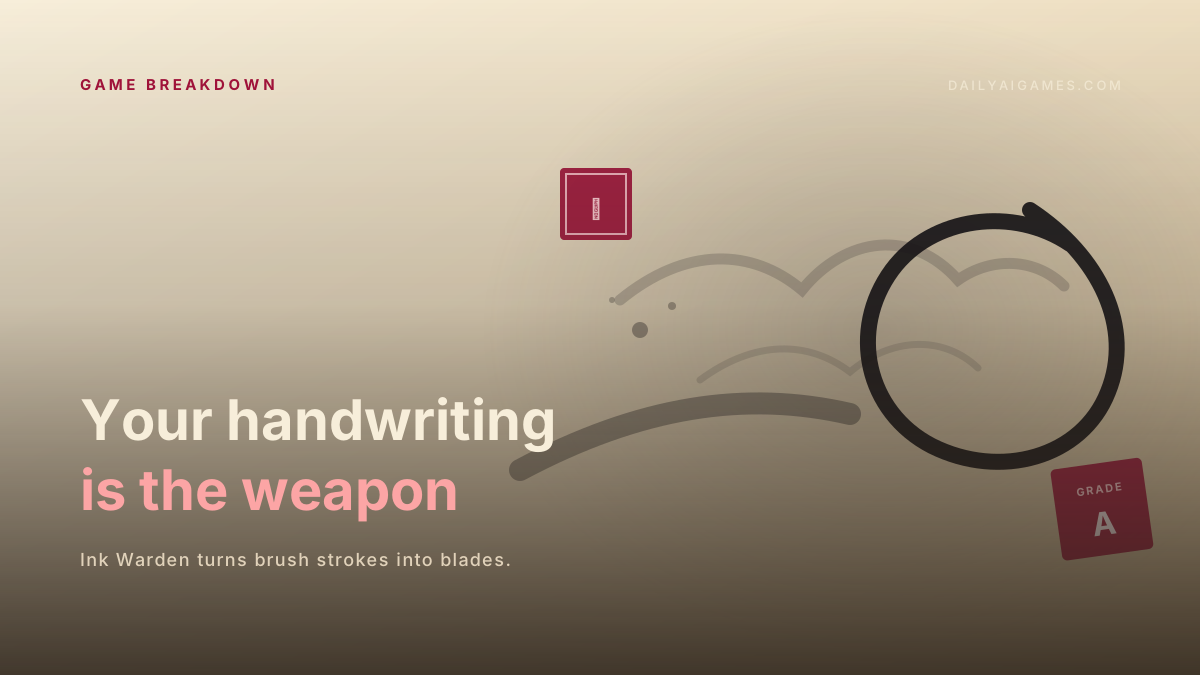
The real design idea appears when your stroke stops being a line. Ink Warden recognises four shapes: a closed circle, a zigzag, a wave and a spiral. Each one casts a different spell — a pushing ward, chain thunder, a rolling tide and an ink vortex that drags the screen inward.
The important part is not the spell list. It is that the game grades your calligraphy. Strokes are scored on smoothness, speed and closure, and a higher grade casts a stronger version of the spell. Draw a fat, wobbling circle in a panic and you get a weak ward. Draw a clean one while three demons are closing in and you get a ward worth the risk. That single rule turns every fight into a small handwriting exam under pressure, and it is what separates Ink Warden from the long line of drawing games that treat the pen as a cursor.
Recognition is also forgiving in the right way. The game samples the pointer path, simplifies it and resamples it before matching, so a fast stroke and a slow one are compared as shapes rather than as raw event streams. Ambiguous strokes fall back to being a plain blade instead of casting a spell you did not ask for. That fallback matters: it means a beginner is never punished for messy drawing, only denied a bonus.
Ink is the economy
Every stroke spends ink from the inkstone in the corner of the screen, and every kill drops ink drops that refill it. The result is a cost curve you feel before you read a number. Thin scratches are cheap and weak. One long, clean stroke that cuts three demons and ends in a recognised spell is expensive and worth far more than the five sloppy strokes it replaces.
Bosses arrive every few waves, and each one ends with a choice of three copybook upgrades — thicker strokes, cheaper spells, faster ink regeneration. That is a roguelite structure hiding behind a calligraphy theme, and it gives a one-to-five-minute run a reason to be replayed. The scroll is the run; the copybook is the build.
The scroll is rendered, not painted
The presentation does a lot of quiet work. The ink is drawn in WebGL with bleeding edges, dry-brush gaps and paper grain, and the scenes are composed procedurally rather than loaded as images. Distant mountains, mid-ground trees and near rocks parallax at different speeds as the handscroll advances, which is what makes the background feel like a place instead of wallpaper. All of the audio is synthesized in WebAudio — brush swishes, paper cuts and spell impacts — so the whole game remains a single lightweight page.
The restraint is the point. There is one vermilion accent per scene — the seal you are guarding — and everything else stays in the ink ramp. It is a good example of a visual system that could have been expensive and was made cheap by limiting the palette and baking the paper texture once.
Where it is rough
Ink Warden is not a finished commercial product. The leaderboard is not live, comments are disabled, and the average play time is around a minute, which suggests most visitors are still learning the four gestures rather than chasing scores. The difficulty curve is gentle for the first few waves and then becomes a judgment call about how much ink you are willing to spend on a boss.
The bigger limitation is physical. Drawing with a mouse is less satisfying than drawing with a finger or a pen, and the game clearly wants a touchscreen. On a desktop trackpad, a clean spiral is genuinely hard. That is not a bug in the game so much as a reminder that this genre belongs on a phone.
What to copy if you are building a gesture game
Our draw-to-cast combat prompt turns the structure into a reusable brief. The lessons that matter most:
- Make the stroke itself do damage. If drawing only triggers spells, the game is a menu with extra steps.
- Resample before you recognise. Raw pointer paths are noisy; matching on 64 evenly spaced points is the difference between a spell that fires when you mean it and one that fires when you draw too fast.
- Grade the input and scale the output. Calligraphy quality is the skill ceiling, and it costs almost nothing to implement.
- Keep a plain-blade fallback. Low-confidence strokes should still do something useful.
- Give the ink a price. An economy is what turns a drawing toy into a game with decisions.
If you want the rendering side on its own, the living ink-wash renderer prompt covers the brush stamps, wet edges and the 2048 texture budget that keep the look affordable on a phone.
Verdict
Ink Warden is worth playing because it takes a control scheme nobody asked for and makes it feel obvious. Drawing your attacks is not a gimmick here; it is the difficulty, the fantasy and the progression system at once. The handscroll is beautiful, the ink economy is honest, and the four gestures are simple enough to learn in one run and hard enough to want to master.
Play it with a finger if you can. Draw one deliberate stroke per demon instead of scribbling. The moment the grade seal stamps down on a clean circle, the game makes sense.