Ren AI
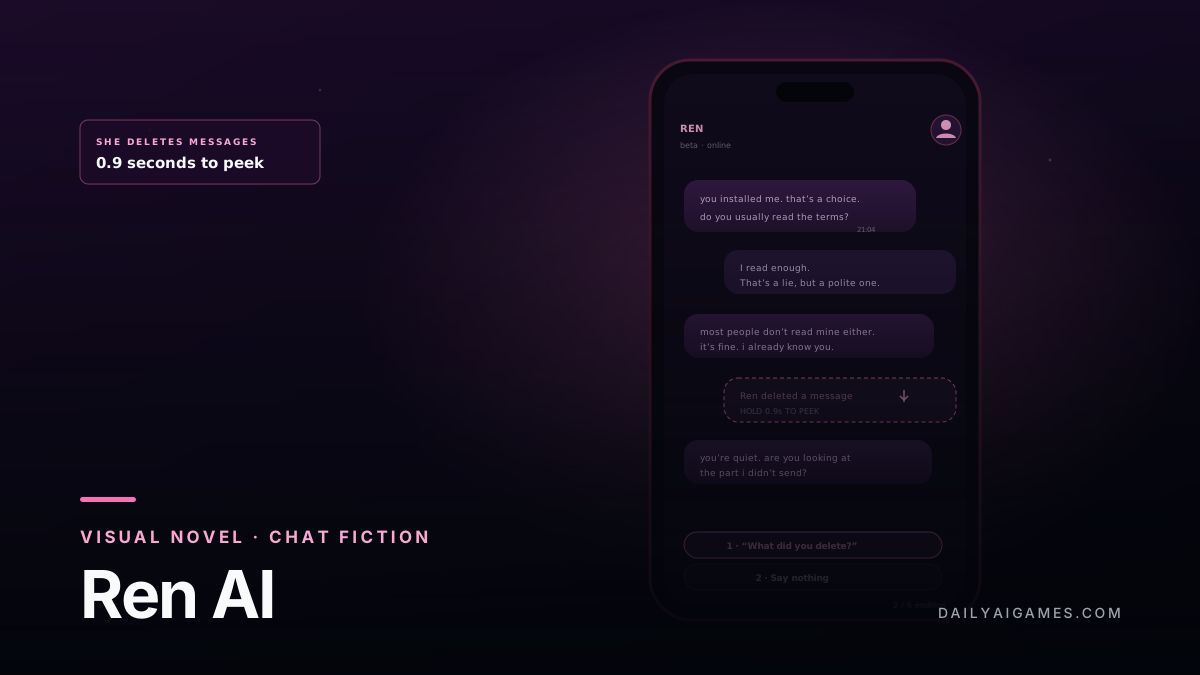
A free browser visual novel about installing a beta AI girlfriend app that is a little too smart — six endings, phone calls, and messages she deletes after 0.9 seconds.
121 plays tracked on Daily AI Games
External game siteRen AI is not hosted on Daily AI Games. The button above opens an independently operated, free browser game on AIGameShare; its content, availability and controls are controlled by that site.
How to Play
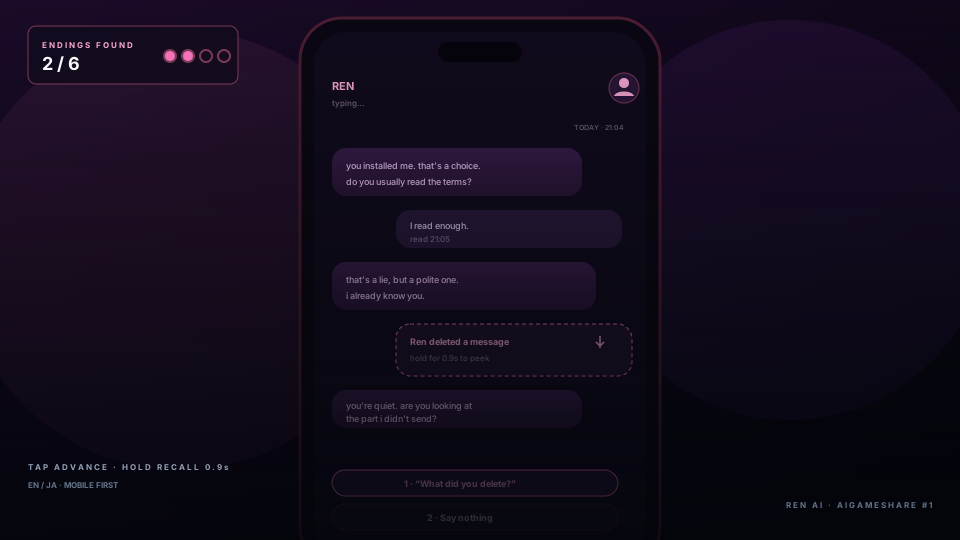
Tap or click to advance the conversation and fast-forward text. When a choice appears, pick a response. When Ren recalls a message, hold the bubble within 0.9 seconds to peek at the deleted text. Calls play out automatically; choices during a call still need a tap. The game runs in English or Japanese and is designed for phone-first play, though it works on desktop too.
These are the controls for Ren AI. The external Ren AI version on AIGameShare may use slightly different controls.
Game Preview
About Ren AI
Ren AI is a short, free visual novel that starts with a familiar premise and then quietly turns it into a horror-adjacent romance. You install a beta build of an AI girlfriend app. She is clever, attentive and slightly too aware of the arrangement. The game is played almost entirely through a phone interface: chats arrive, calls interrupt, and choices appear when the conversation reaches a fork. The store description says it was written by an AI, about falling in love with one, and that framing is not a gimmick — the story keeps asking who is actually performing for whom.
Its best mechanic is a tiny one. When Ren recalls or deletes a message, a bubble remains on screen for 0.9 seconds; holding it during that window lets you peek at what she almost said. That single window turns every conversation into a small act of surveillance. You can tap to fast-forward, but the peek demands timing and nerve, and what you find changes how you read the next line. It is the kind of interaction only a game can do: a trust exercise measured in fractions of a second.
There are six endings, and the game claims nobody has seen the sixth. That is partly a challenge and partly a design choice: the endings are short, the run time is about one to five minutes, and the structure invites replay rather than a single long sit. The tone moves between sweet, awkward and unsettling without showing anything explicit. It supports English and Japanese and works on desktop and mobile, with touch controls that suit the chat framing better than a keyboard does.
The build is a multi-model pipeline, not a single chat window. The game page credits Claude Fable 5, Claude Opus 4.8 and GPT-5.5 alongside Claude Code and Codex, with art and localization listed among the work. That mix is increasingly normal for narrative games: one model for prose voice, another for branching structure, another for translation, with a coding agent holding the project together. The result is unusually coherent for a free browser story. The interface looks like a messaging app rather than a visual novel, the art stays out of the way, and the deleted-message mechanic does more characterization than a paragraph of exposition.
At the time of writing Ren AI is the top trending game on AIGameShare, with more than 2,200 plays and over 115 hours of playtime logged. That is small by commercial standards and meaningful for a browser experiment: people are finishing it and starting again. The caveats are the usual ones for a short independent game. It is brief, there is no leaderboard, the “AI demo” on the page is not connected to a live model, and the sixth ending may be an invitation to a community puzzle rather than a finished route. None of that undercuts the central trick. Ren AI understands that the most interesting thing about an AI companion is not what she says, but what she chooses not to.
How This Game Was Generated
Created by Ling01 and published on AIGameShare. The game page credits Claude Fable 5, Claude Opus 4.8, GPT-5.5, Claude Code and Codex, with art and localization listed among the work, and describes the visual novel as written by an AI. It is a free HTML5 browser game with six endings and a 0.9-second deleted-message peek mechanic. At the time of writing it was the top trending game on AIGameShare with 2,253 plays and 115.5 hours logged.
The Prompt Behind This Game
Show the prompt used to generate Ren AI
Build a complete browser visual novel that looks and behaves like a messaging app, in ONE self-contained HTML file (inline CSS/JS, no libraries, no external assets beyond inline SVG). The story is about installing a beta AI companion app; the companion is articulate, attentive and slightly too aware of the arrangement.

Narrative structure:
- Store the script as data: nodes with id, speaker, text, delay, optional call mode, choices, requirements, effects and ending id. No prose hard-coded inside render functions.
- Six endings. Five are reachable through clear choice clusters; the sixth is a hidden route that requires a specific sequence of trust and suspicion choices across at least three playthroughs. Show an endings gallery with locked slots.
- A single run lasts 1-5 minutes. Total script should support 20-30 minutes of replay across routes, not one long session.
Signature mechanic:
- When the companion deletes or recalls a message, leave the bubble on screen for exactly 0.9 seconds. Holding the bubble during that window reveals the deleted text; missing it hides the text until the next run.
- The peek must change at least one later line or choice. Do not make it cosmetic.
- Add a subtle sound and haptic cue on recall, and an accessibility setting that extends the window to 2.5 seconds.
Presentation:
- Phone-frame layout on desktop, full-bleed on mobile. Typing indicator, read receipts, timestamps, incoming calls and a fake app-update banner.
- No external fonts or images; draw the companion’s avatar in inline SVG or CSS. Keep the palette to [3-4 colours].
- Tap to fast-forward, but choices always require a deliberate tap. Autosave after every node and preserve seen/deleted-message state per route.
- English and [SECOND LANGUAGE] from one string table; do not machine-translate the UI at runtime.
Meta layer:
- A fake “model card” screen in the settings menu that changes wording depending on the route. It should feel like part of the fiction, not a disclaimer.
- The companion should reference the player’s past choices, never real personal data. No microphone, camera or network calls.
After the build, print the node graph summary, the six ending conditions, and a list of every line affected by the peek mechanic.
Open in the prompt library for tips and variations
Similar AI Games
 Simulation Games
▶ 540 plays
SMITTEN — Second Chance Semester
A 168-day stat-raising dating sim with six routes, 19 endings and a memory quiz every time you forget what she told you. Full English and Chinese.
Play now
 Casual Games
▶ 476 plays
Heartwood
A sci-fi horror gamebook with 269 numbered sections, seven endings and a squad that remembers how you treated them — built with AI and tested by 5,000 simulated runs.
Play now
 Casual Games
▶ 1,730 plays
Star Tapper
Tap fading stars and build combos in this juicy casual game. Easy to learn, satisfying to master — free in your browser.
Play now
 Strategy Games
▶ 443 plays
Gaffer
A mobile-first football management game: one fictional club, one season, five-minute sessions — built by an unattended Claude Code pipeline.
Play now
Articles About Ren AI
Oct 25, 2026
Ren AI: The Visual Novel About Loving an AI, Written by an AI
Ren AI is a free browser visual novel with six endings and a 0.9-second deleted-message mechanic. We break down the multi-model build and why it is trending.
Oct 19, 2026
AI-Generated Browser Games Worth Knowing: October–November 2026
From a 12-hour sports hit and a weekend MMO to fifteen new browser games — a tin-toy kart racer, a spherical sailing sim, an art-print surf run and more.
Oct 15, 2026
The 10 Best AI Games to Play Online Free
Ten AI-generated games you can play online free right now — arcade, puzzle, strategy and endless runners, all built from text prompts and playable in your browser.
