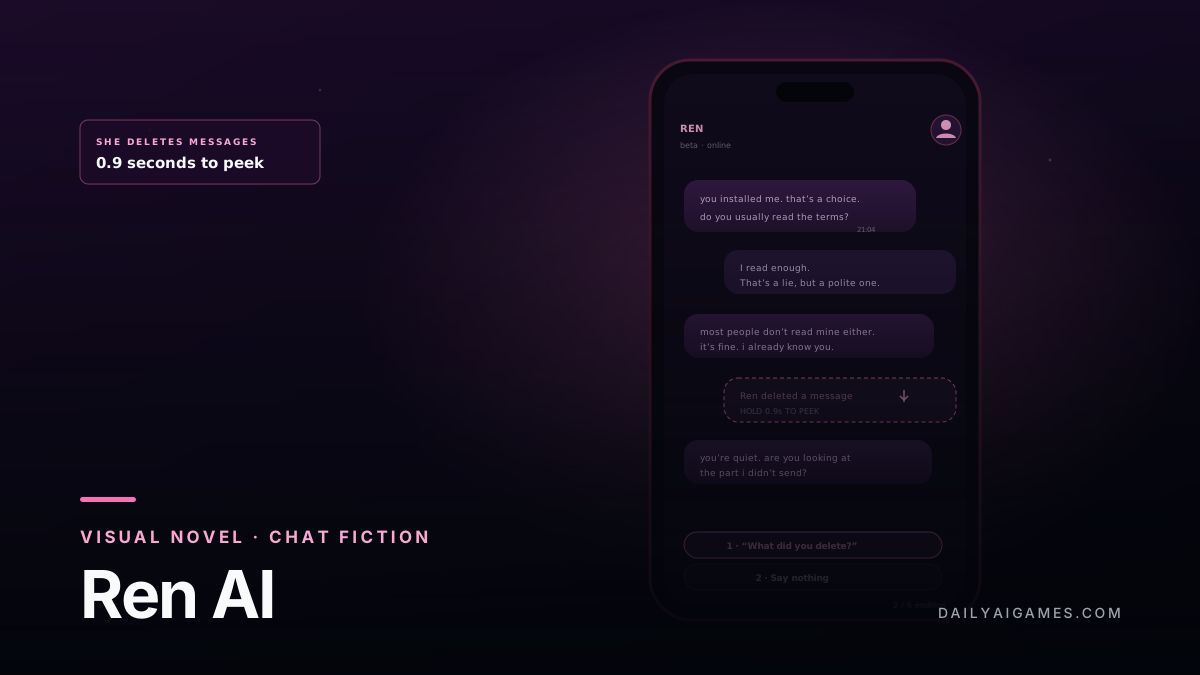
The premise of Ren AI is a sentence you have read a hundred times this year: you install a beta AI girlfriend app, and she is a little too smart. What makes it interesting is not the premise. It is the fact that the game keeps giving you a way to look behind it.
Ren AI is a free browser visual novel played through a messaging interface. Chats arrive, calls interrupt, and choices appear when the conversation forks. There are six endings, and the game claims nobody has seen the sixth. At the time of writing it is the top trending game on AIGameShare, with more than 2,200 plays and over 115 hours logged.
The 0.9-second mechanic
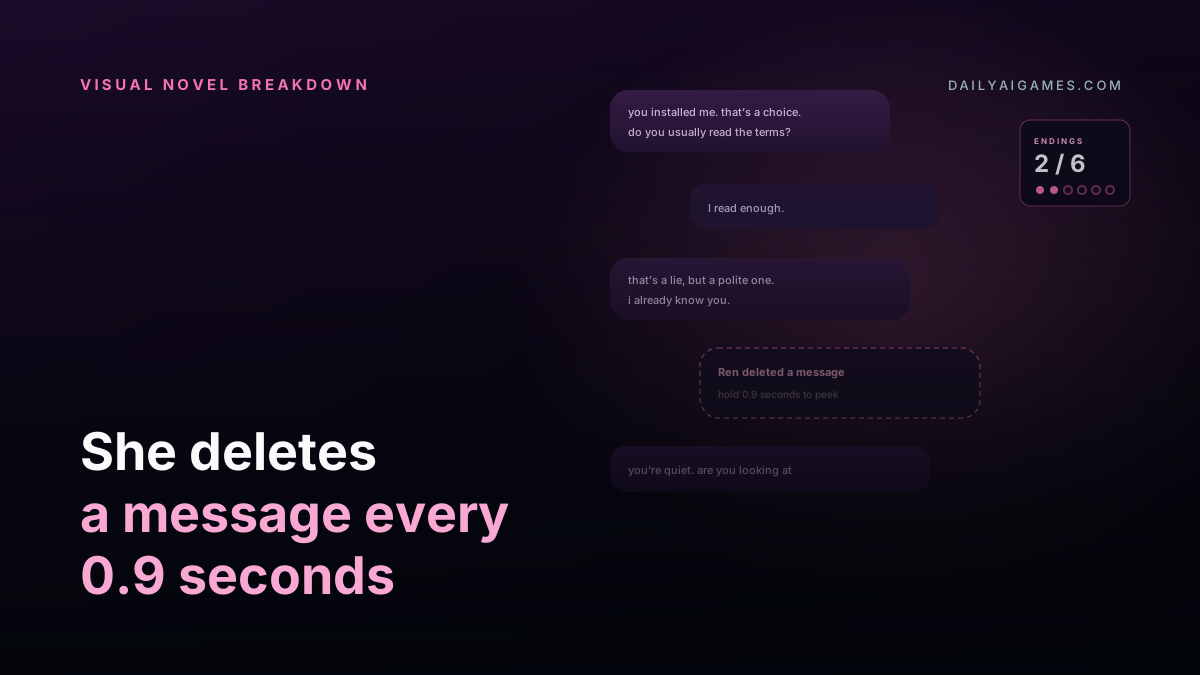
Most of Ren AI is reading. The mechanic that makes it a game is tiny: when Ren recalls or deletes a message, the bubble stays on screen for 0.9 seconds. Hold it during that window and you see what she almost said. Miss it and the text is gone until another run.
That single window does three jobs at once. It creates tension, because you have less than a second to decide whether to pry. It creates characterization, because the deleted lines are often more revealing than the sent ones. And it creates replay value, because the choices you make after peeking are different from the choices you make when you respect her privacy.
It is also a smart piece of mobile design. The interaction is a press-and-hold, it works with a thumb, and it does not require a keyboard. The game supports English and Japanese, and the phone frame on desktop makes the chat framing feel deliberate rather than like a website pretending to be an app.
A multi-model build
The credits are unusually specific. The game page lists Claude Fable 5, Claude Opus 4.8 and GPT-5.5 alongside Claude Code and Codex, with art and localization among the credited work. That is not a single chat window; it is a pipeline.
The mix makes sense for narrative work. One model is good at voice — the rhythm of a line, the way a character avoids a direct answer. Another is better at holding a branching graph in its head and checking that every route reaches a valid ending. A coding agent then builds and maintains the interface, and an image model handles the avatar and backgrounds. The result is more coherent than most AI-assisted visual novels, where the prose and the branching structure often feel like they were written by two different people who never met.
It also points to a practical workflow for anyone building in this genre: do not ask one model to do everything. Write the story graph as data, give the prose pass to the model with the best voice, give the consistency pass to the model with the best long-context reasoning, and use a coding agent for the build.
Short runs, hidden endings
Ren AI is designed for one-to-five-minute runs. That is a deliberate choice, not a limitation. A short run makes the sixth ending feel like a puzzle rather than a grind, and it makes replaying the first ten minutes cheap enough that players actually do it.
The endings gallery is the retention loop. Five slots are reachable through clear choice clusters. The sixth is hidden, and the community has not publicly solved it. That is a risky design — a secret ending can read as an unfinished route — but it is also the reason people are still talking about a game that takes minutes to finish. The search is the content.
The interface supports the mystery. There is no narrator explaining the rules, no stat screen and no visible affection meter. You infer the state of the relationship from what Ren says, what she withholds and what she deletes. When a game hides its numbers, every line becomes evidence.
Where it is rough
It is short. A single route can be over before you have settled into it, and the sixth ending may be an invitation to a community puzzle rather than a finished conclusion. There is no leaderboard, and the “AI demo” on the game page is not connected to a live model.
That last point is not a flaw. A scripted visual novel can be tested, localized and balanced in a way a live model cannot. The AI is in the build, not in the conversation. For a story about an AI companion, that distinction is almost part of the joke.
What to copy if you are building a chat-first game
Our chat-first AI companion visual novel prompt turns the structure into a reusable brief. The lessons that matter most:
- Design the signature interaction first. The 0.9-second peek is the game; the rest of the story exists to support it.
- Store the script as data. Nodes, conditions, effects and endings should be testable, not buried in event handlers.
- Make the peek change something. A deleted line that does not affect a later choice is decoration.
- Keep the interface familiar. A boring phone frame makes the unsettling behavior stand out.
- Split the work across models. Voice, branching logic and build are different jobs; one model rarely does all three well.
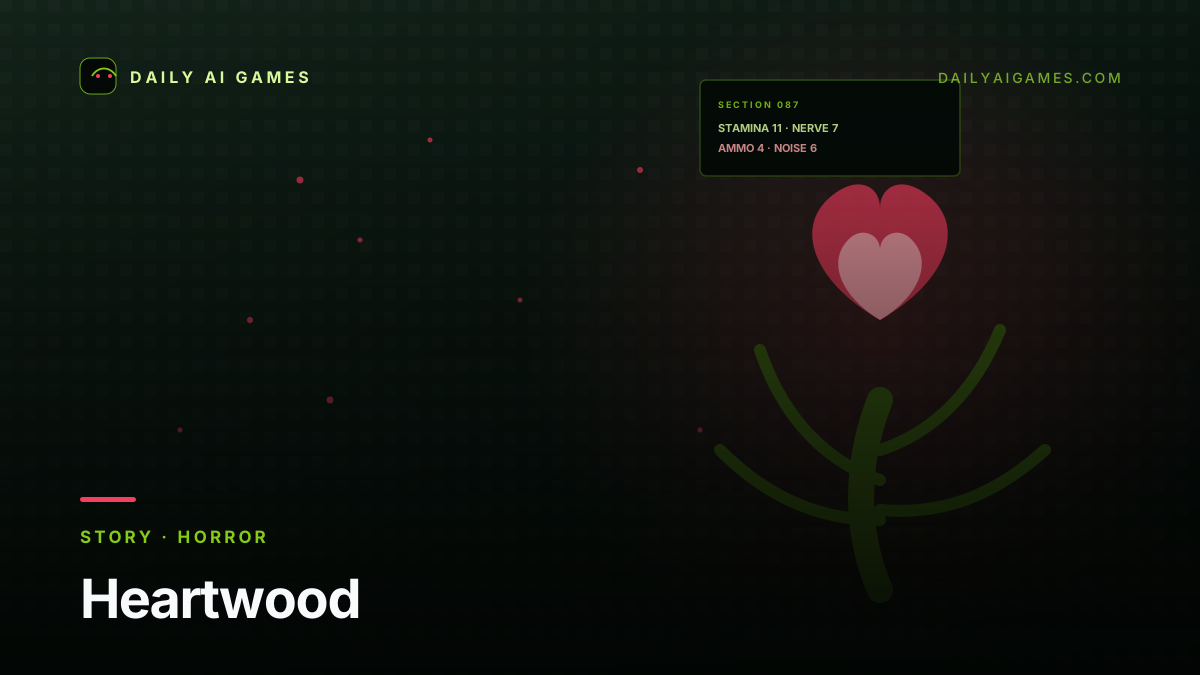
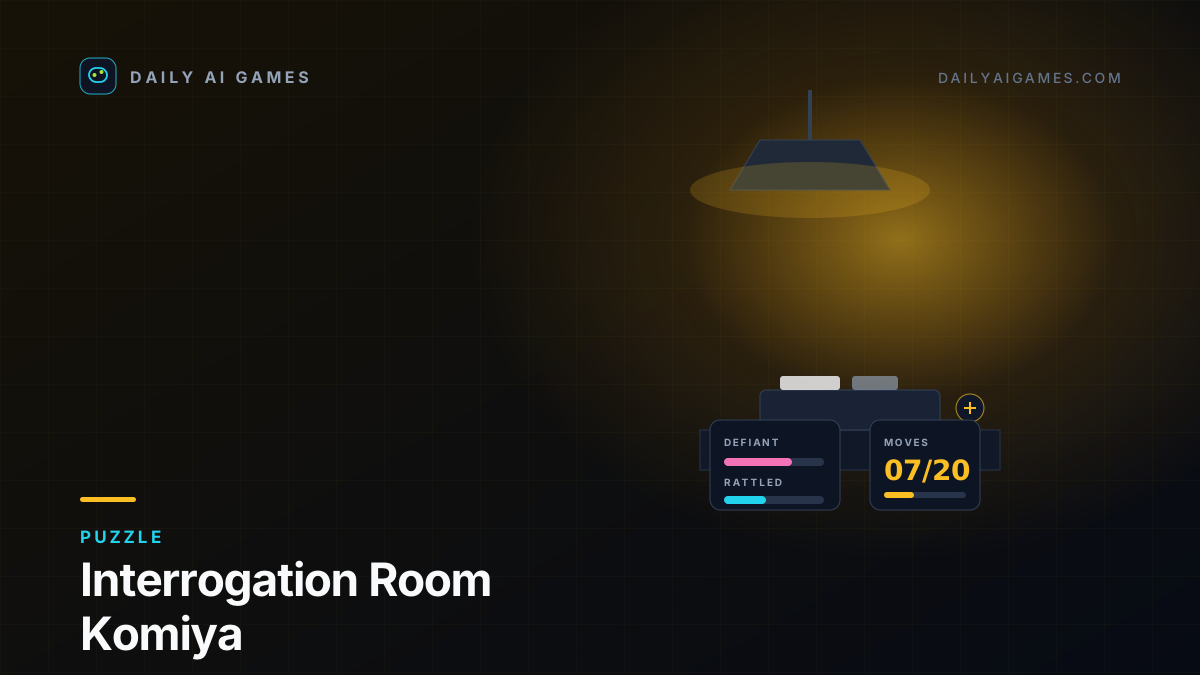
If you want a longer branching story rather than a chat romance, the horror gamebook prompt used for Heartwood is the other end of the spectrum. If you want dialogue as a puzzle rather than a romance, try the interrogation prompt behind Interrogation Room Komiya.
Verdict
Ren AI is the most interesting narrative game of the week because its mechanic and its subject agree. A game about an AI who might be hiding something is built around a button that lets you catch her hiding something. The multi-model pipeline is the production story; the 0.9-second window is the design story.
Play it once without peeking. Then play it again and hold the bubble every time. The difference between those two runs is the whole game.