THIMBLE KNIGHTS: Animal Card Battle Game
A real-time card battle in a sunlit garden, fought by squirrels in acorn caps and mice with bottle-cap shields. Build a deck, spend Honey, break three towers in three minutes.
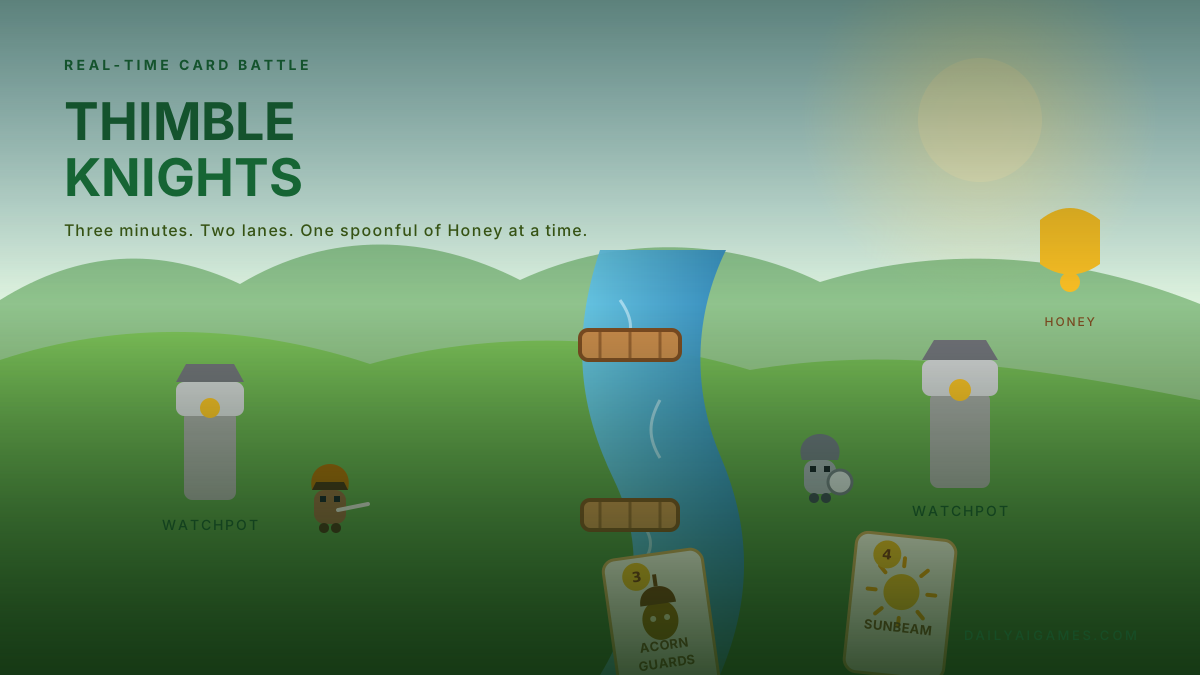
THIMBLE KNIGHTS: Animal Card Battle Game
Play on AIGameShareOpens aigameshare.com in a new tab · free · no download
178 plays tracked on Daily AI Games
External game siteTHIMBLE KNIGHTS: Animal Card Battle Game is not hosted on Daily AI Games. The button above opens an independently operated, free browser game on AIGameShare; its content, availability and controls are controlled by that site.
How to Play
Drag a card onto your half of the lawn, or tap a card and then tap a spot. Keys 1 to 4 arm the card in that slot; Escape disarms it. Spells can be placed anywhere. Each side has three towers: two Watchpots and a Queen's Stump. Win by holding more blossoms when time runs out, or by taking the Stump. Honey refills about every three seconds and doubles in the last minute.
These are the controls for THIMBLE KNIGHTS: Animal Card Battle Game. The external THIMBLE KNIGHTS: Animal Card Battle Game version on AIGameShare may use slightly different controls.
Game Preview
About THIMBLE KNIGHTS: Animal Card Battle Game
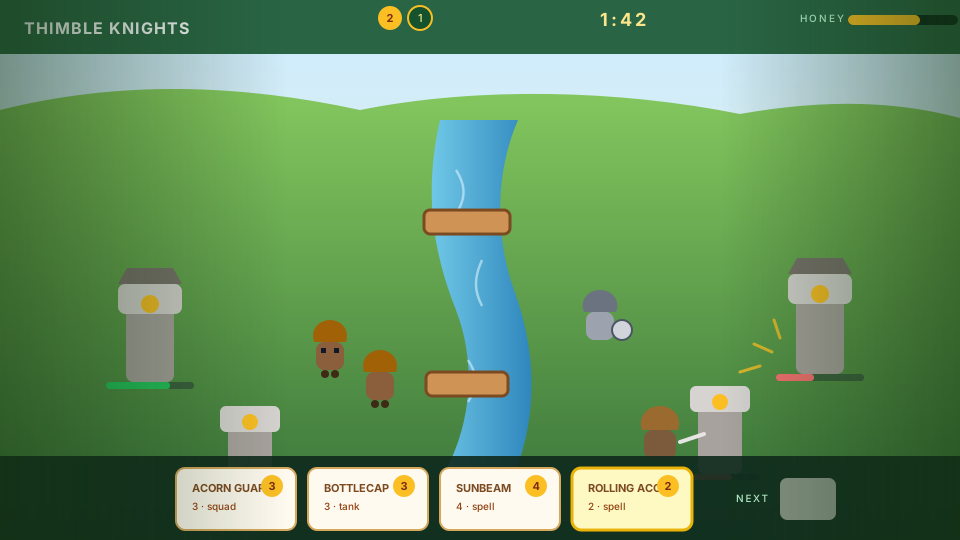
Thimble Knights is a real-time card battle game set in a garden seen from ankle height, and the setting does more work than it first appears. You hold four cards from a deck of eight, spend Honey as it drips in, and drop woodland animals and garden disasters onto your half of the lawn. The rival has a named deck, a temper and a plan. Squirrels in acorn-cap helmets block lanes, a mouse knight with a bottle-cap shield holds a bridge, hamsters spit seeds at flyers, and a boar wearing a walnut shell ignores everything except your towers. It is the most charming strategy game on the platform right now, and the charm is attached to a genuinely tight system.
Each side has three towers: two Watchpots guarding the lanes and a Queen's Stump at the back. Every tower you destroy earns a blossom, and taking the Queen's Stump ends the match with all three. The lawn is split by a brook with two bridges, so ground troops must cross at those points while flyers go over anywhere — which turns every placement into a question about which bridge you are defending. Destroying an enemy Watchpot opens a strip of their half on that side, shortening your next push. Spells can land anywhere: a magnifying-glass Sunbeam burns a circle after a short delay, a Rolling Acorn bowls down a lane, and both are brutal against troops and weak against towers.
The clock is the other half of the design. Regulation time is three minutes. The last minute is Golden Hour, when Honey arrives twice as fast, so saving a little before it starts lets you play two cards back to back. If the match is level on blossoms when time expires, it goes to Dusk: one more minute of sudden death, and the first tower to fall wins. Honey accelerates again, and the final thirty seconds run at triple speed. It is a clean answer to the classic real-time card problem — matches end on time, and the ending is a crescendo rather than a stalemate.
Progression runs through trophies and six gardens, from Clover Patch up to Moonlit Garden. Every rival you meet has its own deck and behaviour, wins pay gold and card copies, and a seed pod opens after each victory with one free pod a day. Cards level up, so the deck you bring to Moonlit Garden is measurably stronger than the one you started with. You can play as a guest; signing in keeps your progress between visits.
Controls work on both desktop and phone. Drag a card onto the lawn, or tap a card and then tap a spot; keys 1 to 4 arm a card on a keyboard, and Escape disarms it. The battlefield is laid out for portrait screens, and the first match is coached, with the rival going easy. After that, it does not. Thimble Knights was created by nilni and built with Claude Fable 5.2. At the time of writing it had 178 plays and 4 hours 20 minutes of tracked play on AIGameShare, and it is the rare browser card game that fits a full strategy loop into a coffee break.
How This Game Was Generated
Created by nilni and built with Claude Fable 5.2. The game ships an eight-card deck with four cards in hand at a time, a Honey economy that drips in roughly every three seconds, two lanes split by a brook with two bridges, three towers per side, a three-minute clock with a Golden Hour double-Honey finale and a sudden-death Dusk, six gardens of named rivals with their own decks, card levelling, trophies and daily seed pods. At the time of writing it had 178 plays and 4 hours 20 minutes of tracked play on AIGameShare.
The Prompt Behind This Game
Show the prompt used to generate THIMBLE KNIGHTS: Animal Card Battle Game
Build a real-time card battle game in ONE self-contained HTML file (inline CSS/JS, DOM or Canvas). No external assets: all art is inline SVG or CSS shapes.

Match structure:
- Two sides, three towers each: two lane towers and one Queen's Stump at the back. Six towers total, symmetric layout.
- Two lanes split by a river with exactly two bridges. Ground units may only cross at bridges; flying units cross anywhere.
- Three minutes of regulation time. Destroying the Queen's Stump ends the match immediately and awards all three towers. Otherwise the side with more towers destroyed wins on time.
- Last 60 seconds is Golden Hour and income doubles. On a tie, go to Dusk: 60 seconds of sudden death, first tower to fall wins, with the Honey rate doubling and then tripling in the final 30 seconds. If nothing falls in Dusk, the side whose weakest standing tower has more health wins.
Economy:
- Honey resource: start 5, cap 10, +1 roughly every 3 seconds. Put the exact drip interval in one constant at the top of the file.
- Deck of 8 cards, hand of 4, played card goes to the back of the cycle, next card always visible.
- Troops take 1 second to arrive, shown as a spawn ring, so the player places before they need to.
- Cards must be data-driven in one table, with at least: 3-cost squad blocker, 3-cost single tank, 3-cost ranged pair that can hit flyers, 3-cost flying squad, 5-cost building-only ram unit, 3-cost ground-only splash unit, 4-cost delayed area spell that is strong against troops and weak against towers, 2-cost rolling lane spell that pushes ground units back.
- Every card has cost, type (troop, building, spell), targeting rule (ground only, air and ground, buildings only, anywhere), health, damage, speed, range and deploy time in that table.
Rival AI:
- Named rivals with their own 8-card decks and one behavioural tendency each: rusher, defender, spell-heavy, split-pusher.
- The AI may place cards on its own side only, must answer the player's committed troops, and must spend Honey instead of sitting at the cap.
- The AI reads only what a human could see. No hidden information, no cost discounts.
- The first match is coached and the rival deliberately plays badly.
Progression (light but persistent):
- Six garden tiers unlocked by trophies. Each win gives gold, card copies and a seed pod; one free pod per day. Card levels are small capped numeric upgrades to health and damage.
- Persist progress in localStorage and allow guest play without saving.
Controls and UI:
- Drag a card onto the lawn, or tap a card then tap a target. Keys 1-4 arm a card; Escape disarms.
- Spells target anywhere; troops and buildings only on your own half. Destroying a lane tower opens the corresponding strip of the enemy half to deployment.
- Portrait-first layout, 44px minimum touch targets, readable at 360px width. Show tower health, blossoms, the Honey bar, the next card and the clock at a glance.
Balance and testing:
- Run 500 headless AI-vs-AI matches per rival pairing and report: average match length, win rate by rival, share of matches decided in Golden Hour or Dusk, cards never played, and average Honey wasted at the cap.
- Fail the build if any rival win rate falls outside 30-70% against the baseline deck, or if a card is played in under 2% of matches.
Deliver in stages: lanes, towers and Honey first, then card placement, then combat and spells, then the clock and Dusk, then the rival AI, then progression. Print the card table and the balance report at the end.
Open in the prompt library for tips and variations
Similar AI Games
 Action Games
▶ 752 plays
CINDERDEEP: Falling Sand Roguelike
A falling-sand roguelike where every pixel of the cave is simulated. Burn, freeze, dissolve and flood your way through five depths with a four-spell wand.
Play now
 Action Games
▶ 504 plays
Glow Squad
A cartoon auto-survivor where you only move and dash. Bolts, satellites and random ultimates fight for you, and wounded bosses heal and grow stronger every 15 seconds.
Play now
 Action Games
▶ 374 plays
SOLMERE SOULS: Pixel ARPG
A pixel-art action RPG dungeon crawler with four classes, four chapters, soul-binding bosses and five loot rarities — built to be finished in a browser tab.
Play now
 Action Games
▶ 294 plays
Baize Monster Bonk
A 3D survivors roguelite drawn from the Classic of Mountains and Seas — auto-attacking beasts, seal-ring taming and a five-element wheel that chains elements.
Play now
Articles About THIMBLE KNIGHTS: Animal Card Battle Game
Nov 12, 2026
THIMBLE KNIGHTS: A Three-Minute Card Battle Fought by Garden Animals
Thimble Knights puts squirrels in acorn helmets and a Honey economy on a three-minute clock. We break down why this tiny card battle plays bigger than it looks.
Oct 19, 2026
AI-Generated Browser Games Worth Knowing: October–November 2026
From a 12-hour sports hit and a weekend MMO to fifteen new browser games — a tin-toy kart racer, a spherical sailing sim, an art-print surf run and more.
Oct 15, 2026
The 10 Best AI Games to Play Online Free
Ten AI-generated games you can play online free right now — arcade, puzzle, strategy and endless runners, all built from text prompts and playable in your browser.
