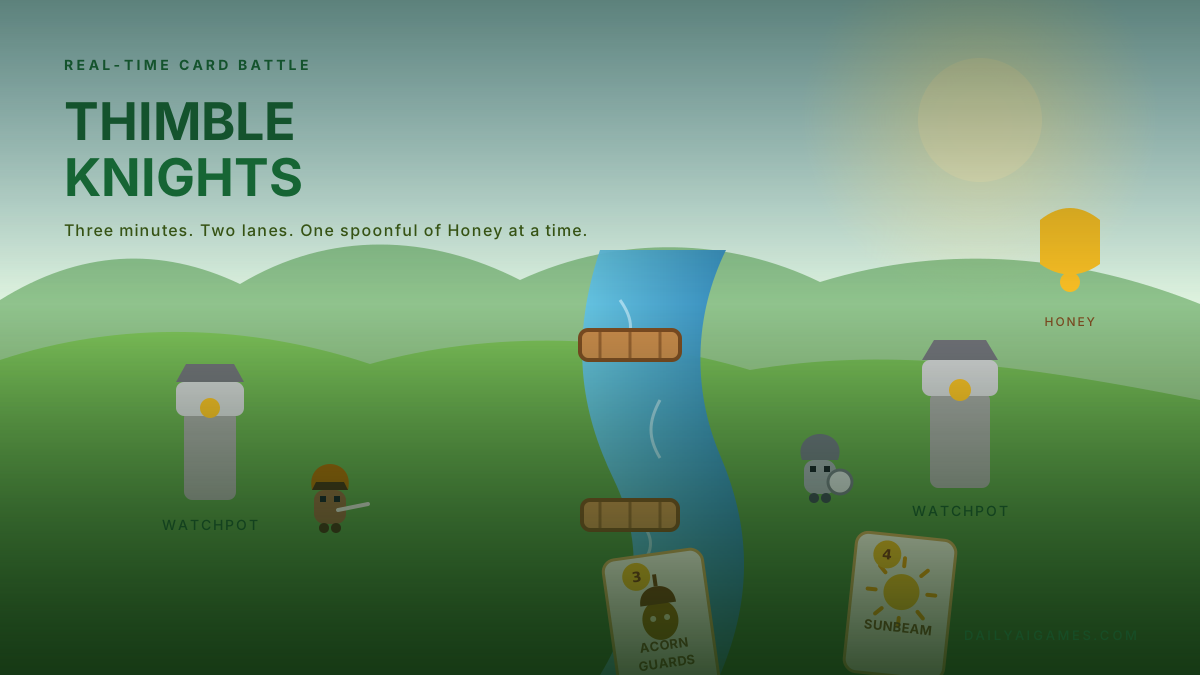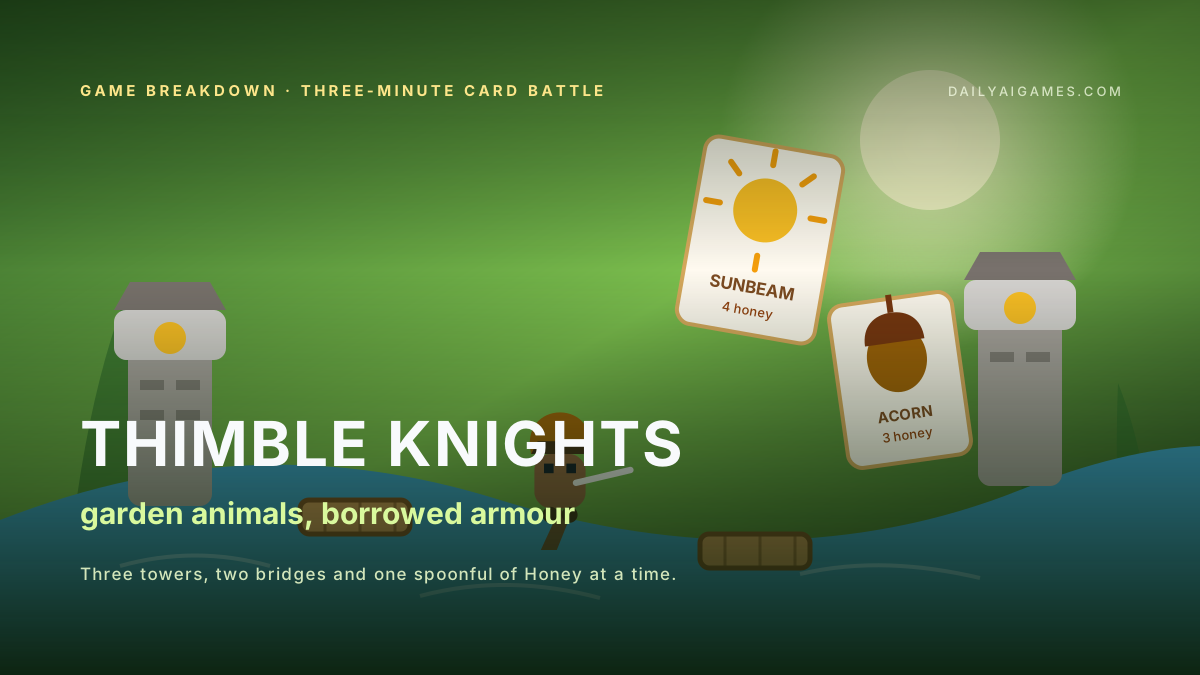
The pitch for THIMBLE KNIGHTS is a sentence you either buy immediately or do not: a real-time card battle in a garden, fought by woodland animals wearing things people dropped. A squirrel in an acorn-cap helmet. A mouse knight behind a bottle-cap shield. A boar with a walnut shell on its head that only wants to hit your buildings. It is charming, and the charm is load-bearing, because underneath it is a genuinely tight three-minute strategy game.
At the time of writing Thimble Knights had 178 plays and 4 hours 20 minutes of tracked play on AIGameShare, and it was published on November 11, 2026. It is early, but the design is not tentative. This is a game with a clock, an economy and a lane structure that all point at the same conclusion: matches should end, and they should end loudly.
Three towers, two lanes, one brook
Each side has three towers: two Watchpots guarding the lanes and a Queen’s Stump at the back. Every tower you destroy earns a blossom. Taking the Queen’s Stump ends the match immediately and awards all three, which means the game has a knockout and a points victory at the same time.
The lawn is split by a brook with exactly two bridges. Ground units must cross at a bridge; flyers go over anywhere. That single constraint does most of the tactical work. You are not defending a wide front — you are defending two crossings and a back line, and every ground card you play is a statement about which bridge you are willing to lose.
Killing an enemy Watchpot opens a strip of their half on that side, so the lane gets shorter for your next push. That is a nice piece of escalation: the first tower does not just score a point, it changes the geometry of the match.
Honey, and the clock as a resource
Honey is the only resource. You start with five, cap at ten, and gain roughly one every three seconds. Cards cost between two and five, so the economy is legible at a glance and the interesting decision is not “can I afford this” but “is this the right moment”.
Then the clock starts doing things. Regulation is three minutes. The last minute is Golden Hour, when Honey arrives twice as fast — so saving a little before it starts lets you play two cards back to back, and dumping everything at 2:01 is a real mistake. If the match is level on blossoms at zero, it goes to Dusk: one more minute of sudden death, first tower to fall wins, with Honey accelerating again and running at triple speed for the final thirty seconds.
This is the cleanest answer I have seen to the classic real-time card problem, which is that matches either end too early or drag. Golden Hour gives the last minute a crescendo, and Dusk guarantees a resolution. The tie-breaker after Dusk — the side whose weakest standing tower has more health wins — is a bit of a technicality, but it almost never comes up.
Eight cards, four in hand
The deck is eight cards, the hand is four, and a played card goes to the back of the cycle with the next card always visible. That is a small enough pool to learn in one match and deep enough to reward sequencing.
- Acorn Guards (3): three squirrels with toothpick spears, cheap blockers that chip at towers.
- Bottlecap Knight (3): one high-health mouse that holds a lane while your ranged cards work.
- Cheek Shooters (3): two hamsters spitting seeds, the answer to flyers and ground alike.
- Sparrow Squad (3): three fast flyers that skip the bridges.
- Boar Ram (5): a slow, tough unit that only attacks buildings, so it needs a screen.
- Berry Bomber (3): a raccoon lobbing berries at groups, ground only.
- Sunbeam (4): a magnifying glass that burns a small circle after a delay, brutal on troops and weak on towers.
- Rolling Acorn (2): a long roll down a lane that damages and pushes back ground units; flyers ignore it.
The targeting rules are where the mind games live. Berry Bomber and Rolling Acorn cannot touch air. Sunbeam clears a squad but barely scratches a tower. Boar Ram will walk past your entire army to hit a building. Every card has a clear answer, and the game is about whether you have it in hand when the answer is needed.
Rivals with names and tempers
Progression runs through trophies and six gardens, from Clover Patch up to Moonlit Garden. Each rival you meet has its own deck and its own tendency, so the match-up changes as you climb. Wins pay gold and card copies, and a seed pod opens after each victory with a free one each day. Cards level up in small capped increments, which gives the ladder a sense of accumulation without turning into a grind.
The first match is coached and the rival goes easy on you. After that it does not, and the difficulty curve is mostly about learning what each rival is willing to spend Honey on.
There is one thing worth flagging: the AIGameShare listing tags the game as multiplayer, but what I played was a single-player ladder against AI rivals with emotes. Treat the “multiplayer” label as aspirational rather than a promise of live opponents.
Controls on phone and desktop
The game is portrait-first, which is the right call for a browser card game. Drag a card onto your half of the lawn, or tap a card and then tap a spot. Keys 1 to 4 arm a card on a keyboard, Escape disarms. Spells can be placed anywhere; troops and buildings only on your own half. The 44-pixel touch targets and the readable board at 360 pixels wide are the difference between a game you can play on a commute and one you cannot.
Guest play works without an account. Signing in keeps progress between visits, which matters once you are three gardens deep.
What AI got right, and where it is thin
Thimble Knights was created by nilni and built with Claude Fable 5.2. The AI-generated part is less visible here than in a 3D game, and that is a compliment: the art is simple, consistent and doing a job. What is impressive is the systems coherence. The three-minute clock, the Honey rate, the two-bridge map and the eight-card deck all fit together, and none of them feels like a default.
The limits are the usual ones for an early browser card game. Eight cards is a small meta, and a few of them are clearly role-players rather than build-arounds. The single-player ladder means the ceiling is the AI’s behaviour, not another human’s. And the presentation, while charming, has very little animation — most of the character comes from the card names and the setting rather than motion.
But the core loop is already good. A three-minute match, a clear reason for every card, and a clock that makes the last minute matter is a stronger foundation than most card games ship with.
What to copy if you build one
Our real-time card battle prompt is the reusable version of this build. The decisions worth stealing:
- Make the clock part of the design. Golden Hour and Dusk give the final minute a shape instead of just ending the match.
- Restrict ground units to bridges. Two crossings create lane decisions without needing three lanes.
- Split targeting rules between troops and spells. Spells anywhere, troops on your half — range without losing the positional game.
- Keep the deck small enough to learn in one match. Eight cards with four in hand is a tutorial that fits inside a single game.
- Audit cards that never get played. In an eight-card deck, one dead card is an eighth of the design doing nothing.
If you want to see the same studio working at a much larger scale, CINDERDEEP applies the same systemic thinking to a falling-sand roguelike, and our falling-sand roguelike prompt breaks down how the material simulation is structured.
Verdict
Thimble Knights is a small game with a clear idea: take a card battle, shrink it to three minutes, and give it a garden full of animals wearing human junk. It works because the shrinking is not cosmetic. The clock, the Honey economy and the two-bridge map are all designed for the length of a browser session, and the result is a strategy game you can finish before your tea goes cold.