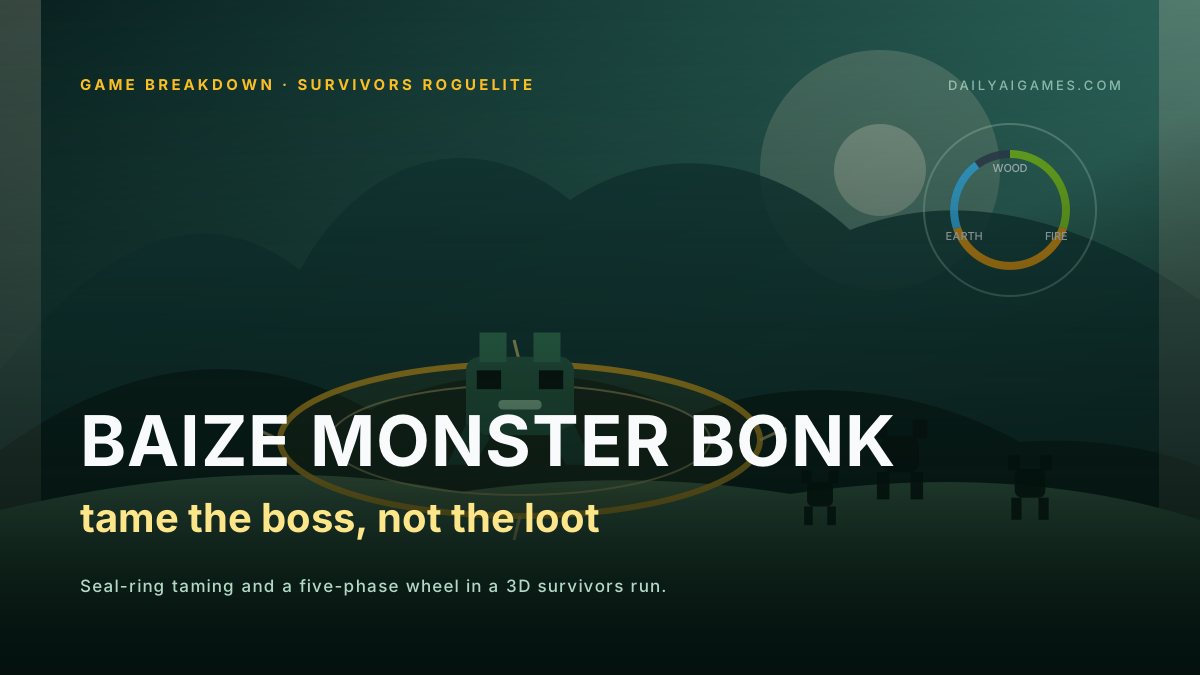
Survivors games have a content problem. Once you have seen the level-up cards, the next run is mostly the same run with different numbers. Baize Monster Bonk solves it with a mechanic that most survivors games skip entirely: instead of collecting loot after a fight, you tame the monster that was trying to kill you.
At the time of writing the game had 294 plays and 24 hours 29 minutes of tracked play on AIGameShare. That is an average of about five minutes per play, which is unusually long for a browser game and the clearest evidence that the loop holds attention.
The survivors part
You play a small pixel beast from the Classic of Mountains and Seas, the ancient Chinese bestiary, and walk into a living blue-green landscape scroll. Your moves fire on their own. You run, jump and slide through swelling hordes, collect orbs, and pick a card every time the level bar fills. A run crosses three zones of a region and ends at a Sanctuary, where a divine beast guards the exit gate.
The familiar systems are all here. Level-ups pause the action and offer cards: new moves, move upgrades, elixirs and training. Chests cost shells and get more expensive with each purchase. Talisman steles and fruit trees offer optional risk-reward interactions. An ultimate meter charges as you fight. It is a complete survivors game, and it would be a competent one even without its twist.
Taming is a hold, not a roll
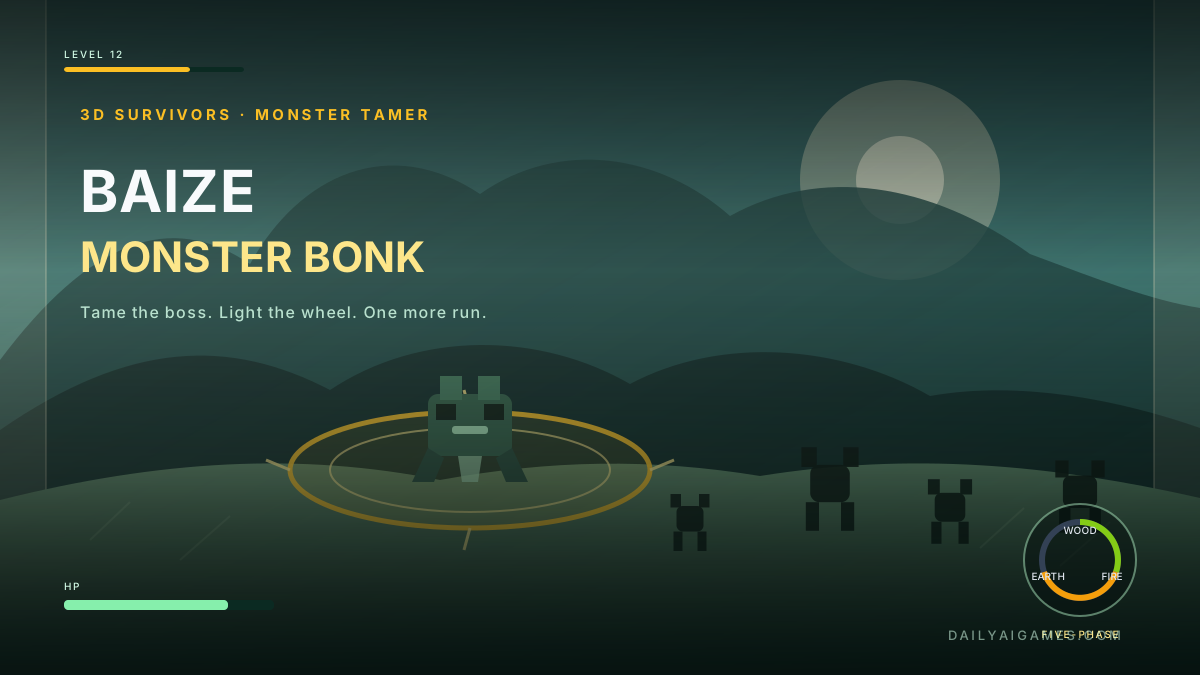
The twist is the seal ring. When a horde leader goes down, it does not die. It lies there for about eight seconds while a golden ring opens beneath it. Step inside and a read bar fills over three to six seconds, depending on the beast. The crowd rushes the ring to knock the bar back. Leave the ring and it drains. If the read breaks, the leader stands back up at 30% health and you have to put it down again; after three failures it flees.
Two details make this work. First, it is deterministic. There is no capture percentage and no random roll — if you hold the ring, you get the beast. That changes the emotional texture of the mechanic entirely. You are not hoping; you are defending a position. Second, the pressure comes from the crowd, not from a timer. Taming becomes a small tower-defence problem in the middle of a survivors run: clear the ring, start the read, keep the swarm off it, and decide whether the beast is worth the health you are about to lose.
Every tamed beast adds an ally and an element. The collection persists between runs, so the roster grows even when a run ends badly.
The five-phase wheel
The element system is the second layer. Beasts carry one of five phases: Wood, Fire, Earth, Metal and Water. Each generating link — Wood feeds Fire, Fire feeds Earth, Earth feeds Metal, Metal feeds Water, Water feeds Wood — lights when both ends are in your pool of your own beast plus your allies. Light all five links and the wheel turns, boosting link effects, accelerating your ultimate and sending a visible pulse ring out around you.
Elements also modify combat. Attacks that overcome an enemy element hit harder; resisted ones hit weaker. That makes the wheel a planning tool rather than a passive buff. When you choose a leader to tame, you are not just collecting a creature — you are deciding which link you can light and which enemies you will struggle against. The HUD shows lit and unlit links, so the reasoning is visible instead of hidden in a stats screen.
Cards, chests and the Academy
The run economy has more friction than most browser survivors games, in a good way. Reroll, skip and banish each have limited charges. Banishing a card removes it from future offers for the rest of the run, which lets you shape a build instead of accepting whatever appears. Chests cost shells and the price climbs as you buy, so every purchase is a bet on whether the next chest is better than a level-up. Spirit ink earned in runs buys permanent Academy upgrades, and medals mark strong clears.
There are two regions at launch — the Eastern and Western Mountains — each with three zones and a Sanctuary guardian, plus the Azure Dragon and the White Tiger waiting at the end. Three difficulties change enemy density and damage. With 33 collectible beasts for the Baize Scroll and three starter beasts (Luzhu, Bifang and Xuangui), there is more long-term structure here than the browser-survivors genre usually offers.
What it gets right, and where it is thin
The strengths are the taming loop and the element wheel. Both are readable in motion, both create decisions that are specific to this game rather than borrowed from Vampire Survivors, and both give the run a shape beyond “keep walking away from the horde”. The pixel-art beasts against the painterly scroll background also give it a visual identity that most AI-generated survivors games lack.
The weaknesses are the usual ones. The camera can fight you in dense crowds, the mobile layout is functional rather than elegant, and 33 beasts is a promise that the balance cannot fully keep — some will inevitably be better than others. The English localisation is serviceable but not the reason to play.
What to copy if you build one
Our 3D survivors monster taming prompt covers the tamable-boss structure, and the survivors card draft economy prompt breaks down the reroll/banish system separately. The decisions worth stealing:
- Make taming deterministic. A hard hold with clear rules is more satisfying than a capture chance.
- Put the pressure inside the ring window. The crowd is what turns taming into a positioning puzzle.
- Show why a synergy link is lit. Visible causality is what makes an element wheel a plan instead of a buff.
- Limit banish charges. Unlimited removal turns a draft into a shopping list.
- Persist the collection. Tamed beasts carry across runs, so a failed run still advances something.
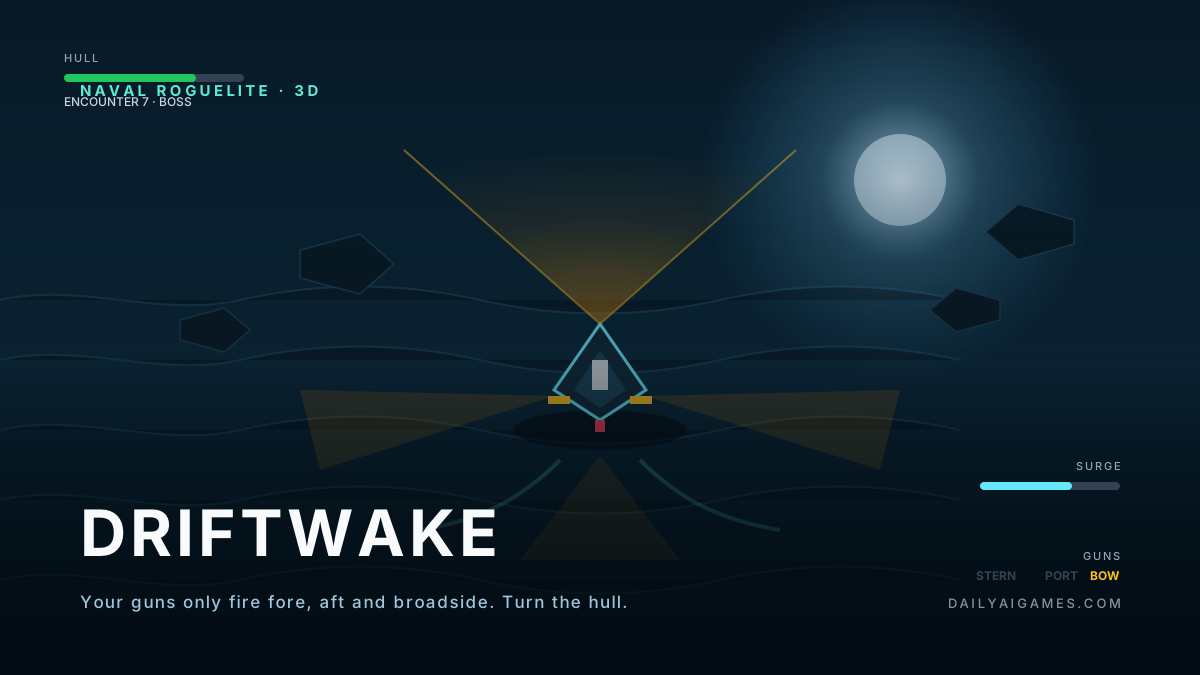
If you like the idea of a run-based game built around one unusual constraint, Driftwake does for naval combat what Baize does for taming — fixed firing arcs turn positioning into the whole skill — and the naval roguelite boss fleet prompt explains how that constraint was designed.
Verdict
Baize Monster Bonk is the rare AI-generated survivors game with an idea of its own. The tame-the-boss loop and the five-phase wheel give every run a decision that is not just “pick the bigger damage card”, and the five-minute average session says the loop is doing its job. Start with the Eastern Mountains, learn to clear the ring before you start the read, and let the wheel do the rest.