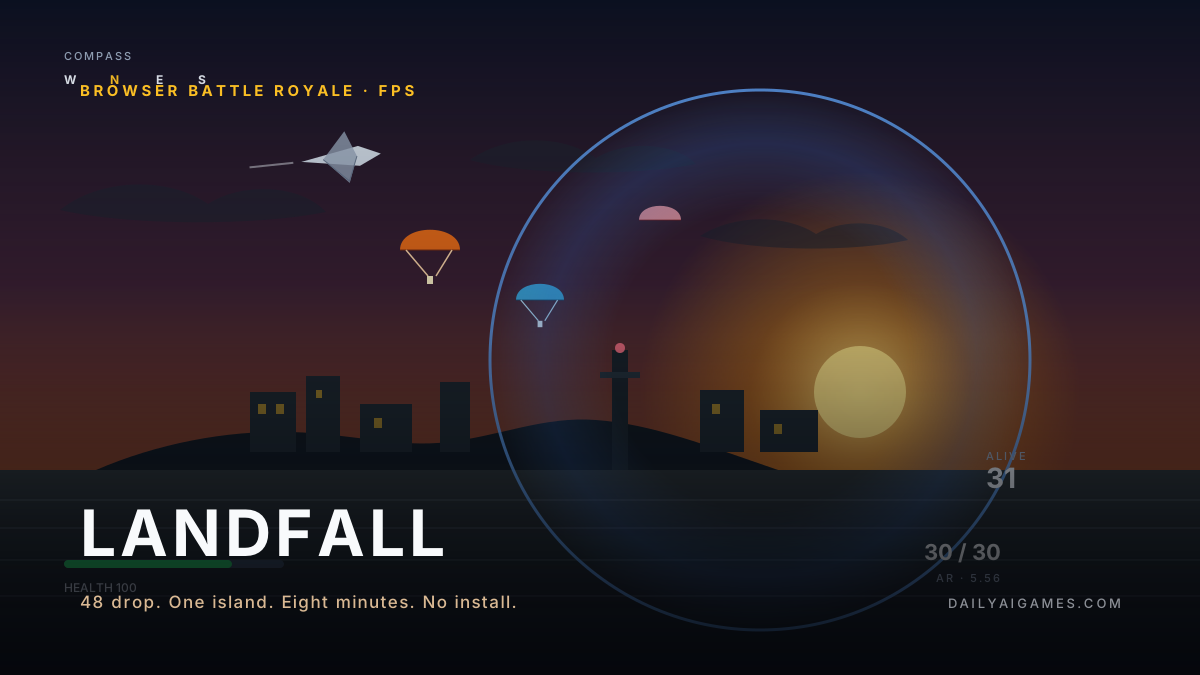
A tactical shooter asks for three things a browser is historically bad at: precise mouse aim, convincing cover geometry and enemies that behave like a squad rather than a shooting gallery. Blackline: Strike does all three in a tab, with no install and no loading screen worth mentioning. It is not the first browser FPS we have covered — LANDFALL built a whole battle royale in one — but it is the first one that feels like it wants to be played slowly.
At the time of writing Blackline: Strike had 328 plays and 7 hours 33 minutes of tracked play on AIGameShare, with 286 plays in the last 30 days. It was updated on 3 November 2026, and the current build is the one worth playing.
A market street instead of a lobby
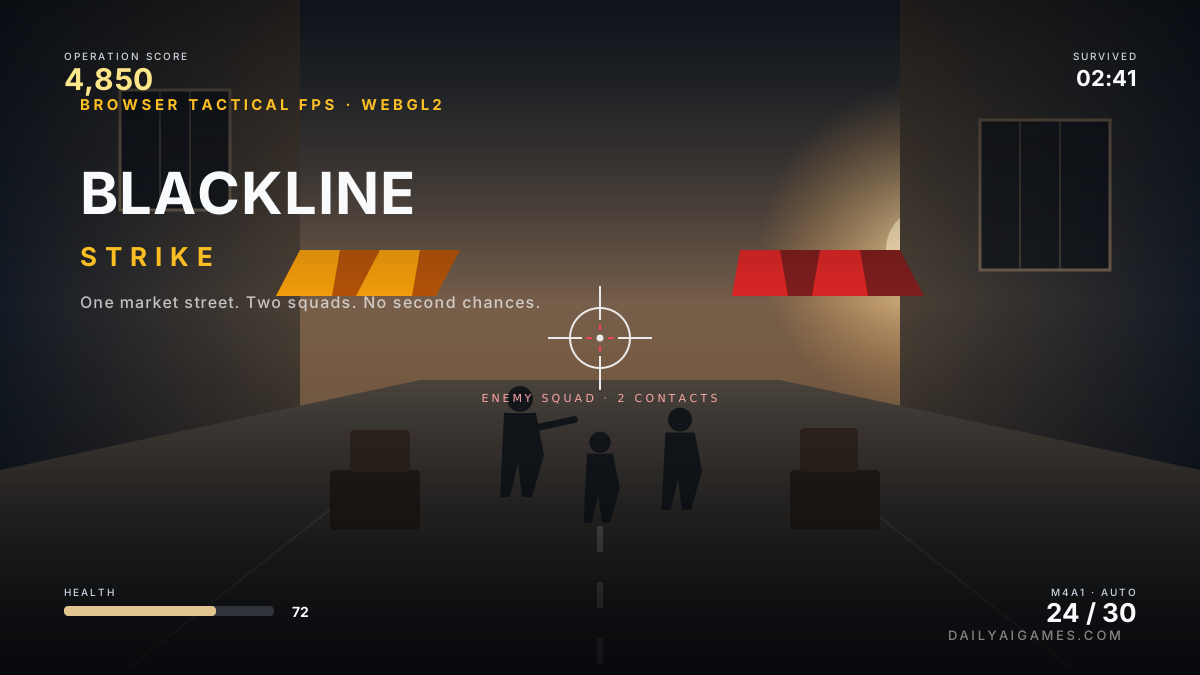
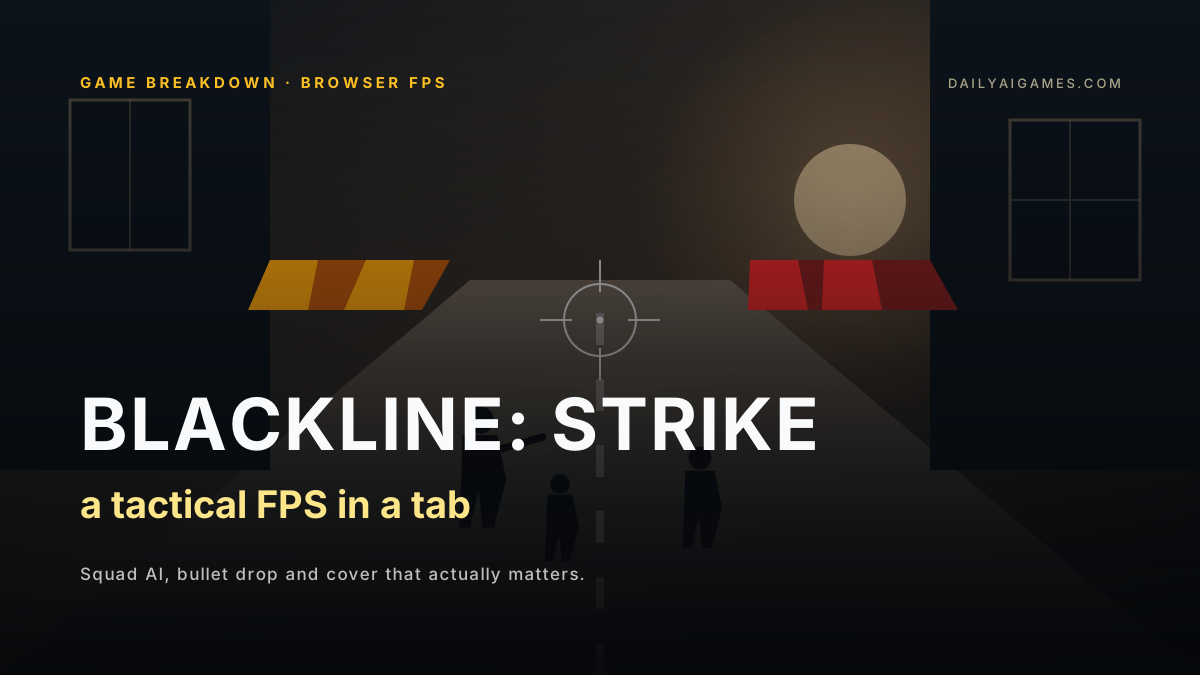
There is no menu, no plane, no lobby. You spawn at one end of a market street of roughly 150 to 200 metres, with stalls, awnings, sheet-metal walls, crates and two enterable shops. Two four-man squads are active. Kill them, survive, and the operation score climbs until you go down.
That scope is the smartest decision in the build. A battle royale needs a map big enough to hide in; a tactical shooter needs a map small enough that every angle is learnable. A single street gives Blackline: Strike both: enough cover to flank through, but a short enough sightline that you can learn where the fights happen after three runs.
The squad is the enemy, not the soldier
The most important detail is that contact is a squad event. When one soldier spots you, the squad calls it out and transitions together — one suppresses from cover, another flanks, a third holds an angle. They do not all rush, and they do not stand in the open trading shots. They reload, they retreat, and they make you move.
That behaviour is why the game rewards patience. Standing still and out-shooting four enemies is a losing plan; breaking line of sight, repositioning and taking one angle at a time is the winning one. The AI is not trying to be human. It is trying to make the street feel occupied by a unit, and it succeeds often enough to change how you play.
The bots still have tells. A patient player will learn the flank timing, and the illusion thins on the fourth or fifth run. That is the same trade-off LANDFALL makes with its 47 bots: a browser game without a server can fake a squad, but it cannot surprise you forever.
Ballistics, cover and the value of a wall
Bullets have travel time and drop, and thin cover is a suggestion. Sheet metal and market stalls reduce damage and can be penetrated; stone and engine blocks stop a round. The game communicates the difference with impact decals and material-specific hit sounds, which matters more than it sounds like it should: players learn what a wall is made of by hearing it get shot, not by reading a damage number.
There are three weapons. The M4A1 rifle has auto, burst and semi modes and a recoil pattern that climbs the same way each time, so you can learn to pull against it. The MPX-9 SMG fires faster with more spread and suits doorways. The P-19 pistol is the precise, low-ammo fallback. There are no health pickups; get out of sight for a few seconds and you regenerate. That single rule turns cover from a shield into a reset button, and it is the reason the game has a rhythm instead of a health-bar grind.
Scoring that rewards survival
The score model is deliberately blunt: 500 points per elimination, 150 for a headshot, 10 for every second you stay alive. Survival scoring changes the calculus. A safe body shot from behind cover can be worth more than a risky head peek, and a run that avoids a fight to reach a better angle is not cowardice — it is the correct play.
A Field Report at the end shows eliminations, time survived and accuracy. The leaderboard was not live at the time of writing, but the run structure is already complete without it: one more attempt is always one click away.
A street with no art files
The production is the quiet technical story. Every piece of geometry, every texture, the animation and the audio are generated in code or with WebAudio. There are no external art assets at all, which is why the game opens almost instantly despite looking like a small 3D level rather than a flat canvas demo.
That constraint shapes the look. The street is lit by one late-afternoon sun, with long shadows and warm light on corrugated walls, and the enemies wear dark fatigues so they read against the warm background. One time of day, one palette, one job for the art: make the silhouette readable. It is the same lesson LANDFALL teaches with its dusk island — a single lighting setup looks better and costs less than a day-night cycle.
Where a browser FPS still stops
The caveats are real. The street is one street; after a dozen runs you know every piece of cover. The squads are bots, there is no matchmaking and there is no anti-cheat because there is nothing to cheat against. The mobile layout works — left stick, drag-to-aim, large buttons — but a phone will never give you the precision the shooting model invites.
Performance is the other limit. Procedural geometry with interiors, projectiles and four active enemies is a lot to ask of a browser, and the game lowers its own resolution when the frame rate drops. It runs; it will not run equally well on every laptop.
What to copy if you build one
Our browser tactical FPS squad prompt is the reusable version of this build, and the procedural WebGL street level prompt covers the environment pipeline separately. The decisions that matter most:
- Make contact a squad event. Shared transitions and callouts are what turn four bots into a unit.
- Use regenerating health with a delay. It forces movement and makes cover a reset, not a shield.
- Penetrate thin cover, block thick cover, and make the difference audible. Material rules should be learnable without a manual.
- Score survival. It gives a tactical shooter a reason to retreat that is not just self-preservation.
- Pick one time of day and build the palette around readability. One sun, one silhouette language, less cost.
If you want the large-scale version of this problem, the 48-player battle royale prompt behind LANDFALL is the other browser FPS worth studying — and a reminder that scope is a staging problem, not a token budget.
Verdict
Blackline: Strike is not a replacement for a full tactical shooter, and it does not pretend to be. What it proves is narrower and more useful: a browser tab can hold squad AI, projectile ballistics, penetrable cover and a score-attack loop that makes you want to reset the run. Play it with headphones, learn the street, and take the fight one angle at a time. The fourth run is where it clicks.