Take a twin-stick shooter, replace the character with a warship, and then refuse to let the player aim. That is Driftwake in one sentence, and the refusal is the best design decision in it.
You can play Driftwake on AIGameShare now. It is a 3D naval roguelite with fixed firing arcs, eight named warship bosses and a run length short enough for a browser tab. Here is why the arc constraint matters, and what the build says about AI-generated action games.
Your guns are bolted to the hull
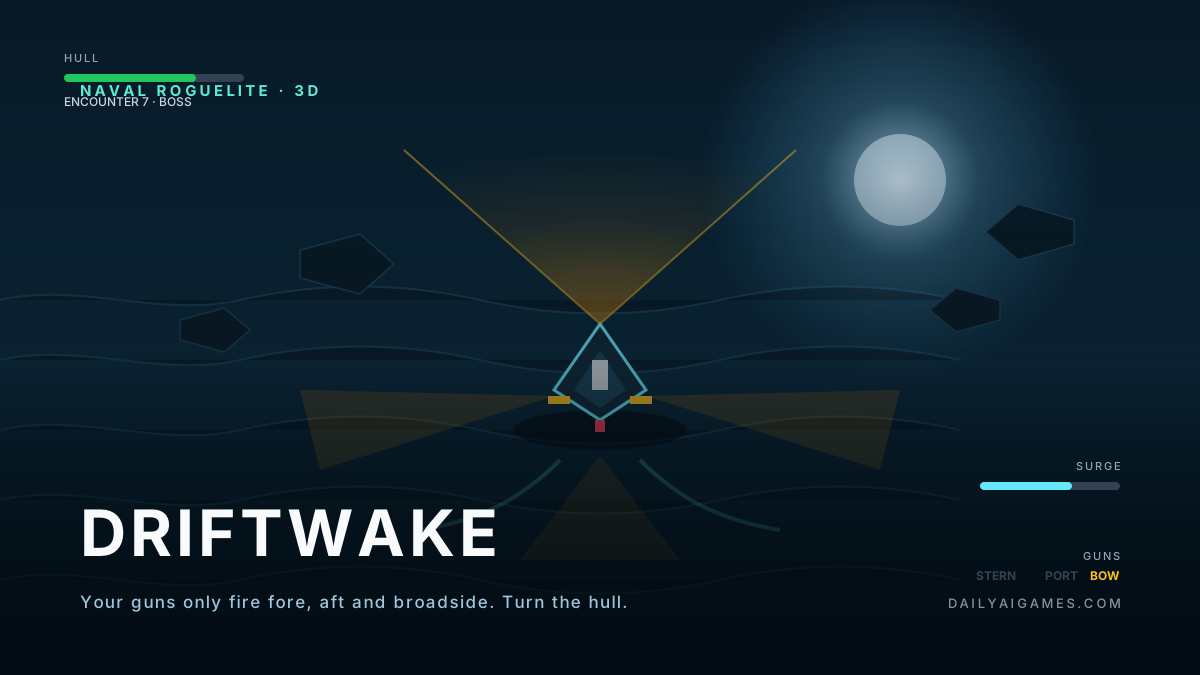
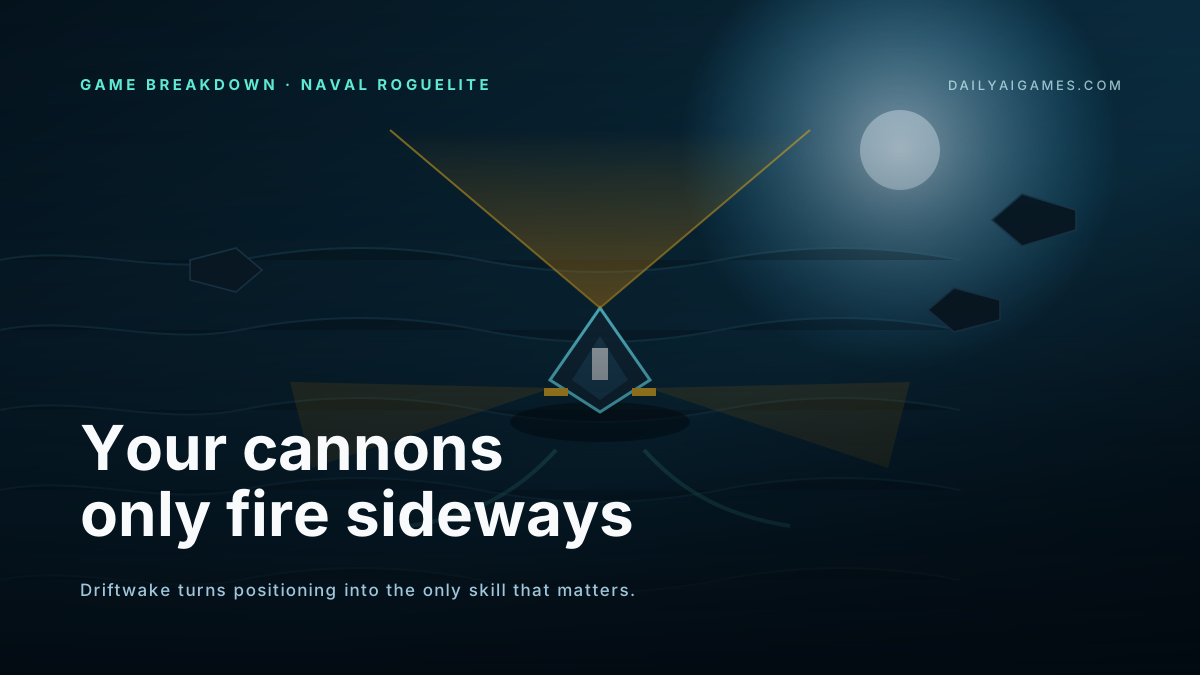
In most ship games, the hull is a camera platform. Your weapons do what you point them at, and steering is just positioning. Driftwake inverts that. The bow gun fires at zero degrees, the broadsides fire at ninety degrees to port and starboard, and the stern gun covers the rear at one hundred and eighty. There are no turrets that track independently.
So aiming becomes steering, and steering becomes commitment. To hit something off your bow, you have to turn the whole ship. To keep a broadside on a circling enemy, you have to match its orbit. The fight is a geometry problem with a reload timer attached, and the skill ceiling is in reading the angle before the enemy volley lands.
This is a classic constraint-driven design move. Remove the free aim, and a generic shooter becomes a naval game. It also solves a problem that browser action games usually struggle with: a fixed arc is far easier to read at low resolution on a phone than a precise twin-stick aim, because the interface can show you a cone instead of a crosshair.
The boss fleet is built around that constraint
Twenty-four normal enemy types share four behaviours — chaser, circler, sniper and rammer — and each one has a preferred side and range. That means the encounter roster doubles as a lesson in positioning. The sniper wants you at range on its bow; the rammer punishes you for presenting a broadside; the circler is the one you rotate against.
The eight persistent warship bosses are the exams. Each is built around a specific arc puzzle: one exposes a weak point only to the stern, one forces a broadside duel, one splits into escorts and turns the fight into target priority. The Kraken encounter is different in kind — it is timed rather than health-barred, so the goal is survival and movement instead of damage output.
Clear twenty-four encounters and Endless Seas unlocks, which is the mode most players will settle into. That is a sensible progression for a browser roguelite: a campaign with a beginning and an end, then an endless mode for the people who want to keep pushing. It is the same shape as BREAKWATER, the portrait MOBA on this site, which also uses a short campaign frame before the repeatable loop takes over.
Surge does two jobs at once
Every roguelite needs a panic button, and most of them give you a dodge that is purely defensive. Driftwake gives you Surge: a short burst of acceleration that leaves an exploding wake behind the hull. It moves you out of a telegraph and damages anything chasing you, so the escape and the punish are the same input.
That is efficient design. One button, two meanings, and a visual that explains both — the wake is the hitbox, so you can see what it hit. It also keeps the control scheme small enough for touch: throttle, steer, fire, Surge. Four verbs for a game with eight bosses.
Our naval roguelite boss fleet prompt turns that into a spec, including the 1.5-second enemy telegraph, the projectile-only rule and the boss weakness table. The 1.5-second figure is worth stealing on its own: long enough to react, short enough that you cannot wait it out.
What it shares with BREAKWATER and LANDFALL
All three games in this comparison are exercises in the same problem: how do you make a browser action game legible at phone size?
BREAKWATER solved it with a portrait one-lane map and a tide cycle that changes the walkable geometry every ninety seconds. That is the subject of our tide cycle arena prompt, and it is the closest structural analogue to Driftwake’s arcs: both games make the map state the thing you read, rather than the enemy.
LANDFALL solved it with ballistics and bot behaviour, which is a different lesson — see the battle royale bots prompt if that is the direction you want to go.
Driftwake sits between them. It has BREAKWATER’s spatial puzzle and LANDFALL’s sense of a world that exists before you arrive, in a package small enough to load in one breath.
How it was made
Driftwake was created by nilni and built with OpenAI GPT-6 and Codex. The stack is Three.js 0.180.0 for rendering, Blender 5.2.1 for models, WebAudio for sound and an image model for textures. The current version is 2.7.0, which tells you the game has been through real iteration rather than a single generation pass.
At the time of writing it had 1,303 plays and 72 hours 20 minutes of tracked play on AIGameShare, sixth on the weekly trend list. That playtime number is the more interesting one: 1,303 plays spread across 72 hours means people are staying for multiple runs, not bouncing after one. For a roguelite, session depth is the whole ballgame.
The build also shows how much of a 3D game can now be assembled from standard parts. Three.js is the renderer, Blender is the asset pipeline, WebAudio is the sound layer, and an image model handles texture variation. None of that is exotic. The notable part is that a model held all of it together long enough to ship eight bosses.
The caveats
Driftwake is a browser roguelite, not a replacement for a premium naval game. The models are low-poly, the sea is a plane with a shader, and the card pool is smaller than a dedicated roguelite’s. The firing-arc constraint will frustrate players who want twin-stick freedom — that is the point, but it is also a real filter.
The size of the boss roster is impressive; the depth of each boss is more variable. Eight bosses with distinct arc puzzles is a strong pitch, but a few of them lean on the same rotate-and-fire rhythm with different silhouettes.
What to take from it
Three lessons for anyone building action games with AI:
- Remove the obvious verb. Taking away free aim made Driftwake a naval game instead of a shooter with boats. Constraints create genre.
- Design the interface around the constraint. A cone indicator is readable on a phone; a free crosshair is not.
- Make the panic button do damage. A dodge that also punishes turns defence into a skill instead of a get-out-of-jail card.
If you like the sound of positioning as a weapon, play Driftwake and try to beat a boss without ever presenting your stern. If you want to build it, start with the prompt and print the arc table before you write a single enemy.