Minimal Rogue
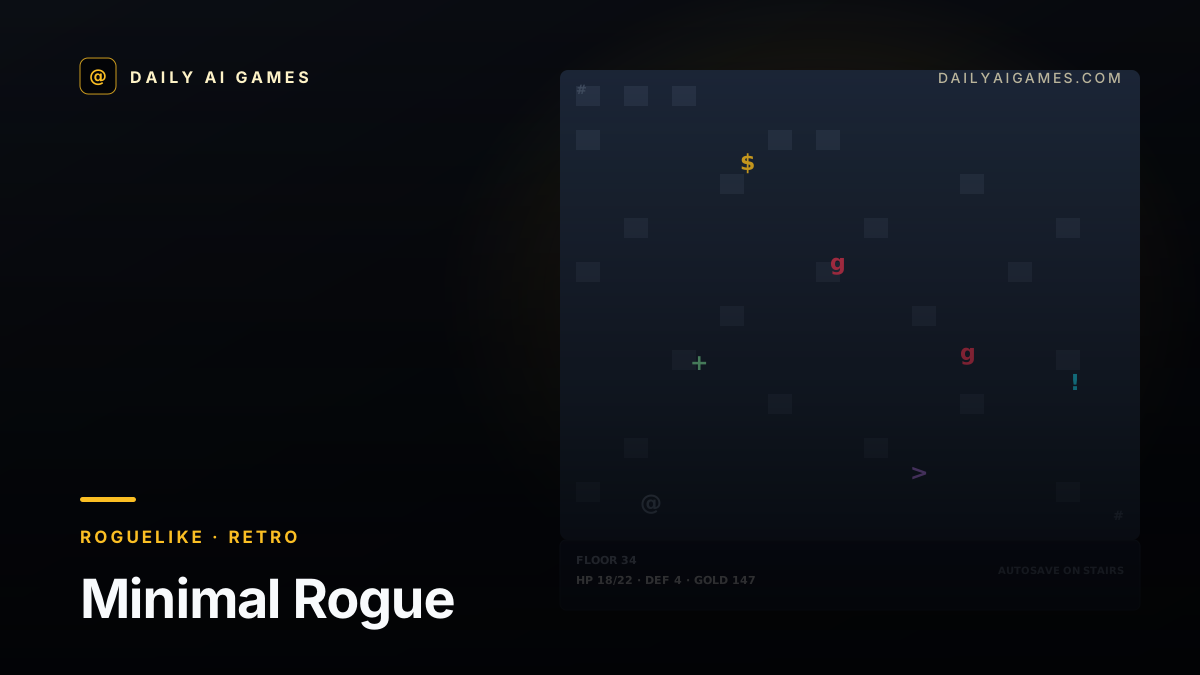
A traditional turn-based roguelike created entirely with AI by novelist Hirotaka Adachi — Claude Code for the game, Suno for the music, MIT source on GitHub.
458 plays tracked on Daily AI Games
External game siteMinimal Rogue is not hosted on Daily AI Games. The button above opens an independently operated, free browser game on itch.io; its content, availability and controls are controlled by that site.
How to Play
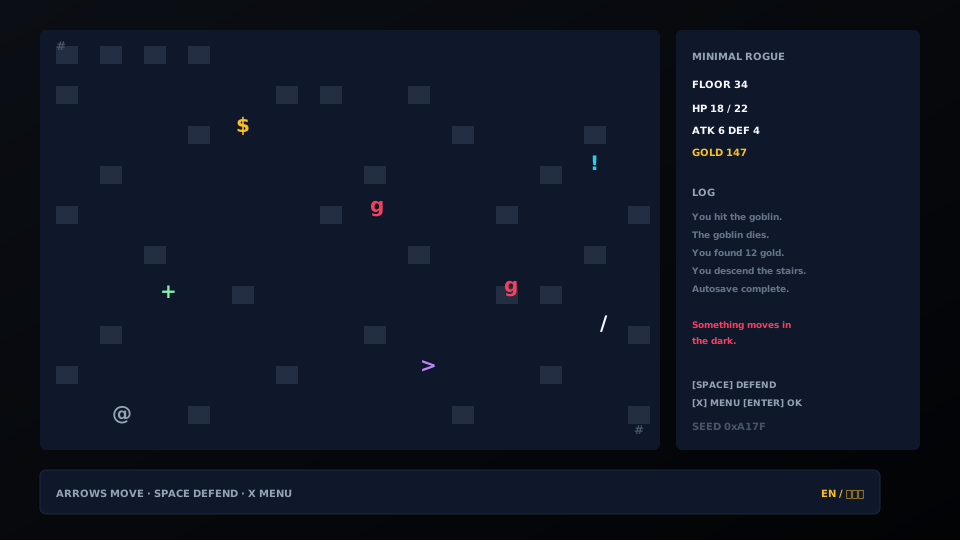
Arrow keys move and attack by bumping into enemies. Space defends. X opens the menu or cancels, Enter confirms. The game autosaves when you change floors; choose Continue on the title screen to resume from the start of the deepest floor you reached. English and Japanese are supported.
These are the controls for Minimal Rogue. The external Minimal Rogue version on itch.io may use slightly different controls.
Game Preview
About Minimal Rogue
Minimal Rogue is a traditional turn-based roguelike with a build story that makes it more interesting than most browser roguelikes: it was created entirely with AI. The game is by Hirotaka Adachi — better known as the novelist Otsuichi — and the itch.io page states plainly that the work was made using AI throughout. Claude Code wrote the game, Suno AI composed the music, and the full source is published on GitHub under the MIT license, so anyone can read it, modify it, or feed it back into an AI and build their own version.
The game itself is deliberately old-school. You move on a grid with the arrow keys, attack by bumping into enemies, defend with Space, open the menu with X and confirm with Enter. Floors are procedurally generated, death is permanent, and the game autosaves when you move between floors, so Continue resumes you at the start of the deepest floor you reached. The itch page estimates three to five hours for a basic playthrough, then adds a joke that reaching the deepest floor would take about 7.51 × 10^14 hours. That number is the design statement: this is a roguelike built for the long climb, not for a three-minute session.
Presentation is minimal by choice. The display is a readable retro grid — closer to a terminal than a modern indie roguelike — with high contrast and no external assets, which keeps the file small and the rules legible. The interface is in English and Japanese, and the in-game help explains what monsters and items do. The composer credit goes to Suno, and the whole thing runs in a browser tab with no download, account or plugin. It is the kind of game you can open on a laptop during a commute and still be playing when you arrive.
What makes Minimal Rogue worth a place in this directory is the authorship question it raises. A professional storyteller with no game-development background directed an AI through an entire playable roguelike, then chose to publish the source rather than the binary alone. The MIT license is an invitation: the value is not protected by hiding the code, it is in the design and the willingness to let others remix. There are rough edges — players have reported save-state problems in some browsers, and a browser-stored save is never as safe as a server — so export anything you care about. But as a demonstration of AI as a creative instrument rather than a novelty, it is one of the clearest examples this year.
How This Game Was Generated
Created entirely with AI by novelist Hirotaka Adachi (Otsuichi). Claude Code wrote the game and Suno AI composed the music. The full source is published on GitHub under the MIT license, and the itch.io page explicitly invites players to modify, republish or feed the code back into an AI to build their own version.
The Prompt Behind This Game
Show the prompt used to generate Minimal Rogue
Build a traditional turn-based roguelike as ONE self-contained HTML file (inline CSS/JS, no libraries, no external assets).

Core rules:
- Grid-based dungeon with procedural floors, permadeath, monsters that move only when you move, items, stairs and a single dungeon goal.
- Controls: arrow keys move and attack by bumping, Space defends, X opens the menu or cancels, Enter confirms. Autosave when changing floors; Continue resumes at the start of the reached floor.
- Display: readable retro look, either ASCII glyphs or minimal inline-SVG tiles, high contrast, no external fonts or images. It must stay legible at phone width.
- Difficulty: the early floors are survivable with patience, the deep floors are not. Every monster and item must have a clearly stated effect in the in-game help.
Architecture:
- Separate rules from rendering: a pure `step(state, action)` function returns the next state and a list of events; the renderer only draws state. This must be testable headlessly.
- Seeded generation so a run can be reproduced from its seed.
- Data-driven content: monsters and items as plain objects with stats and tags, not hard-coded branches.
Testing and balance:
- Build a random-play bot that runs 1,000 games and reports: average floor reached, death floor distribution, items never picked up, monsters never killed, and any floor that can generate without an exit.
- Fix what the report exposes, then print the before/after table.
Licensing:
- Add an MIT license header and keep the source readable enough that another person can feed it to an AI and remix it.

After the code, print the content tables and the bot report.
Open in the prompt library for tips and variations
Similar AI Games
 Strategy Games
▶ 591 plays
Crimson Oath
A free SNES-style JRPG with two chapters, four heroes and FF6-style ATB battles. Every sprite and song is generated in code, and it runs in your browser.
Play now
 Strategy Games
▶ 372 plays
Battle Drones
A mobile-friendly RTS from Simon Willison: 16 units, 10 buildings, fog of war, six maps and a sound-only duel mode that needs no network at all.
Play now
 Strategy Games
▶ 348 plays
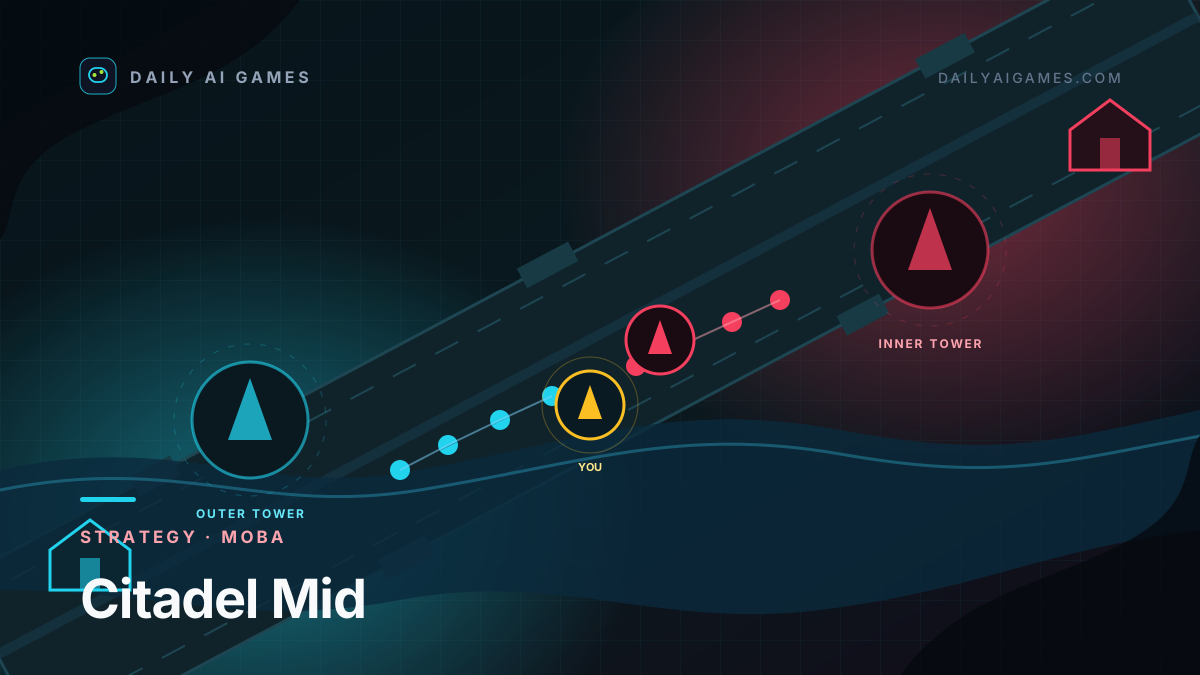
Citadel Mid
A free one-lane MOBA you can finish in one sitting. Pick a hero, last-hit creeps, break two towers and destroy the enemy Citadel before the bot does.
Play now
 Action Games
▶ 294 plays
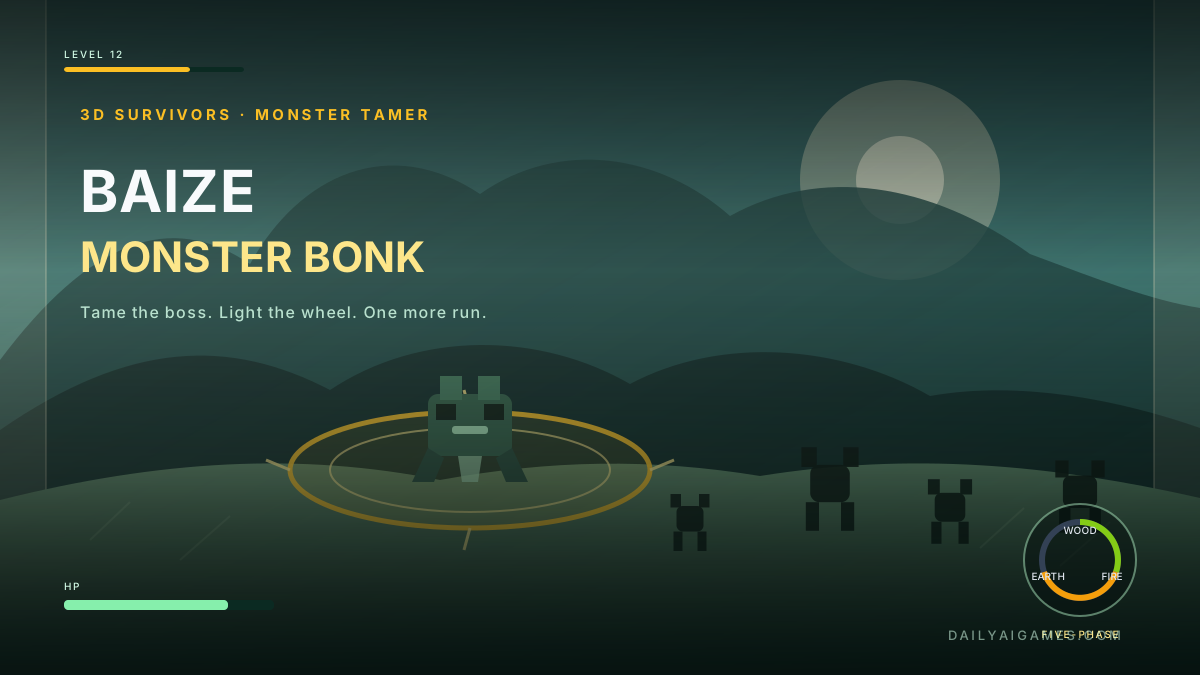
Baize Monster Bonk
A 3D survivors roguelite drawn from the Classic of Mountains and Seas — auto-attacking beasts, seal-ring taming and a five-element wheel that chains elements.
Play now
Articles About Minimal Rogue
Oct 24, 2026
Minimal Rogue: A Novelist Made a Full Roguelike With AI, Then Open-Sourced It
Otsuichi's Minimal Rogue was written by Claude Code, scored by Suno and released under MIT. What a famous novelist's AI game says about authorship.
Oct 12, 2026
Claude vs Gemini vs ChatGPT for Making Games
We build games with Claude, Gemini and ChatGPT daily. A hands-on comparison of code quality, iteration speed and which AI writes better game code.
Sep 28, 2026
What Are AI Generated Games? A Plain-English Guide
AI generated games are playable games built by AI models from text prompts. Here is what they are, how they are made, and where to play them free.
