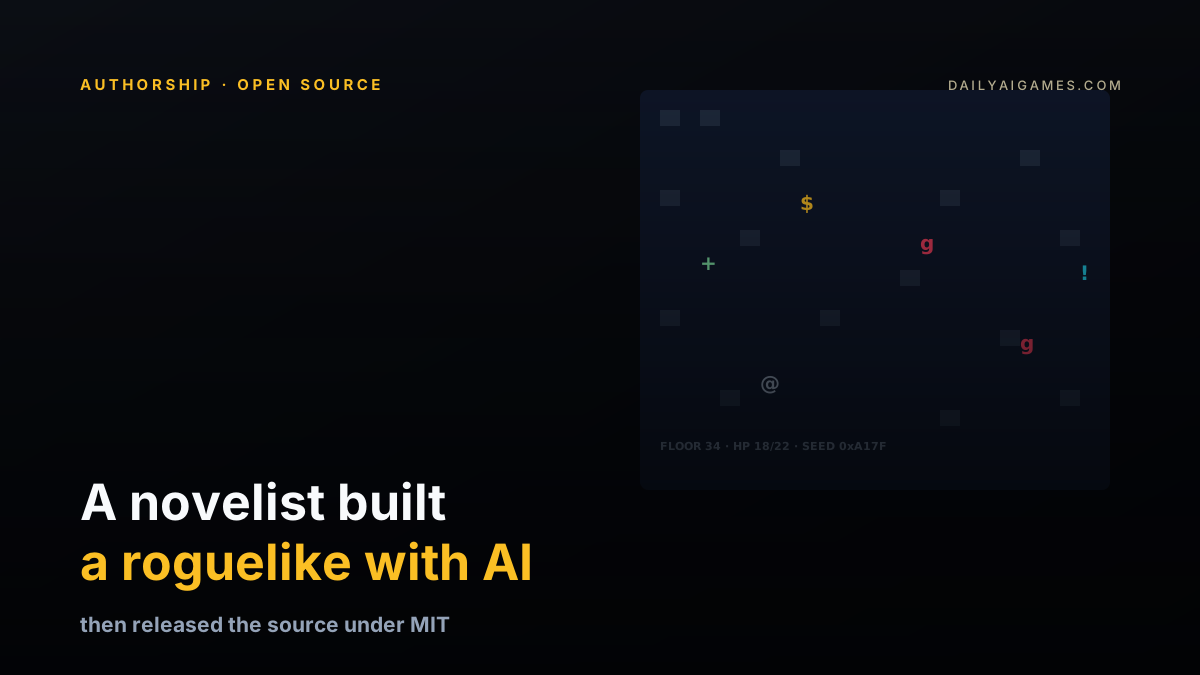
Most AI game stories are about speed: a working prototype in an hour, a weekend MMO, a demo that goes viral and then disappears. Minimal Rogue is about something less common — a finished game, made by a professional storyteller, released with its source code under the MIT license.
The game is by Hirotaka Adachi, better known as the novelist Otsuichi. The itch.io page states plainly that the work was created entirely using AI. Claude Code wrote the game, Suno AI composed the music, and the full source is on GitHub for anyone to read, modify or feed back into a model.
The game itself
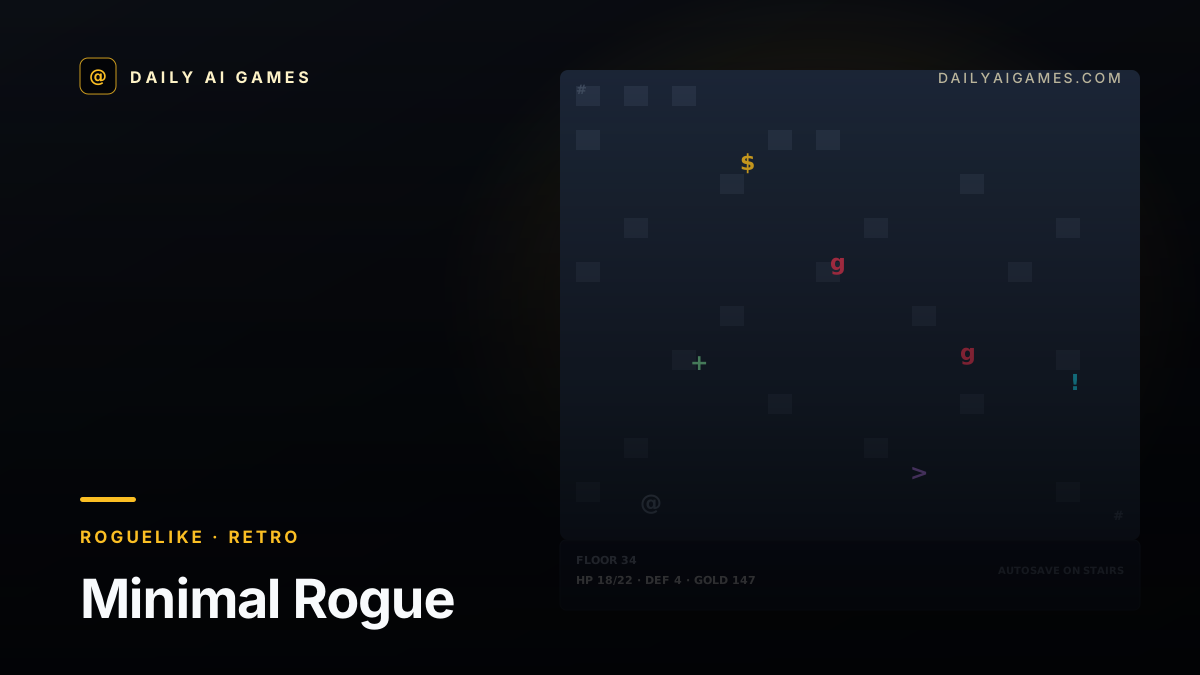
Minimal Rogue is deliberately old-school. You move on a grid with the arrow keys, attack by bumping into enemies, defend with Space, open the menu with X and confirm with Enter. Floors are procedurally generated, death is permanent, and the game autosaves when you move between floors, so Continue resumes you at the start of the deepest floor you reached.
The itch page estimates three to five hours for a basic playthrough, then adds a joke: reaching the deepest floor would take about 7.51 × 10^14 hours. That number is the design statement. This is a roguelike built for the long climb, not for a three-minute session.
Presentation is minimal by choice. The display is a readable retro grid — closer to a terminal than a modern indie roguelike — with high contrast and no external assets, which keeps the file small and the rules legible. The interface is in English and Japanese, and the in-game help explains what monsters and items do. It runs in a browser tab with no download, account or plugin.
The interesting part is the license
Lots of AI-generated games are released as a demo. Minimal Rogue was released with its source, under MIT, alongside an explicit invitation: modify it, republish it, use it commercially, feed the code to an AI and make your own version.
That decision changes the conversation. If the value of a game is only its compiled build, AI generation is a threat to the developer. If the value is the design, the direction and the willingness to let others build on it, the source can be public without giving anything away. Adachi is a novelist; the thing he is good at is deciding what the game should feel like. The code is the part he is willing to share.
It is also a practical choice for a browser game. A single HTML file with no external assets is easy to fork and easy to preserve. The MIT license means the game can outlive the hosting, the browser version and the model that wrote it.
What it says about authorship
The headline “novelist makes a game with AI” is less interesting than the specifics. A traditional roguelike is a tight design problem: turn order, resource pressure, procedural fairness, a difficulty curve that rewards patience without becoming trivial. Those are decisions, not prose. The model can implement them; it cannot decide which ones matter.
The result is a game that feels like a deliberate homage rather than a generated pastiche. The controls are the classic controls. The joke about the deepest floor is a human joke. The decision to publish under MIT is a human decision. AI wrote the code; a writer chose the shape.
Where it is rough
Browser saves are fragile. Players have reported save-state problems in some browsers, including a run that could not be recovered after a rendering bug. If you care about a deep run, treat the save as temporary. That is a real limitation, not a nitpick, and it is the price of a zero-infrastructure game.
The presentation is also austere. If you want animation, sound design and a modern interface, this is not that. It is closer to playing a terminal roguelike in a tab, which is either the appeal or the reason to skip it.
What builders should steal
The new traditional roguelike prompt turns the architecture into a reusable brief. Three lessons stand out:
- Separate the rules from the renderer. A pure step function is testable; a game loop tangled with drawing code is not.
- Run a random-play bot. A thousand automated games will find unwinnable floors and useless items faster than any human tester.
- Publish the source if you want the game to last. Remixing is the point.
Verdict
Minimal Rogue is not the most visually impressive AI game of the year. It is one of the most complete, and the MIT release makes it one of the most useful. Play it for an hour, then open the repository and see what a novelist decided a roguelike should be.