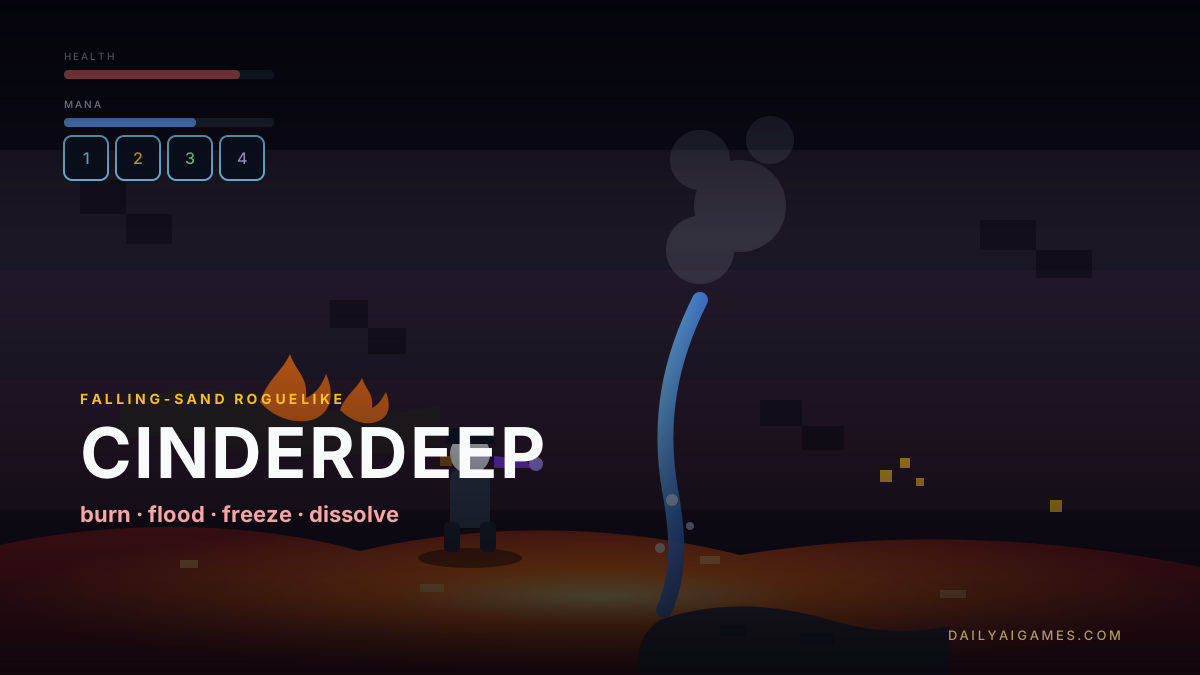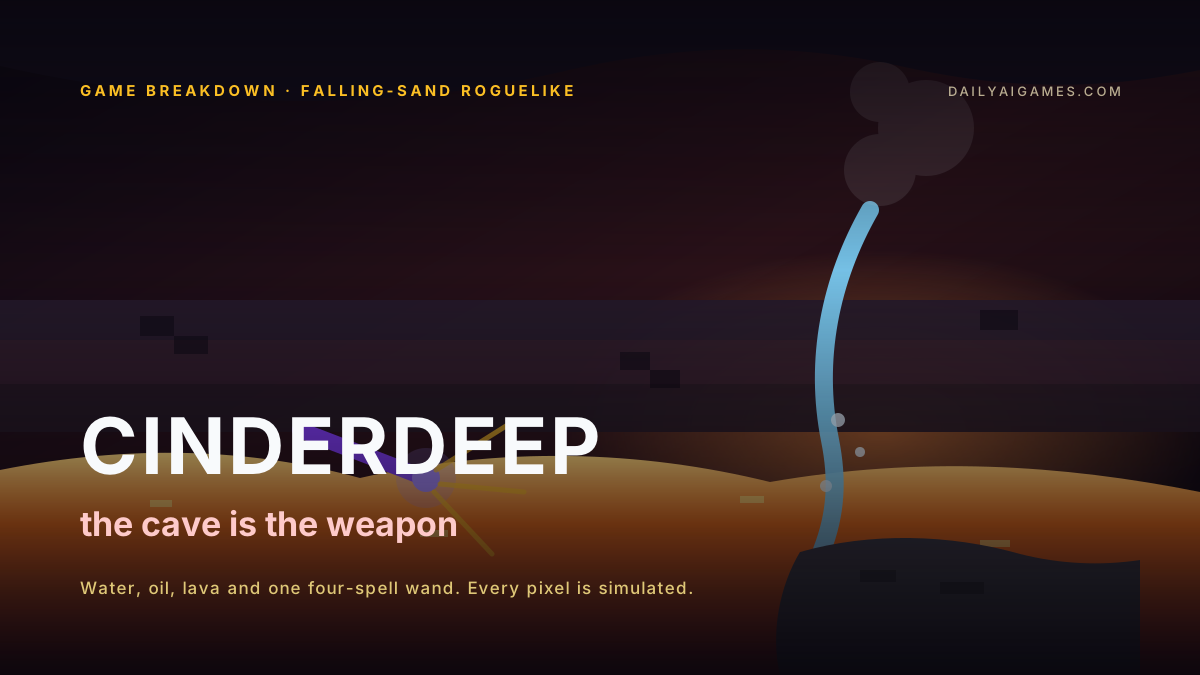
Most roguelikes give you a room full of enemies and a gun. CINDERDEEP gives you a room full of simulated matter and a wand, and then it lets the room kill everything for you. Pour water into a lava pool and it becomes a stone bridge. Spray oil across a floor, back away, and light it. Undercut a ceiling and it comes down on whatever is standing under it. The cave is not the level. The cave is the weapon.
At the time of writing CINDERDEEP had 752 plays and 35 hours 27 minutes of tracked play on AIGameShare, with 709 plays in the last seven days. That makes it the number one trending game on the platform this week, and unlike a lot of trend spikes, the playtime backs it up: an average of about two minutes per play, in a game where a full successful run is five depths.
Every pixel is real
The pitch sounds like a gimmick until you play it. CINDERDEEP runs a falling-sand simulation across the whole cave, which means wood burns, water flows downhill and puts out fire, steam rises and condenses, oil floats on water and catches light, acid eats through stone at a rate, lava meeting water becomes rock, gunpowder and gas pockets chain-react, and any ceiling you remove loses support and collapses.
None of those are scripted events. They are consequences of a material table, and the difference is immediately legible. In a scripted game, pouring water on lava plays the “lava + water” animation. In CINDERDEEP, the lava cools into a solid tile you can stand on, and that tile changes how the rest of the room plays. The simulation is the level design.
It also means the game can hurt you with your own cleverness. Arc Lightning conducts through connected water and metal, which is a wonderful way to clear a flooded room and a wonderful way to electrocute yourself if you are wading in it. Oil plus a Spark Bolt clears a room and also removes the floor you were planning to retreat across.
A wand with twenty real spells
You carry four spells at a time, drawn from a pool of twenty, and every one of them injects material or changes the state of the grid rather than drawing a particle effect. That constraint is what makes the wand feel like a toolkit instead of a weapon list.
- Tide Jet pours an actual stream of water: puts out fire, cools lava into stone, builds a bridge or a wall.
- Oil Spray and Powder Trail prepare a room, and a Spark Bolt finishes it.
- Frost Lance freezes water into ice and enemies solid, turning a lake into a floor.
- Dissolve Ray melts a tunnel when the long way round is the wrong way round.
- Blast Keg brings ceilings down, which is either a shortcut or a burial.
- Blink throws a marker and puts you where it lands, if there is room for you.
Pick up a fifth spell and it replaces the selected slot, dropping the old one as a tome you can pick back up. It is a small system with a lot of decisions in it: which four tools do you take into a frozen vault, and which do you leave behind for a cave that might be full of oil.
Vaults, bosses and the shape of a run
A run is five depths: a collapsed mine, a fungal hollow, a frozen vault, a foundry and the Cinderdeep itself. Each depth ends in a brick vault with a healing font that works once, a way down, and a choice of three gifts.
Those gifts are the build. Spells expand the wand. Wand modifiers reshape it — Twin Cast, Rebound, Seeker, Flame Trail, Acid Trail, Quick Cast, Deep Well. Perks are passive and often run-defining: Asbestos Robe makes fire harmless but leaves lava lethal, Stone Skin reduces contact damage, and Phoenix Ash refuses one death. Depths two, four and five end in boss arenas, and the vault stays sealed until the boss falls.
Death sends you back to the top. Your score — gold, depth, kills, bosses — goes to the leaderboard, so a run that ends on depth four still did something. That is the right structure for a game where most deaths are your own fault, and the game seems to know it: the run-end screen is less “you failed” and more “here is what the cave did to you”.
Reading the floor is the skill
The opening minute teaches the whole game without a tutorial. You have 100 health, 100 mana, Spark Bolt and Blast Keg. Mana regenerates. Levitation fuel refills when you stand on the ground. Gold is a real material that spills out of ore, so the early game is literally digging toward a glint and walking over the spill.
The skill that develops after that is floor-reading. Wet stone plus Arc Lightning is a trap for anything standing in it, including you. Oil on the ground turns one Spark Bolt into a room-wide fire. A lava pool is a resource if you have Tide Jet and a wall if you do not. Good players stop aiming at enemies and start aiming at the terrain underneath them.
The other skill is restraint. Short levitation hops are cheaper than one long one, because fuel refills fast on the ground. The healing font only works once, so passing it at full health is a mistake you make exactly one time. And a ceiling you undercut does not care whose side you are on.
Controls and the mobile version
On desktop, CINDERDEEP uses the familiar platformer kit: A and D to walk, W or Space to jump and then hold to levitate, S to dig down, mouse to aim, click or J to cast, 1 to 4 or the wheel to cycle spells. It is legible within thirty seconds.
The mobile build is the more interesting one. It replaces the keyboard with a fixed D-pad on the left, a drag-to-aim-and-cast pad on the right, and tappable spell slots. That is not a trivial port for a game where aiming at a specific pixel of floor matters, and it works because the spells are streams and areas rather than pinpoint shots. The pause and help panels also switch between English and Chinese.
What AI got right, and where it is thin
CINDERDEEP was created by nilni and built with Claude Fable 5.2. The impressive part is not that an AI produced a falling-sand simulation — those have existed for years. It is that the game is designed around what the simulation can do: the vault gifts are all ways to change the material sandbox, the bosses have material weak points, and the spells are chosen so that every depth has at least two viable solutions.
The limits are real. Five depths is a short campaign, and once you have learned the reaction table, the surprise budget shrinks. The leaderboard is not populated yet, so the score chase is theoretical for now. And the pixel-art caves, while readable, are not especially varied — the fungal hollow and the foundry differ more in materials than in silhouette.
None of that undercuts the core. CINDERDEEP is a game about understanding a system well enough to break it, and the system is deep enough to keep paying out.
What to copy if you build one
Our falling-sand alchemy roguelike prompt is the reusable version of this build. The decisions worth stealing:
- Put every reaction in one table. Once interactions live in if-statements, adding a material breaks the ones you already tested.
- Make spells inject matter, not particles. A water jet is interesting because the water stays, flows and cools lava into a bridge.
- Conserve mass and report leaks. Players feel a simulation that silently deletes matter even if they cannot explain why.
- Give bosses a material weak point. A boss that only dies to raw damage wastes the entire simulation.
- Let the player kill themselves. Self-inflicted physics deaths are the most memorable deaths in the genre.
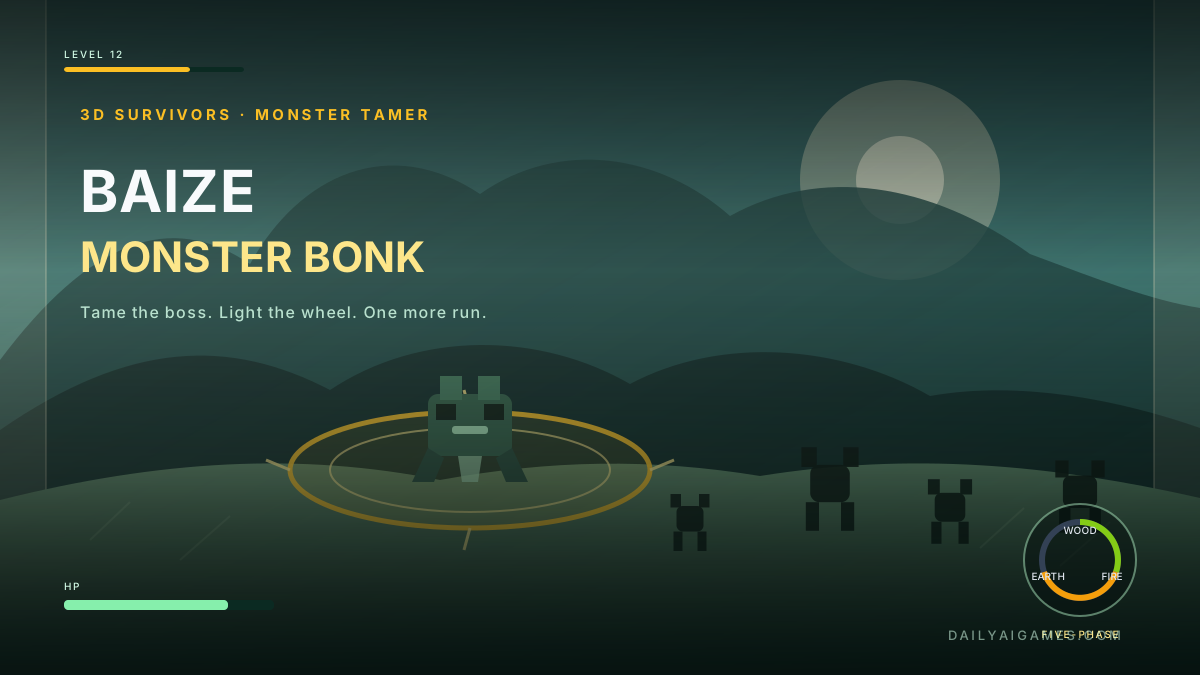
If you like roguelites that make the arena part of the build, Baize Monster Bonk turns the survivors formula into a taming problem, and our 3D survivors taming prompt covers the card economy behind it.
Verdict
CINDERDEEP is the best kind of AI-generated browser game: a small, specific idea executed with enough systemic depth to justify the trend it is riding. It is a roguelike where the correct answer to most problems is “change the terrain”, and the terrain is always listening. Pour the water, light the oil, and try not to stand under the ceiling when it comes down.