A battle royale is the wrong genre for a browser tab. It needs a large map, forty-plus opponents, a loot economy, a shrinking zone and gunplay that feels precise enough to justify losing a fight. Every one of those requirements used to mean a download and a dedicated server. LANDFALL does all of it in a tab, and the strange part is that it works.
At the time of writing it has 530 plays and 25 hours of tracked play time on AIGameShare, with 648 plays across its versions. That is not Ren AI money, but for a first-person shooter built in a browser by an AI pipeline, it is a serious result.
Forty-eight drop, forty-seven are bots
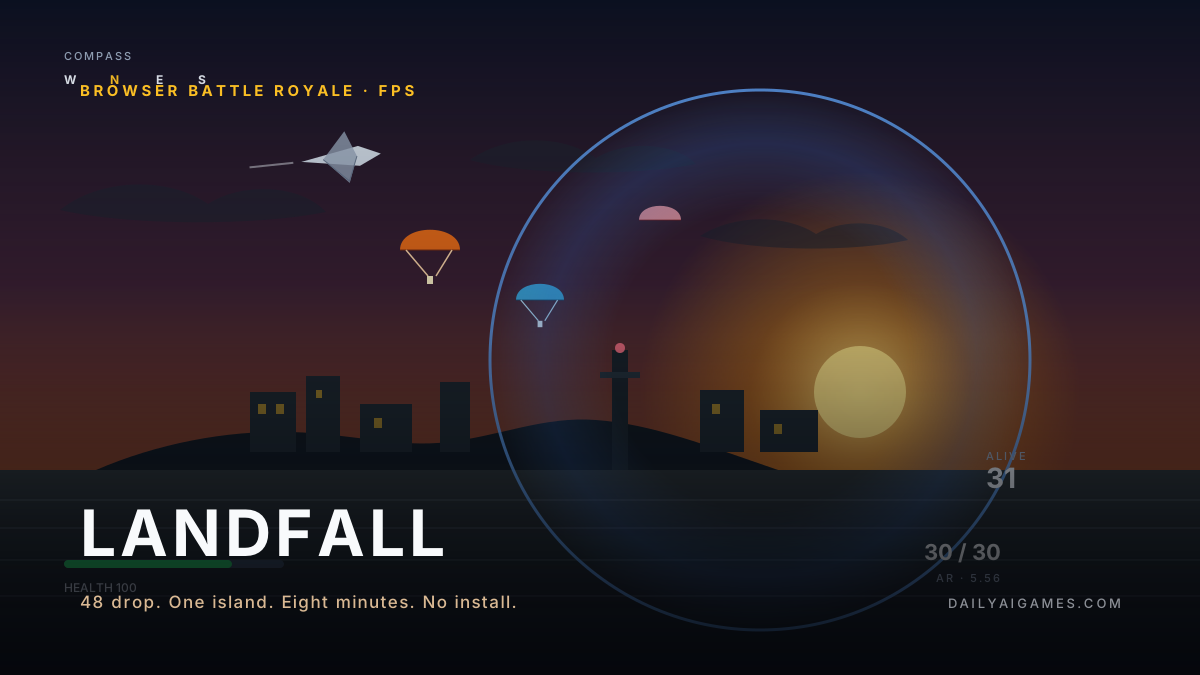
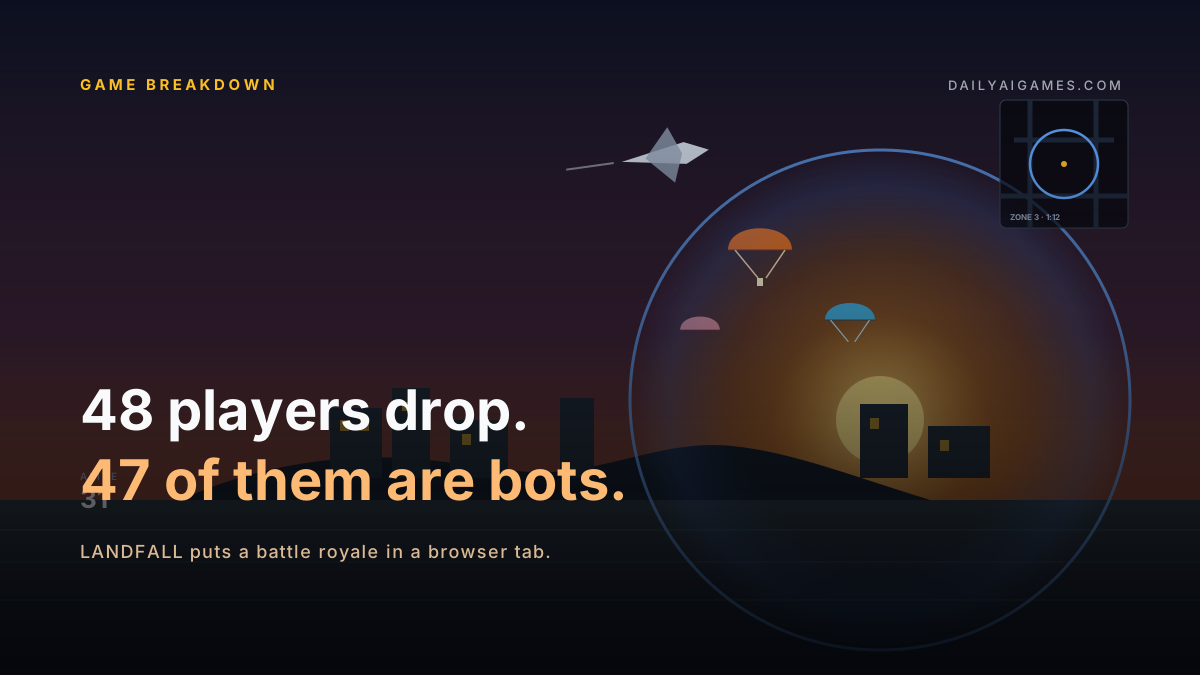
The premise is the standard one. A plane crosses Kray Island at dusk, you mark a spot, you freefall, you cut the chute at roughly 150 metres, and you start looting. What matters is the population: forty-eight combatants, and forty-seven of them are bots.
LANDFALL is honest about this, and that honesty is what makes it interesting. The bots are not statues. They loot, rotate with the zone, camp a building, push a fight they think they can win, and third-party a duel that has gone on too long. The kill feed is busy from the first minute, which is the single most important thing a battle royale can get right, because an empty map with a timer is not a battle royale — it is a walking simulator with a circle.
Each bot has a name. That is a small design decision with a large effect. You read “Marlow killed Kestrel” and your brain fills in a rivalry that does not exist. It is the cheapest possible fiction, and it works better than a generic “Bot 14” ever could.
Gunplay that respects the genre
The shooting model is where LANDFALL stops being a browser toy. There are eight weapons, from a pistol to a bolt-action sniper, plus a golden .338 in the airdrop. Vests and helmets come in three tiers, and there are frags, bandages and stims. Bullets have travel time and drop, aim-down-sights supports 4x and 8x scopes, and buildings across eight named zones — Airfield, Blackrock Harbor, Brine Town and the rest — can actually be entered.
Enterable interiors are expensive, and most browser shooters fake them with painted doors. LANDFALL does not. That changes the texture of a fight: you are not just tracking a target across open ground, you are holding a stairwell and listening for the second player behind the first. The eight named zones do the rest, giving the map enough landmarks that callouts mean something even when you are playing alone.
A match lasts eight to ten minutes, and the zone closes in seven waves. The pacing is tuned for that length: rotate early, watch the map, and the final circle often resolves in the last twelve metres of open ground. Short matches are the right call for a browser game, and they also hide the fact that the lobby is not human.
Dusk as a performance budget
The presentation leans into a single time of day. A low sun, long shadows, warm light on corrugated roofs and a cold blue-grey horizon. That is an aesthetic choice and a performance strategy at the same time: one lighting setup is cheaper than a day-night cycle, and it gives the island a look you can describe after playing.
The interface keeps the standard battle-royale furniture — compass, ammo, armour, map — and the game ships English and Chinese from the same build. On desktop it is pointer-lock first person with WASD, sprint, crouch and jump. On mobile it is a twin-stick layout with buttons. A phone will not give you the same precision, but it runs, and for a first-person shooter of this scale that alone is unusual.
Where it is rough
The core caveat is the one already stated: there is no matchmaking, no human opponents and no anti-cheat, because there is nothing to cheat against. LANDFALL is a solo lobby dressed as a lobby. If you want the social tension of a real battle royale — the third party who is definitely a person, the teammate who lands halfway across the map — this is not that game and does not pretend to be.
The bots also have tells. They rotate on predictable lines, they sometimes hold an angle for too long, and a patient player can learn the rhythm of a lobby in a few matches. That is the trade-off of building believable opponents without a server: the illusion is strong for eight minutes and thinner on the fourth run.
Performance is the other question. Forty-eight agents with interiors, projectiles and loot is a lot to ask of a browser, and the game is clearly built around pooling and culling to make it fit. It runs; it will not run equally well on every laptop.
What to copy if you are building a browser shooter
Our 48-player browser battle royale prompt is the reusable version of this build. The decisions that matter most:
- Give bots temperaments, not just difficulty. Five behaviour profiles — looter, rotator, camper, pusher, third-party — produce a more believable lobby than one aim-bot with a slider.
- Use projectiles with travel time. Hitscan removes the tension that makes a battle royale feel like one.
- Make at least two buildings genuinely enterable. Players forgive a small map; they do not forgive painted doors.
- Say “bots” on the page. A solo lobby presented as multiplayer is the fastest way to lose trust.
- Pick one time of day and commit. It looks better and costs less.
If the ambition here appeals to you, the open-world city sandbox prompt behind Taipei Rush is the other large-scale browser build worth studying — and a reminder that scope is a staging problem, not a token budget.
Verdict
LANDFALL is not the browser PUBG that the headline promises, and it is more interesting for it. It is a demonstration that a frontier model can generate a working first-person shooter with a zone system, ballistic weapons, enterable interiors and bot behaviour varied enough to fill a lobby. Eight minutes disappear. You will not mistake a bot for a friend, but you will flinch when one third-parties you.
Play one match on desktop with headphones. Land at Brine Town, take the first rifle you find, and rotate early. The moment the zone closes on a fight you did not start is the moment the genre arrives in the browser.