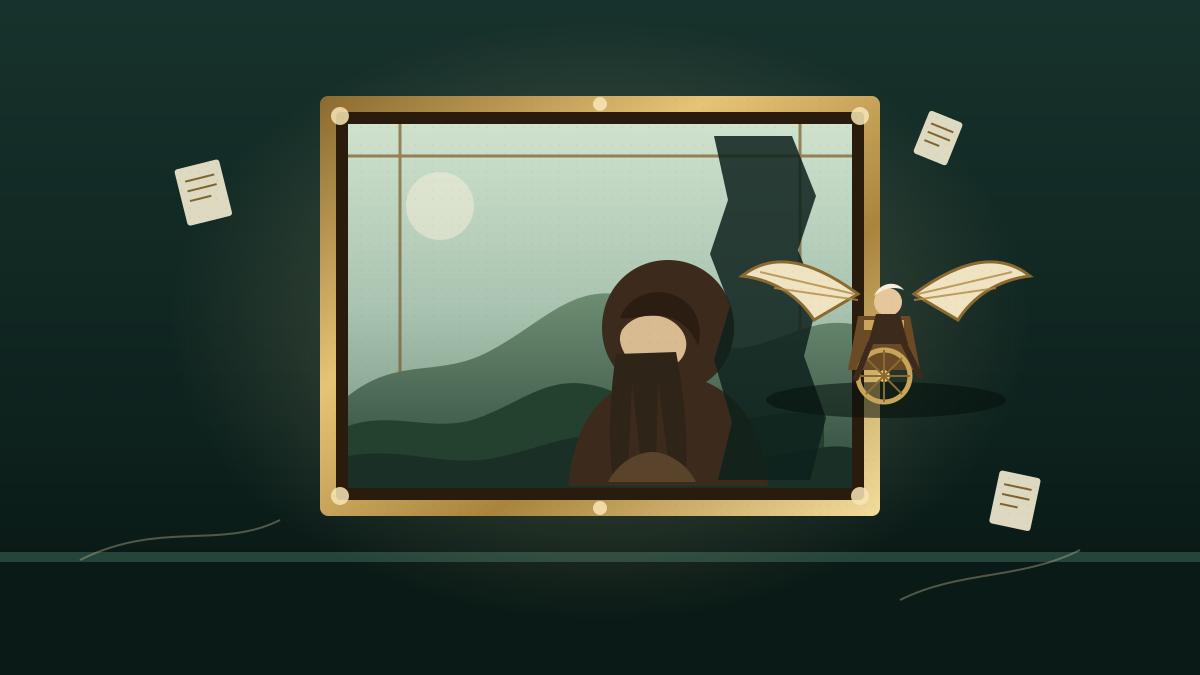
There is a moment near the start of MONA LISA: Fly Behind the Painting that explains the whole design. You are sitting on a wooden pedal machine, looking up at the back of the Mona Lisa, and the painting is the sky. Press Space three times and the machine unfolds a pair of wings. Nothing attacks you. No timer starts. The game simply lets you leave the ground.
At the time of writing MONA LISA had 40 plays and 43 minutes of tracked play on AIGameShare. Those are small numbers, but the average session is longer than a typical arcade run, and the shape of the usage tells you what kind of game it is: people are not grinding it. They are taking a walk.
The valley is a notebook
The premise is that old Leonardo is living inside a valley containing roughly 175 things he made in his life. Crucially, everything begins as brown-ink drawing. The valley is not a museum of finished masterpieces. It is a notebook, and the notebook is unfinished.
Loose pages drift near each work. Bring a page to a drawing and the drawing wakes. Colour floods in, the subject begins to move, and the scene changes register from sketch to oil painting. The Last Supper starts moving in its hall. The Duomo rises. The Lady with an Ermine appears. The Vitruvian Man assembles. The aerial screw begins to turn.
That is the progression system. There is no XP, no currency and no combat. You find pages, you wake works, and the world becomes more alive. It is a clean loop for a game with no fail state, and it gives the player a reason to fly somewhere specific without ever putting a marker on the map.
Five machines, five verbs
Five of Leonardo’s other machines can be built from pages and then ridden. Each one has a different movement verb: glide, pedal, screw-lift, parachute, boat. The variety matters because the game has no enemies to vary the moment-to-moment experience. The machine you are riding is the variety.
The flight model is gentle by design. A/D or the arrow keys bank, holding Space or W flaps, S dives and lands, and E or Shift opens a parachute. Number keys switch machines, N opens the notebook, T hides the HUD, C changes the camera and M mutes. On a phone you hold to flap and drag to steer, drag down to land, and use the wing button to take off. The interface is available in English, Chinese and Japanese.
That control scheme is doing something specific: it removes the fear of falling. There is no fall damage, and nothing ends the flight. You can dive at a rooftop, pull up late, and the game will let you. The only pressure is curiosity, which is the right pressure for an art game.
The ink-to-oil transition is the whole build
From a technical perspective, MONA LISA is interesting because its art direction is its system. Every object has two visual states: ink, with monochrome hatching and a paper texture, and oil, with rich colour and brush texture. The transition between them has to read at phone size, and it has to feel like waking rather than switching a filter.
That is a much harder rendering problem than it sounds. A 3D world where every object can be a drawing or a painting needs two coherent material languages, a cross-fade that does not look like a dissolve, and enough performance headroom to keep the frame rate steady while the effect runs. The game targets 60fps on a mid-range phone with low-poly geometry and vertex colours, and it keeps the draw-call count low. It also localises its UI, which is rare for a browser art piece.
What AI got right, and where it is thin
MONA LISA was created by nilni and built with Claude Fable 5.2 and Claude Code. The achievement is the coherence of the fantasy. The painting-as-sky image, the notebook pages, the ink-to-oil reveal and the no-fail flight model all point at the same idea: this is a sketchbook you can climb into.
The limits are equally clear. Forty plays is not an audience yet, and the game asks for a kind of patience that a browser tab rarely gets. The valley can feel sparse once you understand that every interaction is a page delivery. The notebook is the only interface, and if you close it by accident you may spend a minute working out where you were. And the machines are delightful but shallow — each is a verb, not a system.
That is fine for what this is. MONA LISA is not trying to be a sim. It is trying to be a ten-minute walk through a notebook, and it succeeds at that.
What to copy if you build one
Our painting-world flight exploration prompt is the reusable version of this build. The decisions worth stealing:
- Make restoration the only progression. Pages found and works woken are a cleaner loop than XP in a game with no combat.
- Design the ink state first. If the world is not beautiful as line art, the oil reveal has nothing to reveal.
- Remove failure completely. No fall damage and no timer is what lets players look up at the sky.
- Keep the notebook legible on a phone. In a no-HUD game, the journal is the interface.
- Give each vehicle one verb. Five simple machines beat one complicated one in a game about curiosity.
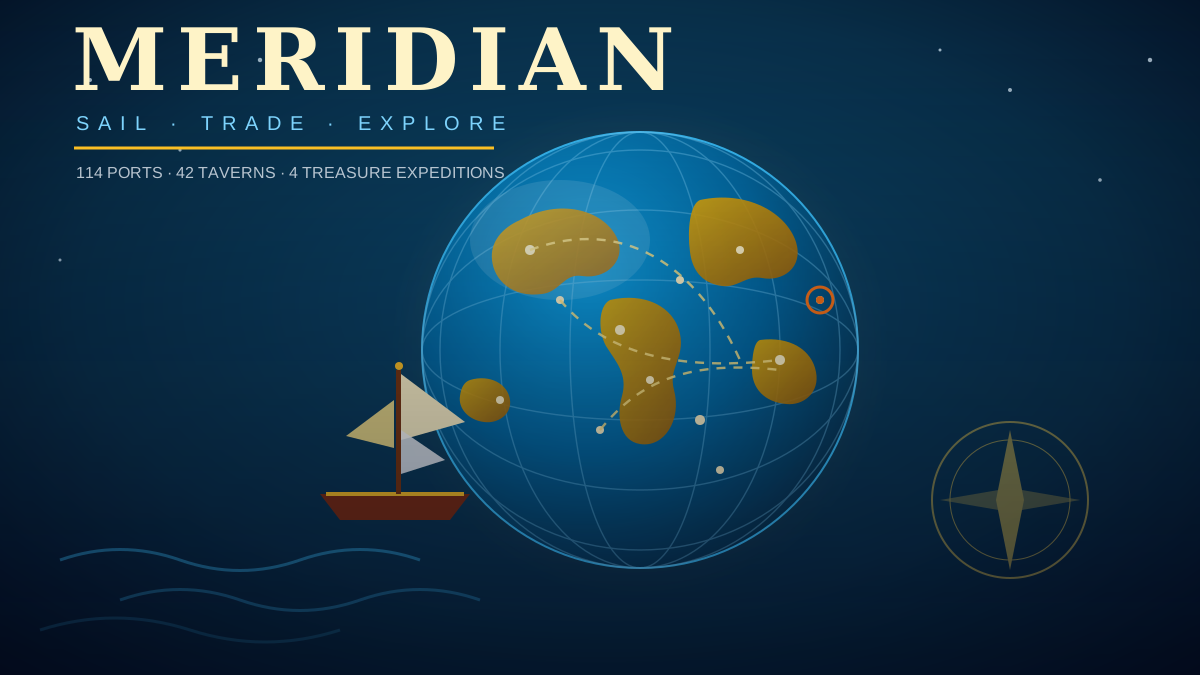
If you want the same art-history idea with a score attached, GREAT WAVE turns Hokusai’s print into an eight-wave surf run. If you want a bigger, stranger world to get lost in, MERIDIAN gives you a spherical Earth and 114 ports to sail between.
Verdict
MONA LISA is the calmest AI-built game I have played this month. It takes a famous painting, turns it into a sky, and then hands you a pedal-powered flying machine and no reason to hurry. The ink-to-oil reveal is the best single effect in any browser game this week, and the no-fail design is a confident choice in a genre that usually cannot resist adding a health bar.