MONA LISA: Fly Behind the Painting
A no-fail 3D flight through Leonardo da Vinci's notebook: bring ink drawings back to life, build his machines and fly out the back of the Mona Lisa.
MONA LISA: Fly Behind the Painting
Play on AIGameShareOpens aigameshare.com in a new tab · free · no download
40 plays tracked on Daily AI Games
External game siteMONA LISA: Fly Behind the Painting is not hosted on Daily AI Games. The button above opens an independently operated, free browser game on AIGameShare; its content, availability and controls are controlled by that site.
How to Play
Ride: A/D or arrow keys steer, Space/W pedal, S brakes. Press Space three times to unfold the wings and take off. Fly: hold Space/W to flap, A/D bank, S dive and land, E or Shift opens the parachute, 1-6 switch machines, N opens the notebook, T hides the HUD, C changes the camera and M mutes. Touch: hold to flap, drag to steer, drag down to land, or use the on-screen wing button.
These are the controls for MONA LISA: Fly Behind the Painting. The external MONA LISA: Fly Behind the Painting version on AIGameShare may use slightly different controls.
Game Preview
About MONA LISA: Fly Behind the Painting
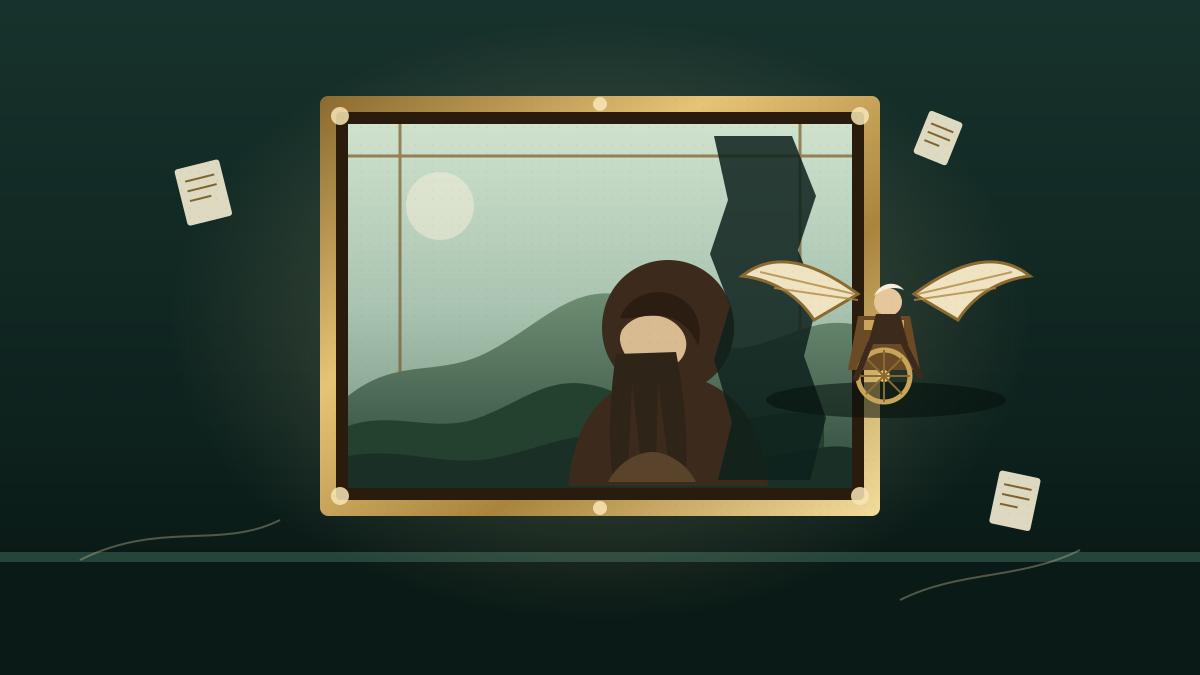
MONA LISA: Fly Behind the Painting begins where most art games stop: at the frame. You are old Leonardo, sitting on a wooden pedal machine in a valley filled with roughly 175 things he made in his life, and the Mona Lisa — seen from behind — is the sky. Press Space three times and the machine unfolds a pair of wings. From there the game is a quiet, open flight through a landscape made of his work.
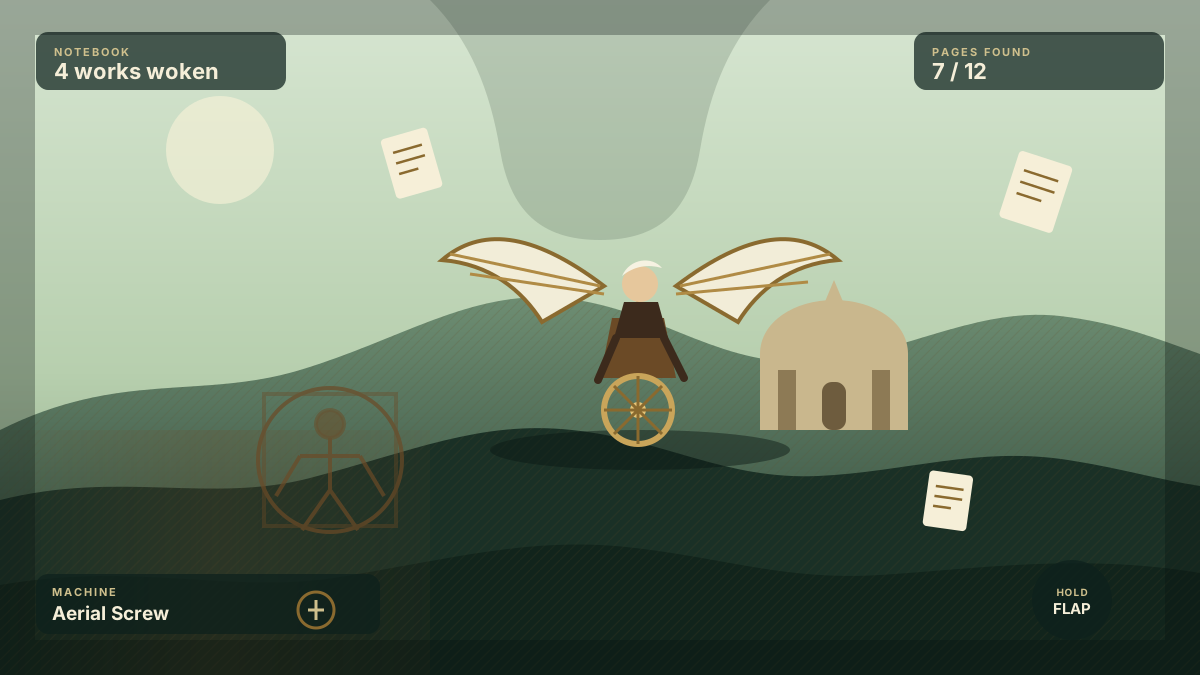
The central mechanic is restoration. Everything starts as brown-ink drawing. Loose notebook pages drift near each work, and bringing a page to a drawing wakes it into oil paint and motion. The Last Supper starts moving in its hall. The Duomo rises, the Lady with an Ermine appears, the Vitruvian Man assembles, and the aerial screw turns. Five of his other machines can be built the same way and then ridden, which turns the notebook into a workshop rather than a gallery. There is no timer, nothing chases you and nothing ends the flight. The only pressure is curiosity.
That makes MONA LISA the opposite of an arcade game. Steering is gentle: A/D or the arrow keys bank, holding Space or W flaps, S dives and lands, and E or Shift opens a parachute. Number keys switch between machines, N opens the notebook, T hides the HUD, C changes the camera and M mutes. On a phone you hold to flap and drag to steer, drag down to land, and use the wing button to take off. The interface supports English, Chinese and Japanese, and the whole experience is designed to be understood without a tutorial.
The build is technically interesting because the art direction is the system. A 3D world where every object is a drawing that becomes a painting is a rendering problem disguised as a history lesson, and the transition has to be legible from a phone at arm's length. MONA LISA was created by nilni and built with Claude Fable 5.2 and Claude Code. At the time of writing it had 40 plays and 43 minutes of tracked play on AIGameShare, which is a very different usage pattern from a high-score game: people are not grinding it, they are taking a ten-minute walk through a notebook.
How This Game Was Generated
Created by nilni and built with Claude Fable 5.2 and Claude Code. The game puts you on a wooden pedal machine inside a valley of about 175 Leonardo da Vinci works. Brown-ink drawings wake into oil paint when you bring them loose notebook pages, including The Last Supper, the Duomo, Lady with the Ermine, the Vitruvian Man and the aerial screw. Five other machines can be built and ridden, the Mona Lisa forms the sky, and there is no fail state. It includes English, Chinese and Japanese text plus keyboard, mouse and touch controls. At the time of writing it had 40 plays and 43 minutes of tracked play on AIGameShare.
The Prompt Behind This Game
Show the prompt used to generate MONA LISA: Fly Behind the Painting
Build a 3D exploration game set inside an artist's notebook. ONE self-contained HTML file (inline CSS/JS); Three.js from one pinned CDN import is the only library; all geometry, textures and audio are procedural. No external assets.

World and fantasy:
- You are an old inventor on a wooden pedal machine in a valley that contains about 175 works from one artist's life. The back of a famous portrait forms the sky, so looking up is part of the landscape.
- Everything starts as brown-ink line art on a paper-like ground. The world must look like a drawing before it looks like a place.
- The mood is quiet and curious. No enemies, no timer, no fail state, no fall damage. The player cannot lose the game.
Restoration mechanic:
- Loose notebook pages drift near each drawing. Bring a page to a work and it wakes into full oil paint: colour floods in, the subject begins to move, and a short sound cue confirms the change.
- Include at least eight named works, among them a long dining hall mural, a cathedral dome, a portrait of a lady with an ermine, a man in a circle and square, and a spiral flying machine. Each must have a distinct wake animation.
- Five other machines can be built from pages and then ridden. Each machine has one simple, different movement verb (glide, pedal, screw-lift, parachute, boat).
Flight and controls:
- On the ground: steer and pedal. Press takeoff three times to unfold wings. In the air: hold flap, bank, dive, land and open a parachute. Switching machines is a number key or a visible wheel on touch.
- Desktop: A/D or arrows steer, Space/W pedal or flap, S brake/dive, E or Shift parachute, 1-6 machines, N notebook, T hide HUD, C camera, M mute.
- Mobile: hold to flap, drag to steer, drag down to land, plus a wing button and a machine wheel. All touch targets at least 44px.
- A notebook screen lists discovered works, pages found and machines built. It must be usable as the only progression system.
Art direction and performance:
- Two visual states for every object: ink (monochrome, paper texture, line hatching) and oil (rich colour, soft shading, visible brush texture generated in code).
- Cross-fade between states over about one second; never pop instantly.
- Target 60fps on a mid-range phone. Use low-poly geometry, vertex colours and one directional light; no real-time shadow maps on mobile. Keep draw calls under 150.
- Localise UI strings into English, Chinese and Japanese. Persist discovered works in localStorage.
Testing and delivery:
- Write a headless traversal bot that starts at the spawn, finds every page and wakes every work using only the documented controls. Report: time to wake each work, any work that cannot be reached, any page that clips through geometry, and the frame-time p95 at 720p.
- Fail the build if any work is unreachable, if the game can enter a state with no valid input, or if the ink-to-oil transition drops below 45fps.
Deliver in stages: ink valley and walking first, then takeoff and flight, then one wakeable work, then all works and pages, then machines and the notebook, then localisation and polish. Print the works table and the traversal report at the end.
Open in the prompt library for tips and variations
Similar AI Games
 Simulation Games
▶ 467 plays
MERIDIAN
A 3D sailing and trading adventure on a spherical Earth with 114 ports, 42 illustrated taverns and four treasure expeditions you follow from clue to coastline.
Play now
 Action Games
▶ 752 plays
CINDERDEEP: Falling Sand Roguelike
A falling-sand roguelike where every pixel of the cave is simulated. Burn, freeze, dissolve and flood your way through five depths with a four-spell wand.
Play now
 Casual Games
▶ 512 plays
Anomnomnomaly
A seamless browser space sim: fly a solar system of nine planets and six moons with no loading screens, installable as a PWA, built solo with AI help on the server.
Play now
 Puzzle Games
▶ 425 plays
Tree Appreciator
A calm spot-the-difference game with two procedurally grown 3D trees. Find the differences, collect herbarium entries, and take your time.
Play now
Articles About MONA LISA: Fly Behind the Painting
Nov 17, 2026
MONA LISA: The AI Game That Lets You Fly Out the Back of a Painting
A no-fail 3D flight through Leonardo's notebook, where loose pages wake ink drawings into oil paint. Inside the restoration loop and its five rideable machines.
Oct 19, 2026
AI-Generated Browser Games Worth Knowing: October–November 2026
From a 12-hour sports hit and a weekend MMO to fifteen new browser games — a tin-toy kart racer, a spherical sailing sim, an art-print surf run and more.
Oct 15, 2026
The 10 Best AI Games to Play Online Free
Ten AI-generated games you can play online free right now — arcade, puzzle, strategy and endless runners, all built from text prompts and playable in your browser.
