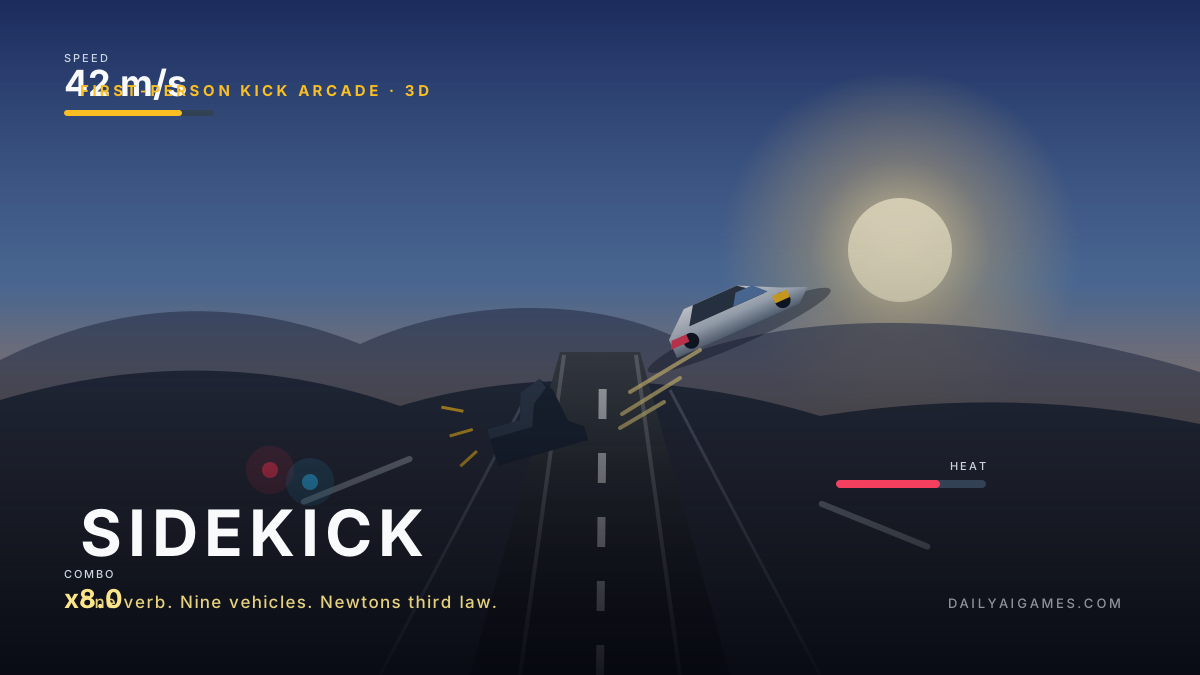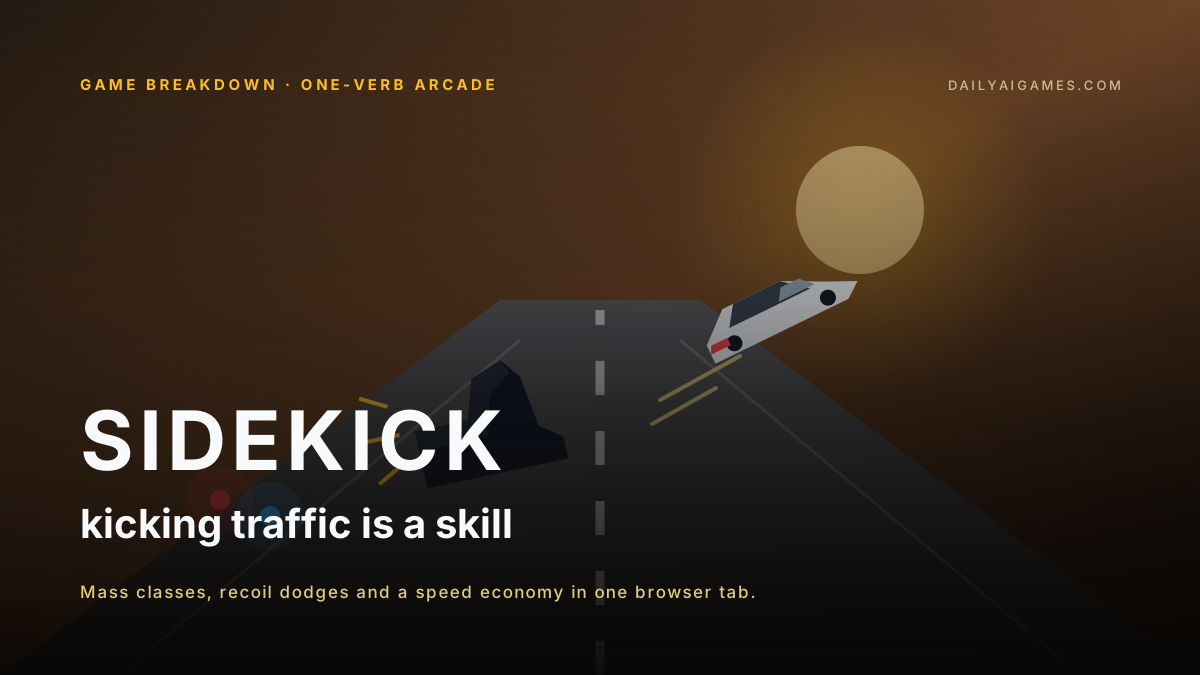
Most browser arcade games give you three buttons and hope one of them feels good. SIDEKICK gives you one, and it is a boot. You ride a motorcycle down a four-lane highway at speed, pull alongside a car, and kick it. The car leaves the road. That is the game, and it is a much better game than that sentence makes it sound.
At the time of writing SIDEKICK had 450 plays and 10 hours 41 minutes of tracked play on AIGameShare, with 275 of those plays in the last 30 days. For a game whose entire input is “kick the traffic”, those are strong numbers — and an average session long enough to suggest people are coming back.
One verb, three physics rules
The design works because the single verb is backed by a real physics model, not an animation. Cars are sorted into three mass classes: light sedans, taxis and hatchbacks fly when you kick them; pickups and vans move less; trucks and buses barely budge. A kick transfers impulse scaled by your current speed, so the same input produces different results depending on how fast you are going.
The clever part is the third rule: kicking something heavy throws you sideways. Newtons third law is not a detail here, it is the dodge. Springboarding off a bus to cross lanes is the advanced move, and it only exists because the game refuses to make the player a weightless camera with a foot attached.
That combination gives SIDEKICK a skill ceiling that the premise does not advertise. You are not aiming. The game picks the best target. You are positioning, timing and managing recoil, which is a very different and much more interesting problem than pointing at a car.
Speed is health, kick power and score
SIDEKICK collapses three resources into one number. Your speed is your health, the force behind your kicks, and your score. Grazing traffic and grinding the guardrail drain it. Clean driving recovers it. A head-on collision with live traffic ends the run.
That single-number economy is why the game stays tense without enemies. Every decision is a trade: take the gap between two cars and risk a graze, or swing wide and lose the speed you need for the next kick. The combo multiplier — up 0.5 per kick, to a cap of x10, expiring six seconds after your last one — pushes you toward the risky line rather than the safe one.
There is also a rare armoured vault van that pays a 40 to 60 coin jackpot when you kick it or knock another car into it. It is the closest thing SIDEKICK has to a boss, and it is worth the detour almost every time.
Heat, police and the perfect kick
Kicking builds HEAT. At high heat, police cars arrive from behind, pull alongside and ram you. You can kick a cop for a COP DOWN bonus, which adds even more heat. And if a cruiser stays within 20 metres while you are under 16 m/s for 2.5 seconds, the run ends as BUSTED. Speed is the escape, which loops neatly back into the speed-as-health design.
The other timing layer is the white footprint prompt that appears for about a quarter of a second before the ideal kick. Hit it and you get a PERFECT: double force, no speed cost, half the recoil. It is the difference between a run that survives a wall of traffic and one that ends under a truck. At 40 m/s, a footprint icon is readable in a way that a text prompt never would be.
The garage and the five-minute loop
Coins from runs persist, and the Garage has three upgrade tracks with four tiers each: BOOTS for kick force, STANCE for recoil and grip, ENGINE for top speed and recovery. The numbers are visible, the next price is visible, and the improvements are felt immediately. On a phone, the game becomes a drag-to-steer plus one large KICK button, with target selection still automatic. The controls change; the skill does not.
That is the whole structure: a two-minute run, a small permanent upgrade, another run. It is the oldest loop in arcade games, and SIDEKICK executes it with enough comedy — slow-motion bus flips, a GoPro-style HUD, a run-end card that frames your death as a viral clip — to make the repetition feel like the point.
What AI got right, and where it is thin
SIDEKICK was created by nilni and built with Claude Fable 5 as a Three.js game with procedural traffic and no downloadable assets. The remarkable part is not that an AI wrote a motorcycle game. It is that the game understands its own joke well enough to build mechanics around it: the mass classes, the recoil-as-dodge rule and the perfect-kick window are all design decisions, not default engine behaviour.
The limits are equally clear. The highway is one road with one set of vehicle types, and after a dozen runs you have seen every trick the traffic can play. There is no reason to learn the lanes the way you learn a racing line. SIDEKICK is a five-minute game that knows it is a five-minute game, and it does not overstay.
What to copy if you build one
Our first-person motorcycle kick arcade prompt is the reusable version of this build. The decisions worth stealing:
- Give the one verb a physical consequence for the player. Recoil turns a gag into a movement system.
- Collapse your resources. Speed doing three jobs creates constant, readable tension.
- Put timing on screen as a shape, not a sentence. A footprint icon works at speed; “press Space now” does not.
- Make the reward rare and loud. The vault van is memorable because it is not every third car.
- Sell permanent upgrades with visible numbers. The garage is why run twenty happens.
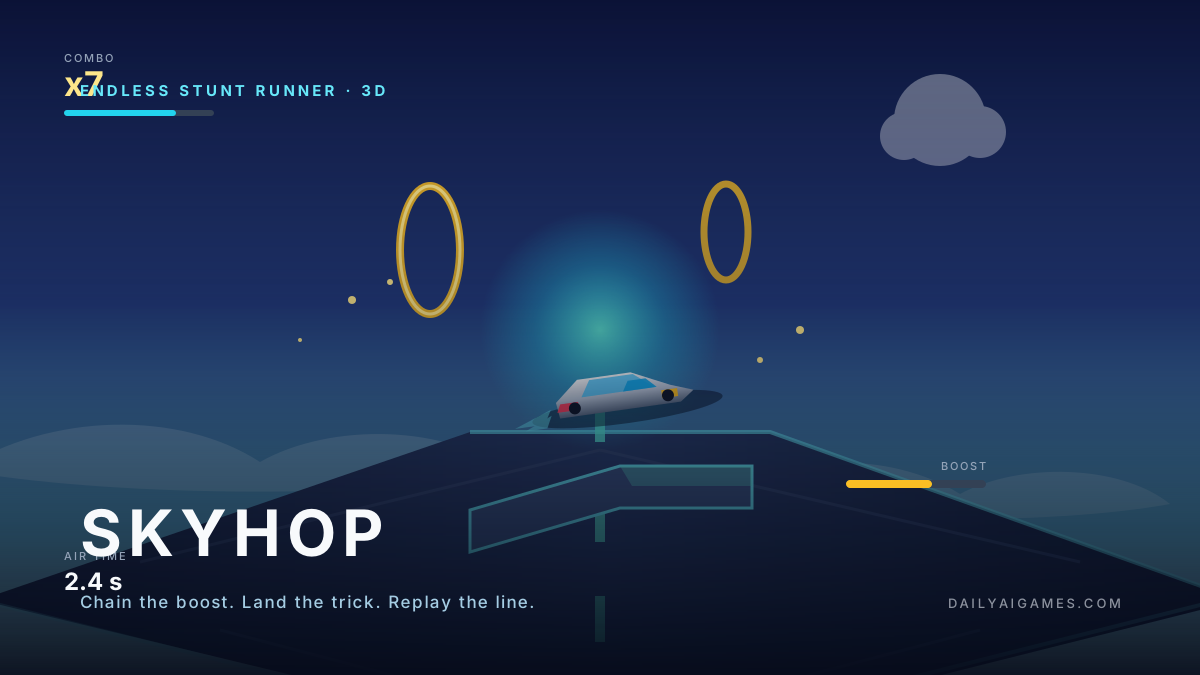
If you like the idea of a browser game built around vehicular chaos, SKYHOP takes the opposite approach — a flying car, an endless sky strip and a trick-scoring system — and our flying-car stunt combo prompt breaks down how that one was built.
Verdict
SIDEKICK is not deep, and it does not need to be. It is a one-verb arcade game with a real physics joke at its centre, a speed economy that makes every lane change matter, and a progression loop that fits inside a coffee break. Kick a bus, get thrown across the highway, land it, and tell yourself you meant to do that. The game is built for exactly that moment.