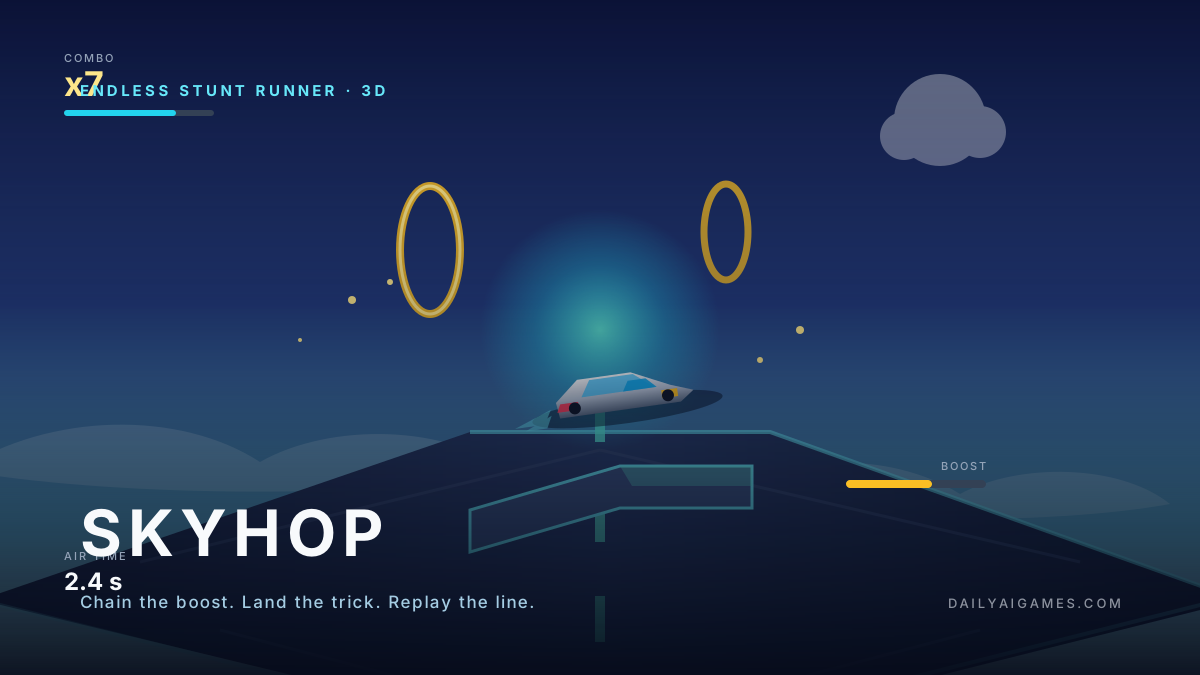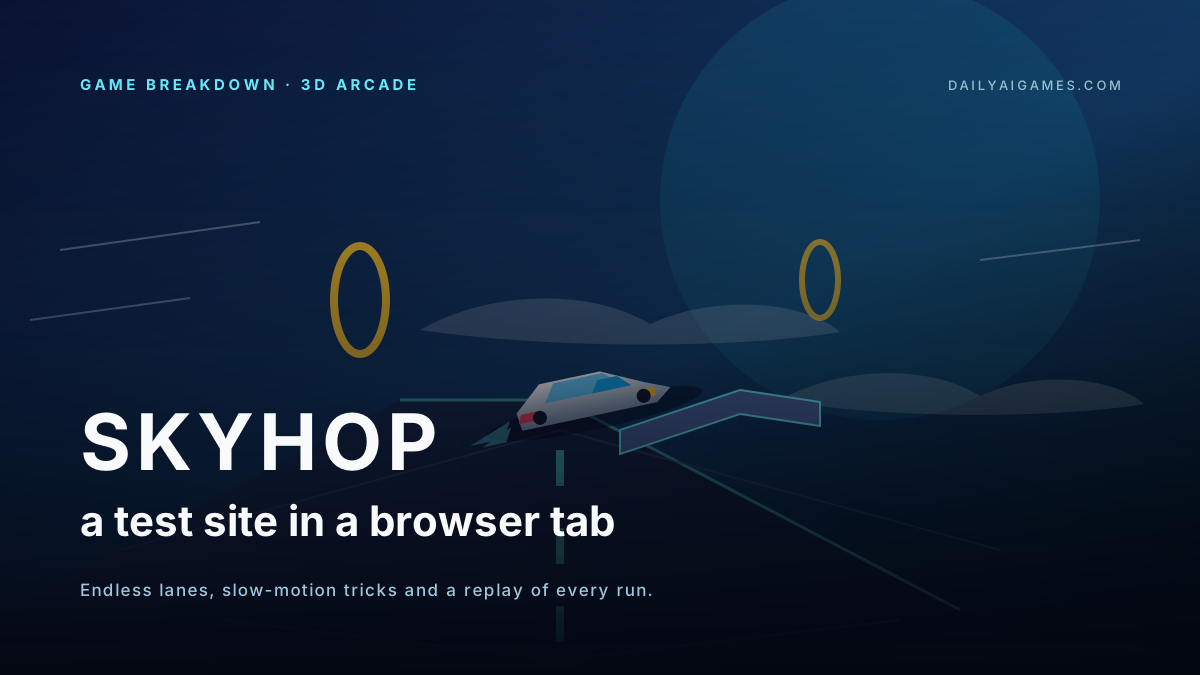
Most browser driving games ask you to race something. SKYHOP asks you to survive the road. It is a 3D flying-car stunt game on an endless strip of sky-lanes, and the whole design is pointed at one feeling: the half-second between leaving a ramp and finding out whether you land it.
You can play SKYHOP on AIGameShare right now, and if you have five minutes and a keyboard, that is probably the best use of them in this article. The rest of this is about why the game works and what it says about AI-generated 3D games in late 2026.
The run is a single line, and that is the point
There is no garage, no track select and no start screen. The car is already moving when the page loads, and the world builds itself ahead of you in chunks: ramps, gaps, moving hazard blocks and rings that refill your boost. Behind you, the track is recycled. Nothing is pre-built, and nothing waits for you.
That structure removes the two things that usually kill a browser arcade game in the first thirty seconds: a menu and a loading screen. SKYHOP starts in motion, which means your first input is a steering correction rather than a click on “Play”. It also means the game is always in its most interesting state — at speed — instead of easing you in with a tutorial lap nobody reads.
The cost is that failure is immediate. Miss a gap and the run ends. But the game is generous about everything else: air control is wide, landings are graded rather than binary, and a sloppy trick usually costs you a combo instead of the whole run. That balance — harsh on the road, forgiving in the air — is what makes the one-more-run pull work.
The combo meter is the real game
Driving is the entry fee. The trick system is the game.
Every jump puts the car into an air state where steering rotates it. When you land, the game compares your rotation to the road and scores three things separately: air time, rotation and landing quality. A clean landing keeps your speed and extends the combo; a bad one cuts your speed and resets the chain.
That separation is a small design decision with a large effect. In most stunt games, a failed trick is just a failed trick. Here, you can see exactly which part you got wrong — you had the rotation but landed nose-down, or you landed clean but had no air time to speak of — and that gives you something to practice. It turns a novelty into a skill.
The presentation then does the emotional work. Big jumps trigger a short slow-motion window so you can watch the car turn, and the run ends with a replay of your best line from a chase camera. The replay is the smartest thing in the build. A one-minute run is disposable; a one-minute run that ends with footage of your best jump is something you want to send to someone.
What it borrows from kart racers
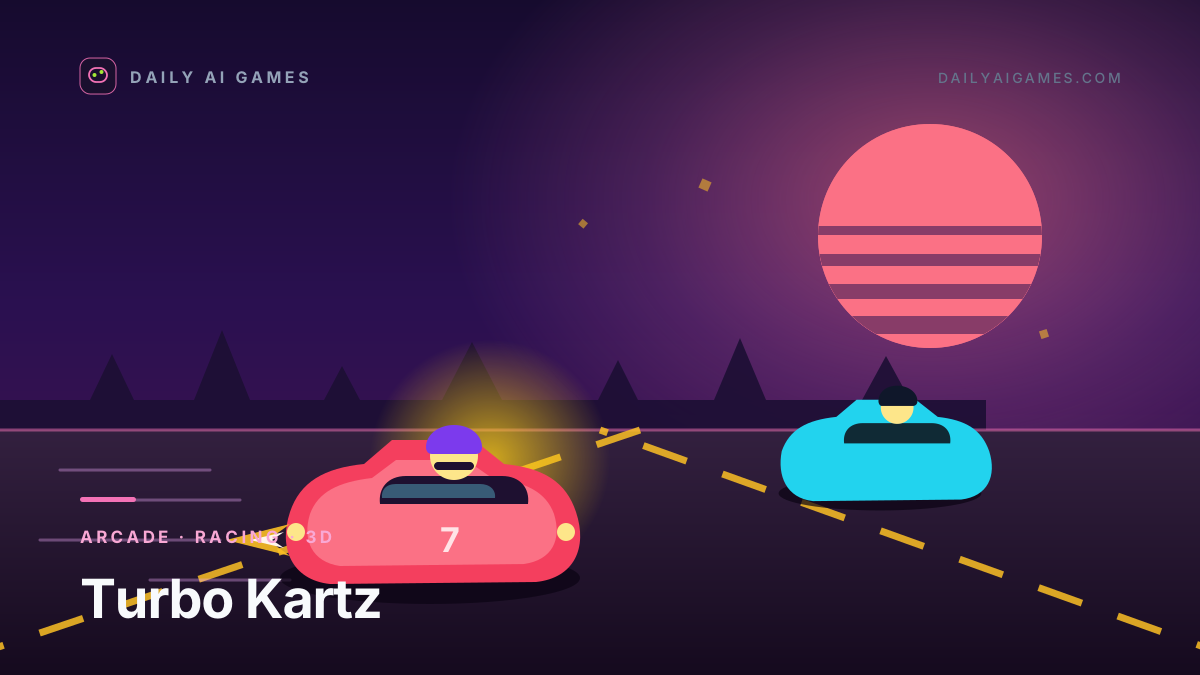
If you have played Turbo Kartz, the local-multiplayer kart racer in our arcade category, the family resemblance is obvious: chunky vehicles, ramps on the fast sections, and a boost that is earned rather than given. Both games also understand that a browser racer lives or dies on input feel, which is why both ship gamepad support alongside keyboard and touch.
The difference is the audience. Turbo Kartz is a living-room game for two to four people. SKYHOP is a solo score chase with no opponents at all — the track is the antagonist. That makes it closer in spirit to Cyber Dash, our endless runner, where the only question is how long you can keep the line clean. If you like one, the other is the same itch at a different speed.
SKYHOP also slots into a genre the site did not have a proper home for until this week. We added a Racing tag so the stunt and driving games are reachable as a group, and SKYHOP and Turbo Kartz are the first two entries.
How SKYHOP was made
SKYHOP was created by nilni and built with Claude Opus 5.5 in Claude Code. The game page credits twelve demo nights of iteration before the current build, which is a useful number: it suggests the first version was playable and the next eleven were about feel, not features.
The technical shape is a Three.js scene with procedural track chunks, instanced road geometry and no downloadable art. That is the only sane way to build an endless 3D track in a browser. If you generate the whole course you pay for it in load time; if you generate per-frame you pay for it in frame time. Chunking and pooling sit in the narrow band between the two.
If you want to build something similar, our flying-car stunt combo prompt lays out the full spec: the chunk generator, the survivable-line check, the air state, the three-part scoring and the replay buffer. For the presentation layer — speed lines, landing shockwaves, camera roll and the restraint to keep shake under two pixels — the game juice polish prompt is the companion piece.
The caveats
SKYHOP is a small game, and it does not pretend otherwise. There is one car, one environment and one mode. The leaderboard is not something you build a rivalry around, and the twelve demo nights show in the polish of the trick camera more than in the amount of content.
It is also, at the time of writing, a trend rather than an institution: third on the AIGameShare weekly list with 201 plays for the week, and sessions that average one to five minutes. That is a healthy number for a game this new, but it is not proof of a lasting audience.
What to take from it
Three lessons are worth copying, whether you are building a stunt game or anything else for a browser:
- Start in motion. Remove every screen between the player and the loop. The first five seconds decide whether the tab stays open.
- Score the failure, not just the success. A three-part trick score teaches players something a single pass/fail check cannot.
- Give the run a souvenir. A replay buffer is cheap to implement and does more for retention than another mode.
If you have a spare five minutes, play SKYHOP and try to chain two tricks without losing speed. If you have a spare weekend, read the prompt and build the version you wish existed.