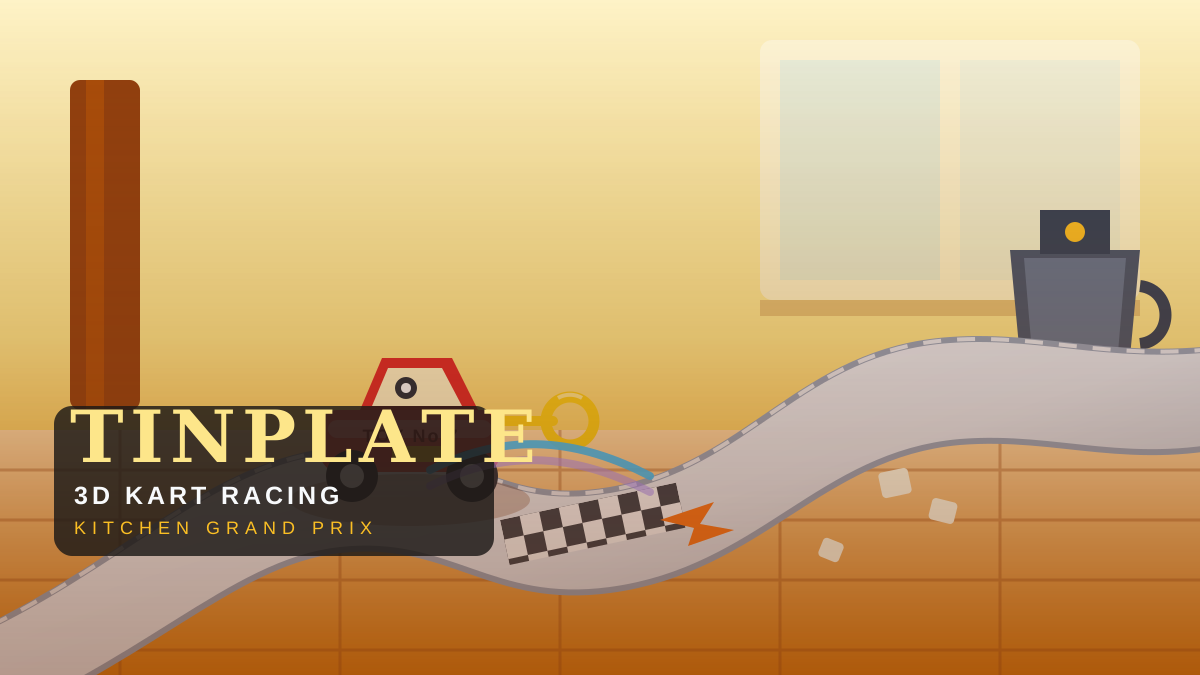
Most browser racing games are a camera, a road and a number that goes up. TINPLATE 3D Kart Racing: Kitchen Grand Prix is a camera, a giant 1950s kitchen and six wind-up tin toys, and the difference is the whole game. You are not driving a car around a track. You are a clockwork rabbit the size of a thumb, diving off a breakfast table into a spiral tower and crossing a sink on a tin bridge while a percolator hums somewhere above you.
At the time of writing TINPLATE had 548 plays on AIGameShare and ranked ninth on the platform’s weekly trend list, which is a strong second wind for a game that first appeared in late September. It is also the best argument I have seen this month that a browser game’s theme can do real mechanical work instead of sitting on top of the mechanics like paint.
The kitchen is the track
The circuit is one continuous toy-scale diorama. You start on the breakfast table, drop into a spiral tower, race under the dinette chairs, cross the sink on a tin bridge, U-turn around the percolator, run the sunny windowsill straight and swing out over the floor at a balcony hairpin before climbing back to the table. Three tracks are built from these pieces, and every one supports a reverse run, which effectively doubles the circuit list without doubling the art budget.
That is a smart production decision, and it is not the only one. The racers are deliberately simple shapes — robot, rabbit, duck, bear, monkey, cat — because at kart speed you read silhouette, not detail. The lighting is baked rather than real-time, which is why the game holds up on a phone while still looking sun-drenched. The whole thing is wrapped in a live 1950s rock and roll soundtrack that does more for the period feel than any amount of extra polygons.
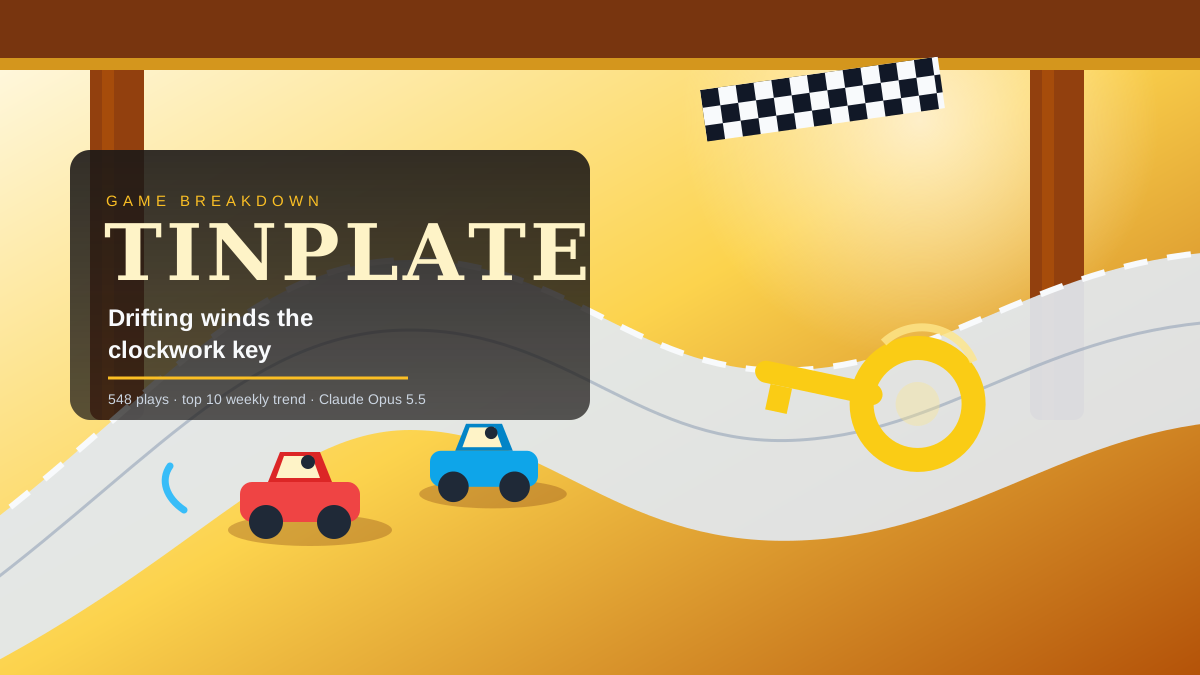
Drifting winds the key
Here is the mechanic that makes TINPLATE more than a pretty diorama. Each tin toy has a visible clockwork key on its back. Hold the drift button through a corner and the key winds through three colour stages: blue, then orange, then violet. Release the drift and the stored tension fires as a boost scaled to the stage you reached. Drift too long and the key overheats, cancelling the boost.
That one rule turns every corner into a decision. A clean line is safe and slow. A greedy line winds the key further but risks the overheat. Because the boost is shown on the kart’s body, you can read an opponent’s intentions from behind: a violet key means they are about to launch, and you should probably not be directly in front of them.
The rest of the handling is arcade-first. Hold accelerate on the count of two for a rocket start; miss it and you get wheelspin. Sugar cubes give you items — springs that bounce you forward, marbles you drop behind, butter pats that leave a slick patch, and the golden key for a short invulnerable burst. Nothing here is a simulation, and nothing here needs to be.
A four-race Cup with real rooms
The structure is generous for something that loads in a tab. There are three speed classes, and they are not just multipliers on the same curve — the slow class has a genuinely tighter turning circle, which changes which lines are viable. The Kitchen Cup runs four races, awards points per finish, and keeps a leaderboard time for the fastest full Cup. A results screen shows the gap to first, which is exactly the number a time-trial player wants.
Multiplayer is handled better than most small browser racers. You can create a room and share a code, or quick-match into a live room, for up to six players. Empty seats are filled by CPU racers immediately, and latecomers join the next race instead of stalling the lobby. That sounds like a small thing until you have sat in a browser game waiting for a room to fill; it is the difference between a game you try once and a game you send to a friend.
The CPU drivers also use the drift system, defend a line and recover from spins. They are not brilliant, but they are legible, and they make the Cup feel like a race rather than a time trial with obstacles.
Why the theme matters
TINPLATE was created by nilni and built with Claude Opus 5.5 with a 1M-token context plus Claude Code. The technical achievement — a 3D kart racer with online rooms in a browser — is real, but it is no longer rare. What is rare is the discipline of the theme. The clockwork key is the boost meter. The sugar cubes are the item boxes. The kitchen is the circuit. Every mechanic belongs to the toy world, so the game feels designed rather than assembled.
That is the lesson worth taking to your own build. If you want to make a racing game with AI, do not ask for “a kart racer”. Ask for a specific toy, a specific room and a specific reason the boost exists. Our 3D kart racer prompt is written that way, with the drift-to-wind rule, the three speed classes and the room-fill rules spelled out as fixed numbers and failure conditions.
Controls and the mobile build
On desktop, Up or W accelerates, Down or S brakes, Left and Right steer, and holding Space or Shift drifts. X or E uses an item, Esc opens the menu. On mobile, you drag on the left to steer and use accelerate, brake, drift and item buttons on the right, sized for thumbs. Gamepad steering and accelerate are supported too.
The mobile build is the one that surprised me. Drifting with a touch drag is not obviously going to work, but the key stage gives you a clear visual target: you are not timing a slide, you are watching a gauge fill on your own kart. That makes the mechanic readable on a small screen in a way that a hidden drift charge would not be.
What AI got right, and where it is thin
The impressive part is not the 3D. It is that the game has a coherent answer to “why this kitchen?” at every layer: the items, the racers, the soundtrack, the track furniture. The weak part is variety. Three tracks plus reverse runs is a fine afternoon, not a long-term racing habit, and the leaderboard is still sparsely populated. The CPU field is honest but not devious; once you can hold a violet key through the balcony hairpin, you will win the Cup more often than not.
None of that undercuts the core. TINPLATE is a small, specific, well-made racing game that happens to run in a browser tab, and it is the first AI-built racer I have wanted to replay for the line rather than the novelty.
What to copy if you build one
- Tie the core mechanic to the theme. “Drift winds the key” is memorable; “drift fills a bar” is not.
- Give drifting a failure state. Overheating the key turns a greedy corner into a real risk.
- Never block a race on a lobby. Fill with CPU racers and let latecomers join the next one.
- Bake your lighting. A single directional light and vertex colours will run on a phone; real-time shadows will not.
- Report corner-cutting exploits. One wall-ride shortcut can invalidate every leaderboard time.
If you like games that build a whole world out of one material idea, CINDERDEEP does the same thing with falling sand, and MERIDIAN does it with an ocean you can actually sail around.
Verdict
TINPLATE is the best kind of AI-generated browser game: a small, specific idea executed with enough mechanical depth to justify the theme. It is a kart racer where the boost is a wind-up key, the track is a kitchen and the fastest line is the one that winds the key furthest without breaking it. Take the corner, watch the violet, and let go.