HANDFUL: Island God Game
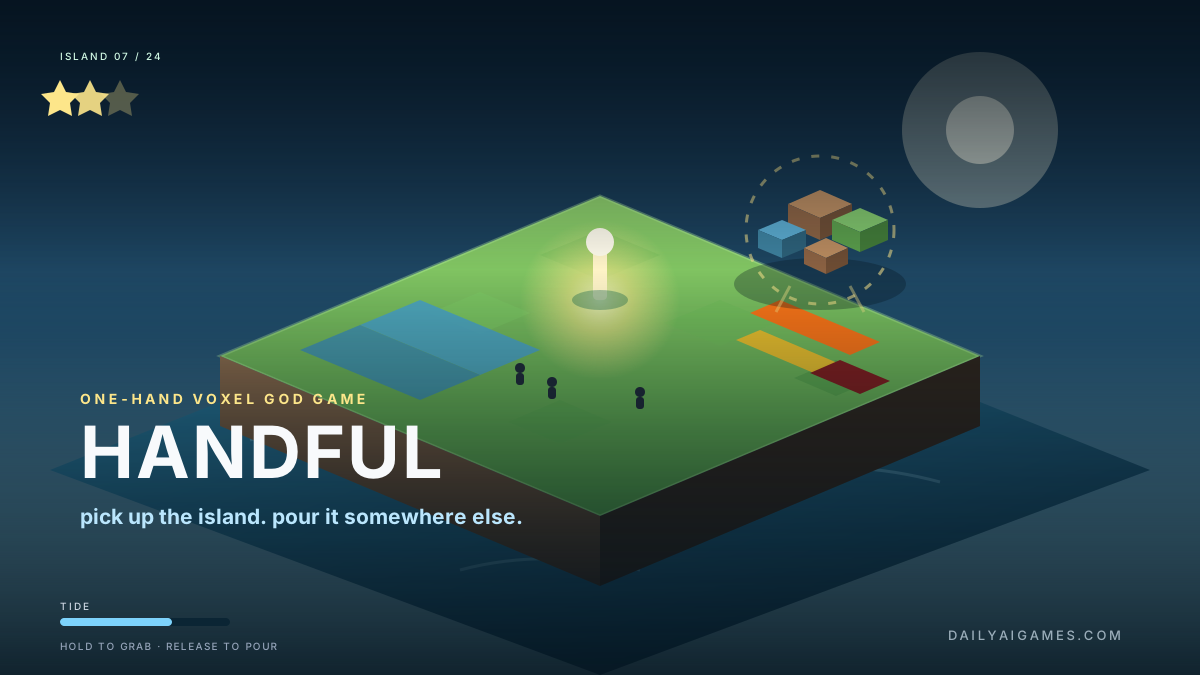
A 3D god game on an island of eight million simulated voxels. Scoop up sand, water and lava with one hand, reshape the coast, and lead your island folk to the beacon.
HANDFUL: Island God Game
Play on AIGameShareOpens aigameshare.com in a new tab · free · no download
51 plays tracked on Daily AI Games
External game siteHANDFUL: Island God Game is not hosted on Daily AI Games. The button above opens an independently operated, free browser game on AIGameShare; its content, availability and controls are controlled by that site.
How to Play
Hold the left mouse button or one finger on the ground to grab, drag while holding, then release to pour. Right-drag a mouse, swipe sideways with two fingers on a trackpad, or press A/D to orbit the camera. Each island asks you to connect the villagers to the glowing beacon; sink or pour material to build the route. 24 islands, three stars each, plus an endless sandbox.
These are the controls for HANDFUL: Island God Game. The external HANDFUL: Island God Game version on AIGameShare may use slightly different controls.
Game Preview
About HANDFUL: Island God Game
HANDFUL is a god game built on a single, beautifully literal idea: you have one hand. Hold the button on the ground to scoop up whatever is there — sand, earth, sea water, even lava — then hold somewhere else to pour it out. That is the entire control scheme, and it is enough to reshape an island of eight million simulated voxels. Your island folk want to reach a glowing beacon, and they start walking the moment a path exists. Your job is to build that path, and the island does not make it easy.
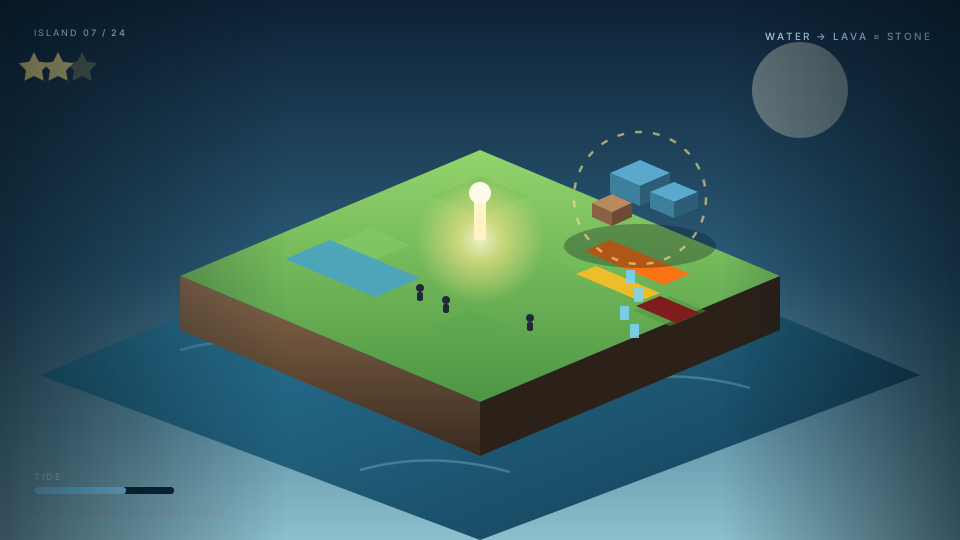
Everything in the simulation is emergent rather than scripted. Water flows downhill and finds its level. Lava creeps toward the sea and crusts over into stone when it meets water. Fire spreads through forest, steam rises and falls back as rain, and sand slopes under its own weight. Fill a strait with sand to raise a causeway, then watch the rising tide eat it away. Quench a wildfire with handfuls of sea water. Pour water on an incoming lava flow to forge a stone wall before it reaches the village. None of these are special-case mechanics; they are all consequences of a small set of material rules, which is why the solutions feel like your own.
The campaign gives you 24 islands, each with a beacon, a village and a specific problem: a broken causeway, a flooding valley, a volcano that will not stop. Every island is proven winnable by a bot that plays with the same hand you do, which matters more than it sounds — it is the guarantee that no level depends on a trick the simulation cannot actually perform. Each island is scored out of three stars, usually for saving time, saving villagers or saving material, and there is a full sandbox where the volcano never stops erupting and nothing is scored at all.
Presentation is deliberately calm. The island is low-poly voxel terrain with a readable colour language — blue for water, black for cooled rock, orange for anything that will hurt — and the camera orbits with a sideways two-finger swipe, right-drag, or A and D. A single run takes one to five minutes, which makes it a browser game you can dip into rather than a management sim you have to commit to. On a phone, one finger is genuinely enough: hold to grab, drag, lift to pour.
HANDFUL was created by nilni and built with Claude Fable 5.2 and Claude Code. At the time of writing it had 51 plays and 57 minutes of tracked play on AIGameShare, which is a small sample — but the design is unusually clear-eyed about what a browser god game should be. It does not ask you to manage an economy or learn a tech tree. It hands you a handful of the world and asks what you want to do with it.
How This Game Was Generated
Created by nilni with Claude Fable 5.2 and Claude Code. The game runs a voxel simulation of roughly eight million cells with emergent water, lava, fire and steam behaviour, no scripted level solutions, 24 campaign islands each validated as winnable by a bot using the same one-hand input as the player, three-star scoring per island, a free sandbox mode, and mouse, trackpad, keyboard and one-finger touch controls. At the time of writing it had 51 plays and 57 minutes of tracked play on AIGameShare.
The Prompt Behind This Game
Show the prompt used to generate HANDFUL: Island God Game
Build a 3D voxel god game in ONE self-contained HTML file (inline CSS/JS). Three.js from a single pinned CDN import is the only library; all terrain, materials and effects are procedural. No external models, textures or audio files.

The core verb (one hand):
- The player has exactly one interaction: hold on the terrain to grab the material under the cursor, drag while holding, release to pour it. No tool menu, no build palette, no second action.
- Grab a sphere of roughly 600 voxels at a time (radius about 5 cells), rendered as a floating clump that follows the cursor and casts a soft shadow on the ground so the player can aim the pour.
- Pouring fills empty or replaceable cells gravity-first, from the bottom of the clump upward. A pour must never leave floating material.
- Desktop: hold left mouse, orbit with right-drag or A/D. Mobile: one finger grabs and pours, two fingers orbit. Portrait and landscape both playable.
World and simulation:
- An island of roughly 8 million voxels on a 256x128x256 grid. Only surface cells and a shallow shell need full simulation: use a heightmap plus a sparse delta layer for edits so memory stays inside a phone budget.
- Materials: air, sand, dirt, stone, grass, wood, sea water, lava, fire, steam, rain, cooled rock. Interactions live in one small rule table: water flows downhill and levels; lava + water -> stone + steam; fire spreads through wood and is put out by water; steam rises, condenses and falls as rain; sand collapses past a slope limit.
- Run the simulation on a fixed tick (about 12Hz) decoupled from rendering, and keep cost bounded: simulate active cells within a radius of recent edits, plus the ambient tide and weather.
- The sea has a slow tide cycle, so a causeway built at low tide can be lost later.
Campaign:
- 24 islands, each with a village, a glowing beacon and one clear problem: a broken causeway, a flooding valley, a wildfire, a volcano, a drought, a wall that must be opened.
- Villagers pathfind to the beacon automatically the moment a walkable route exists. Never require a start button; the level reacts to the world.
- Prove every island winnable: write a headless bot that uses the same grab-and-pour interface, not a cheat API, and can solve each island. Fail the build if any island has no bot solution.
- Three-star scoring based on time, villagers saved and material moved. Unlock the next island on any win and show the star thresholds before the player starts.
- A sandbox mode with an endless volcano and no scoring, available from first launch.
Presentation:
- Low-poly voxel look with flat lighting and a readable palette: blue water, black cooled rock, orange-hot lava, green grass. Keep the horizon visible and never hide hazards behind UI.
- HUD: island number, stars, a small tide meter and a reset button. No minimap.
Testing and delivery:
- Run a headless solver over all 24 islands and print: solution time, voxels moved, whether the solution survives one tide cycle, and any island requiring more than three times the median moves.
- Report frame-time p95 at 720p on a mid-range phone, peak memory, and the active-cell count during a large lava flow.
Deliver in stages: heightmap island and grab/pour first, then water, then lava/fire/steam, then villagers and pathfinding, then the 24 islands, then stars and sandbox. Print the material table and the solver report at the end.
Open in the prompt library for tips and variations
Similar AI Games
 Action Games
▶ 752 plays
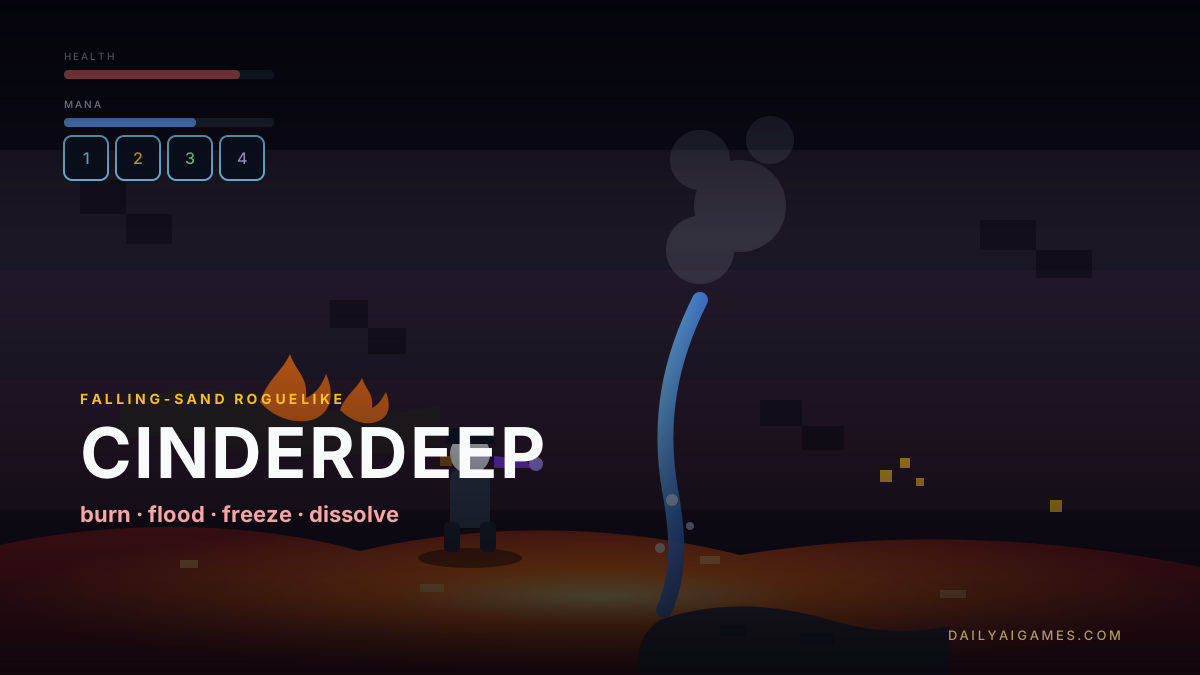
CINDERDEEP: Falling Sand Roguelike
A falling-sand roguelike where every pixel of the cave is simulated. Burn, freeze, dissolve and flood your way through five depths with a four-spell wand.
Play now
 Puzzle Games
▶ 425 plays
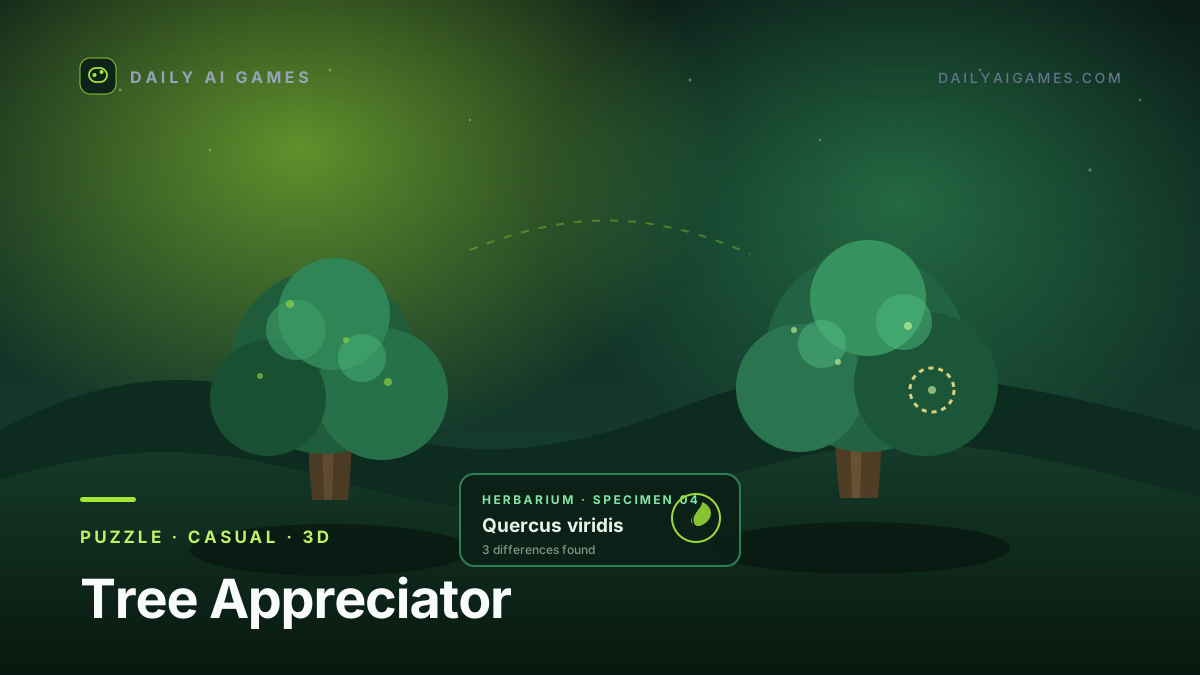
Tree Appreciator
A calm spot-the-difference game with two procedurally grown 3D trees. Find the differences, collect herbarium entries, and take your time.
Play now
 Casual Games
▶ 40 plays
MONA LISA: Fly Behind the Painting
A no-fail 3D flight through Leonardo da Vinci's notebook: bring ink drawings back to life, build his machines and fly out the back of the Mona Lisa.
Play now
 Simulation Games
▶ 24 plays
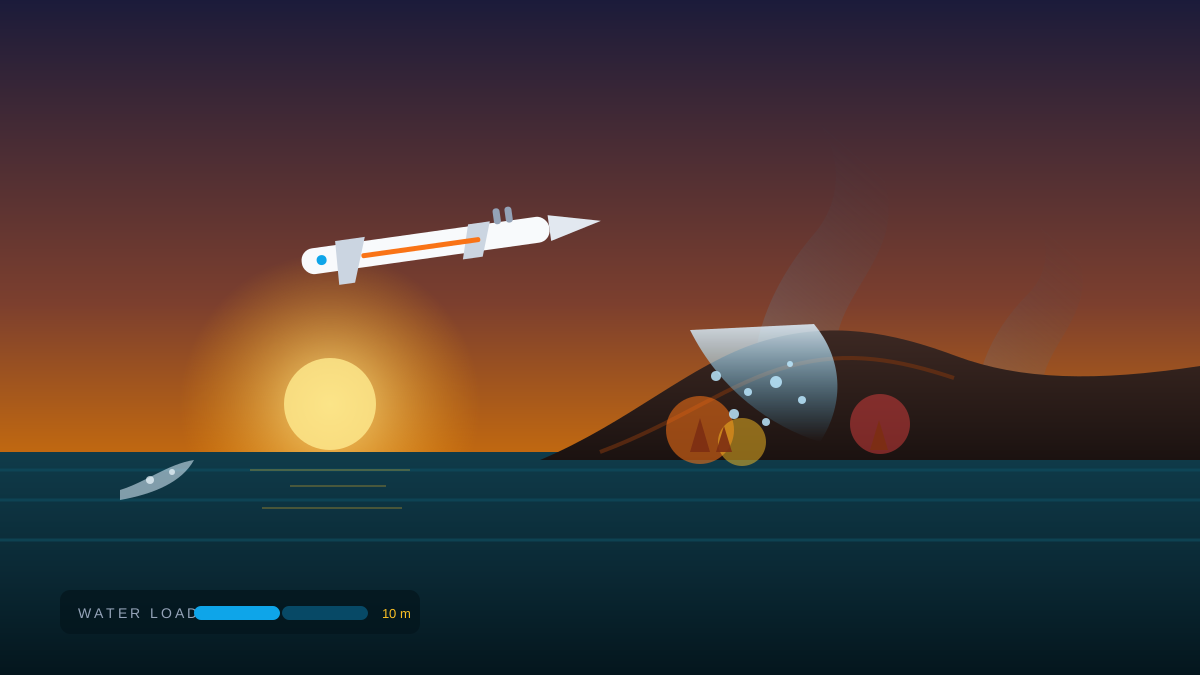
Firefighting Plane 3D: Pelican Reach
A twin-prop firefighting sim over Pelican Reach: skim the sea below 10 m to refill two water loads, then time the drop on burning cedar groves.
Play now
Articles About HANDFUL: Island God Game
Nov 12, 2026
HANDFUL: The One-Hand God Game Built on Eight Million Voxels
HANDFUL gives you a single verb — grab the ground and pour it somewhere else — on a fully simulated voxel island. We look at why the constraint makes the god game.
Oct 19, 2026
AI-Generated Browser Games Worth Knowing: October–November 2026
From a 12-hour sports hit and a weekend MMO to fifteen new browser games — a tin-toy kart racer, a spherical sailing sim, an art-print surf run and more.
Oct 15, 2026
The 10 Best AI Games to Play Online Free
Ten AI-generated games you can play online free right now — arcade, puzzle, strategy and endless runners, all built from text prompts and playable in your browser.
