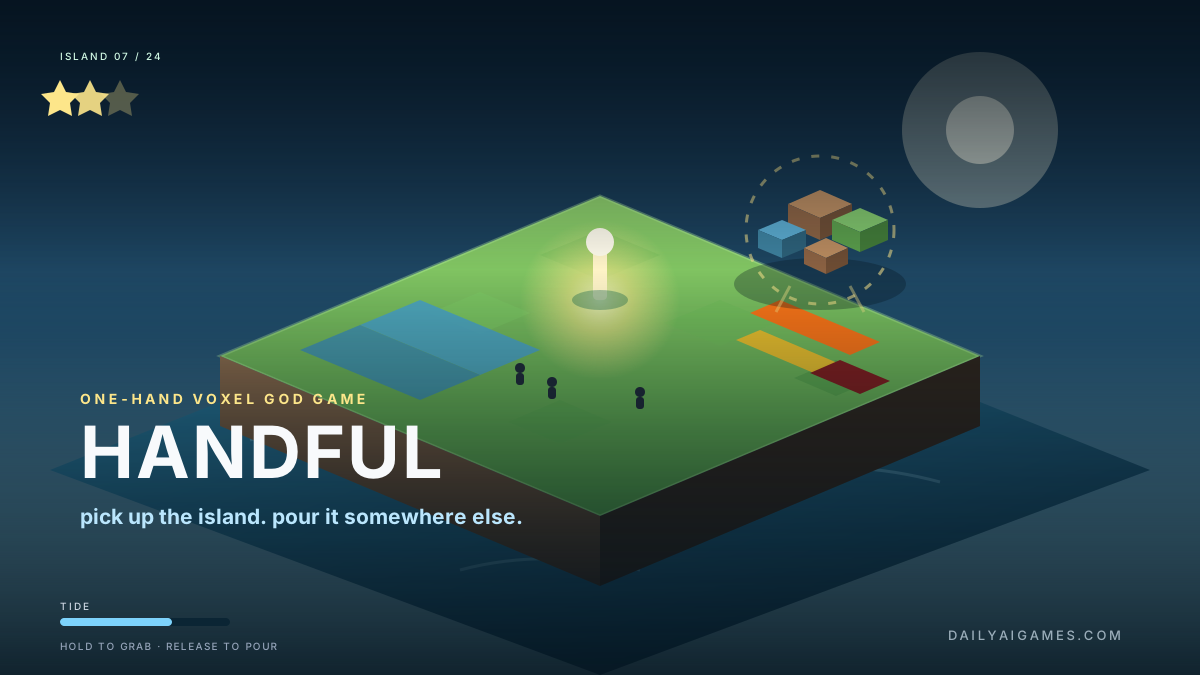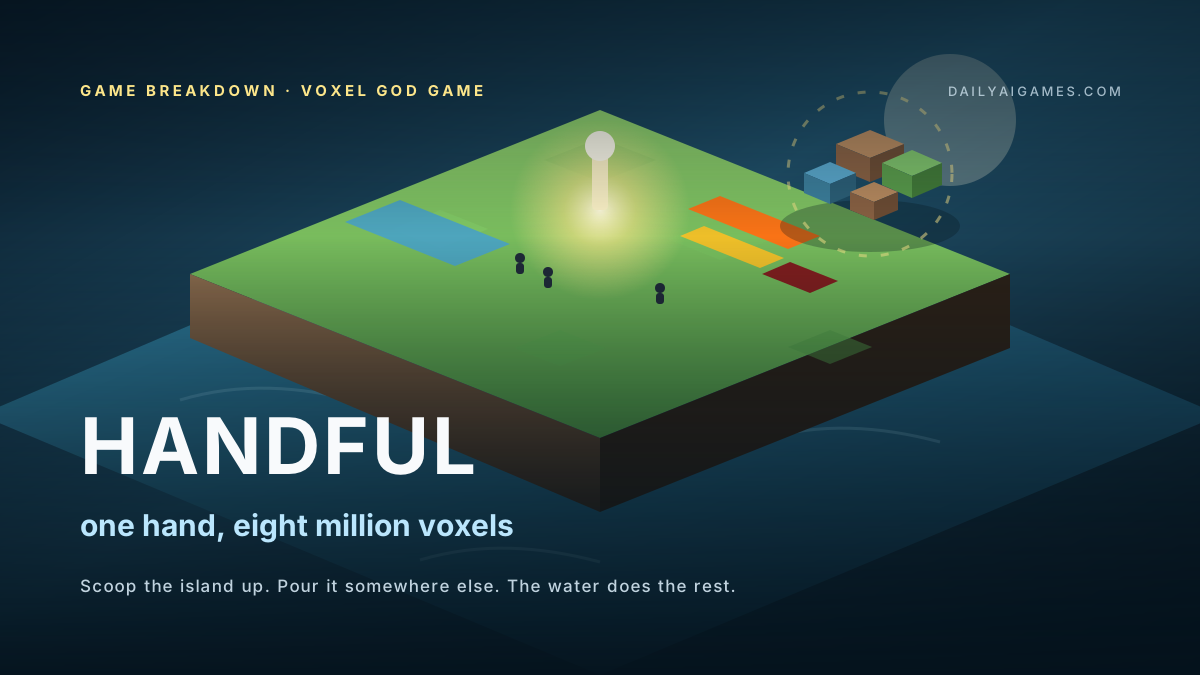
God games usually give you a toolbar. Raise terrain, lower terrain, paint water, spawn a disaster, open a menu. HANDFUL takes all of that away and replaces it with one action: hold on the ground to grab whatever is there, and hold somewhere else to pour it out. Sand, earth, sea water, lava. That is the whole interface. No brush sizes, no material picker, no disaster button.
It sounds like a limitation. It plays like a thesis. The constraint is what makes the island feel like a physical object rather than a spreadsheet with a 3D view.
One hand, eight million voxels
The island is a voxel simulation of roughly eight million cells, and the hand picks up a clump of them at a time. The clump follows your cursor and casts a shadow, which is the only aiming aid you get. Pour it and the material falls, settles and behaves according to what it is.
Everything is emergent rather than scripted. Water flows downhill and finds its level. Lava creeps toward the sea and crusts into stone where it meets water. Fire spreads through forest, steam rises and comes back down as rain, and sand collapses past a slope limit. None of these are special animations triggered by a level script. They are the same small set of rules applied everywhere, which is why solutions feel authored by the player rather than discovered in the designer’s pocket.
The sea also has a tide. A causeway you build at low tide can be eaten away later, which turns a one-time construction puzzle into a question about margin. Build it high enough, or build it twice, or accept that you are racing the water.
The island wants something
Each of the 24 campaign islands has a village, a glowing beacon and one clear problem. A broken causeway. A valley that floods. A wildfire that will not stop. A volcano that keeps erupting. A wall that has to be opened.
The villagers do the rest. The moment a walkable route to the beacon exists, they start walking. There is no start button and no confirmation dialog. The level reacts to the world you have made, which means the feedback loop is immediate: pour sand into the strait, watch the path form, watch the villagers move.
That immediacy is the entire appeal. A traditional god game asks you to plan, then simulates, then reports a result. HANDFUL asks you to move a handful of dirt, then shows you the consequence in the same second.
Every island is proven winnable
The detail that elevates this from a toy to a game: every island is validated as winnable by a bot that plays with the same grab-and-pour interface as the player. Not a cheat API that teleports villagers to the beacon — the actual hand, the actual material, the actual physics.
That matters because physics sandboxes routinely ship levels that are technically solvable and practically miserable. A solver using the real input is the only honest proof that a level’s intended solution exists. It also puts a hard ceiling on how much the designer can lean on precision: if the bot needs frame-perfect pouring, the island is not a puzzle, it is a dexterity test.
Each island is scored out of three stars, usually for time, villagers saved or material moved. The thresholds are visible before you start, which is the right way to do it — you know what a three-star run asks of you.
A sandbox with the volcano left on
There are 24 islands, and then there is the sandbox: no beacon, no score, an endless volcano, and an entire island to ruin. It is available from the first launch, which is a smart decision. Some players want the puzzle. Some players want to pour lava into the sea for twenty minutes and watch the steam. Both are legitimate uses of a physics toy, and the game does not make you earn the second one.
A single campaign run takes one to five minutes. That is short enough to fit in a browser tab and long enough for a solution to feel like a plan rather than a reflex.
Controls that survive a phone
Desktop uses the left mouse button to grab and pour, right-drag or A and D to orbit. A two-finger sideways swipe works on a trackpad. On a phone, one finger grabs and pours while two fingers orbit the camera. The camera is the only thing that needs a second input, and that is the correct priority: the hand should never compete with the view.
The presentation is deliberately calm. Low-poly voxel terrain, flat lighting, a readable palette — blue water, black cooled rock, orange for anything hot, green grass. There is no minimap and no resource panel. The HUD is the island number, the stars, a small tide meter and a reset button.
What AI got right, and where it is thin
HANDFUL was created by nilni and built with Claude Fable 5.2 and Claude Code. The AI-generated label is doing real work here: this is a 3D voxel simulation with procedural terrain, a tide, weather and 24 validated levels, and it runs in a browser tab. The fact that the whole thing is one HTML file is genuinely hard to believe the first time you see the sea move.
At the time of writing it had 51 plays and 57 minutes of tracked play on AIGameShare, published on November 11, 2026. That is a very small sample, and the game is early. The limits are the ones you would expect from an early build: the campaign’s problems repeat in structure, the villagers are functional rather than expressive, and there is no audio to speak of. It is a design proof more than a finished product.
But the design proof is strong. The one-hand restriction is the kind of constraint that usually gets removed in playtesting because it is “limiting”. Here it is the reason the game works. You are not a toolbar with a god attached. You are a hand.
What to copy if you build one
Our one-hand voxel god game prompt is the reusable version of this build. The decisions worth stealing:
- Give the player one verb and make the world do the rest. Every extra tool dilutes the fantasy of being a hand rather than a cursor.
- Prove levels with a bot that uses the real input. A solver with cheat access can approve islands the player can never finish.
- Simulate only active cells. A full-grid voxel update is fine on a desktop and fatal on a phone.
- Make the tide matter. A build that can be partially undone later turns a one-time puzzle into a decision about margin.
- Ship the sandbox unlocked. The players who want to break the simulation are not a lesser audience than the ones who want the campaign.
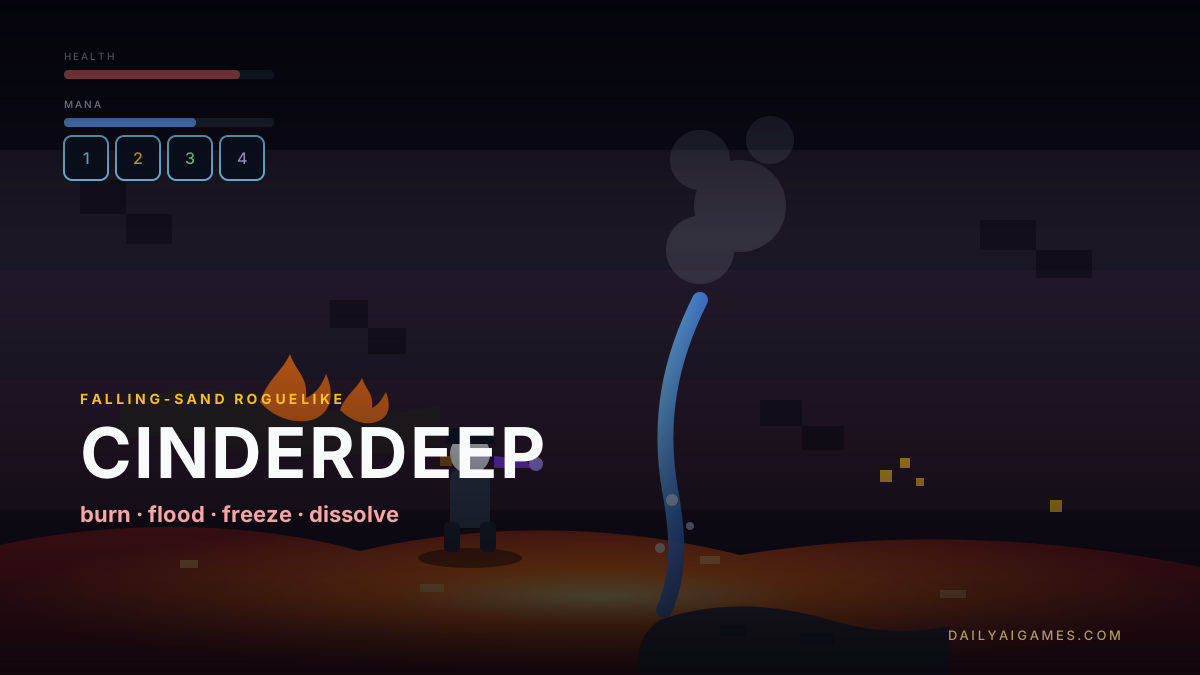
If you like simulations where the material is the mechanic, CINDERDEEP applies the same philosophy in 2D with a falling-sand cave, and our falling-sand alchemy prompt explains how the reaction table is organised.
Verdict
HANDFUL is a god game with the toolbar removed, and it is better for it. One hand, one island, a handful of simulated matter and a village that walks as soon as you build the path. It is early and it is small, but the core is exactly right: the pleasure of the game is not commanding the world, it is picking it up.