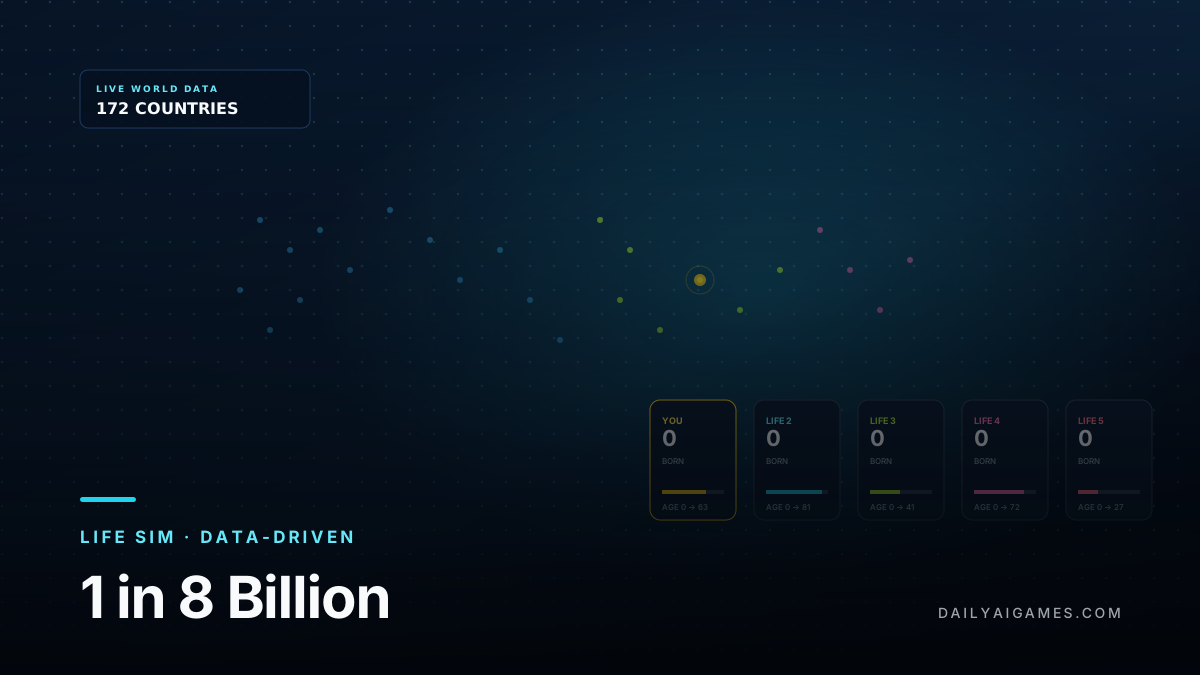
The most emotionally effective AI-built game of the month has no 3D, no leaderboard and no character creator. 1 in 8 Billion begins by refusing you the one choice every other life sim offers: where you are born.
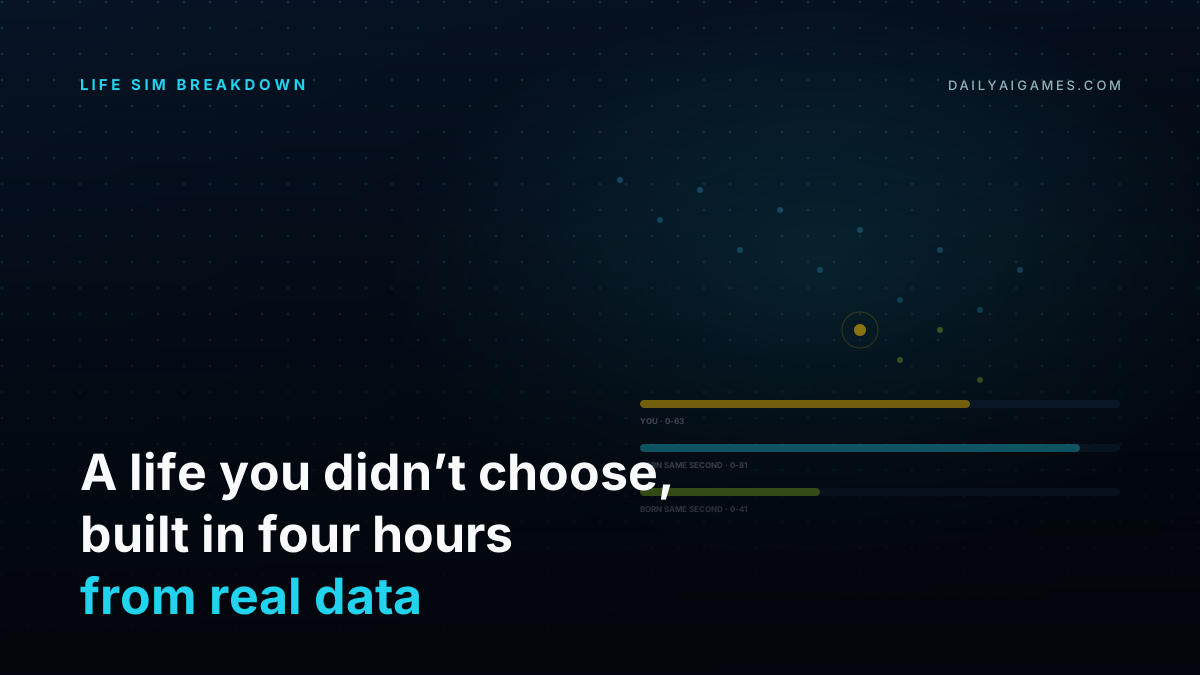
The game picks a country weighted by real birth numbers, assigns a family and an economic starting point from that country’s statistics, and then runs your life from age zero to death. Four other babies born in the same second are simulated beside you. The comparison is the point.
How a life plays out
A full life takes roughly 30 to 90 minutes, depending on the country’s life expectancy and the pace you choose. At ages 5, 15, 30, 50 and 70 the clock stops and asks you to think about the person you are playing and your own life. Between those pauses you choose a yearly focus — school, work, family, health, migration or rest — and make decisions about education, relationships, moving abroad and medical care.
Those choices matter, but they cannot erase the baseline of your birthplace. The game says so plainly. That honesty is what separates it from a power fantasy: a smart, hard-working simulated person born in a low-income country can still end up with worse health and income than a passive person born somewhere rich. You are not playing to win. You are playing to see.
An Auto mode lets you watch a life without making decisions. The official site also lets you choose a data year — today, a historical year, or a UN projection — and compare your simulated life with the country you were actually born in. That comparison stays on your device.
The data is the design
For 172 countries, the simulation draws on births, life expectancy by sex, infant and under-five mortality, GDP per capita at purchasing-power parity, income inequality, years of schooling, university enrolment, agricultural employment, fertility, maternal mortality, HIV prevalence, homicide rates, smoking, out-of-pocket health costs, child marriage and life satisfaction. Causes of death follow WHO regional and age patterns.
None of that would matter if the game used it as decoration. It uses it as the rule set. Country selection, age at death, illness risk, education access and income distribution all come from the tables. The result is a game that can be explained in one sentence and still produces wildly different lives.
The restraint is deliberate. There is no 3D world to explore, no inventory and no score. The interface is mostly text, a timeline and five other lives to compare against. That is what makes it work on a phone and what makes the emotional beat land: there is nothing to distract you from the numbers.
Four hours from idea to launch
Independent developer Jin Hwi-eus, who posts as Jin’s Earth, released the game on 5 October 2026 and says the whole project took about four hours from concept to public launch. The official site credits Claude for the build and names the public statistics sources behind the simulation.
Four hours is a useful benchmark, but it is not the whole story. The content already existed: decades of UN, World Bank and WHO data, plus a clear design idea about birth luck. AI compressed the implementation. It did not invent the meaning. That is the pattern behind most of the AI-built games that travel beyond the demo crowd — the model is doing the engineering, while a human supplies a thesis.
The response was not a product launch. Within ten days, players on Threads, X and Japanese social media were posting about crying when their simulated person died and arguing about what happiness means when so much of a life is assigned at birth. A free browser game with no marketing budget had found a universal anxiety.
The parts that are still rough
It is a beta. The version we played was 0.8.31, and the site asks players to report anything that feels off. The statistics describe populations, not individuals, and the game says so; treat any single life as an illustration, not a forecast.
The subject matter is heavy. The game is rated 15+ and handles death, illness, violence, addiction and suicide at real-world rates. It does not show scenes and it surfaces help links, but it is not a cozy life sim. If you want a gentle village builder, this is the wrong tab.
There is also a design tension the game cannot fully resolve: choices versus determinism. If choices changed everything, the inequality thesis would collapse. If they changed nothing, it would not be a game. 1 in 8 Billion lives in that tension, and the five pause points are where it becomes personal rather than statistical.
What to copy if you are building a life sim
Our data-driven life simulator prompt turns the structure into a reusable brief. The lessons that matter most:
- Start with a dataset, not a story. A life sim is only as interesting as the rules that generate lives.
- Simulate a comparison cohort. One life is a statistic; five lives born at the same second make inequality visible.
- Pause at human milestones. Ages 5, 15, 30, 50 and 70 turn a spreadsheet into a reflection.
- Put safety in the data layer. Content warnings and help links should be part of the simulation, not a footer.
- Run thousands of lives before launch. Check that simulated ages at death match the source life expectancy by country.
Verdict
1 in 8 Billion is the best argument yet that AI-built games do not have to be technical demos. It is plain, fast, cheap to run and unusually hard to forget. The four-hour build is impressive; the fact that it made people cry is the part worth studying.
Play one life with the settings left alone. Then play another with your real country selected. The gap between the two is the game.