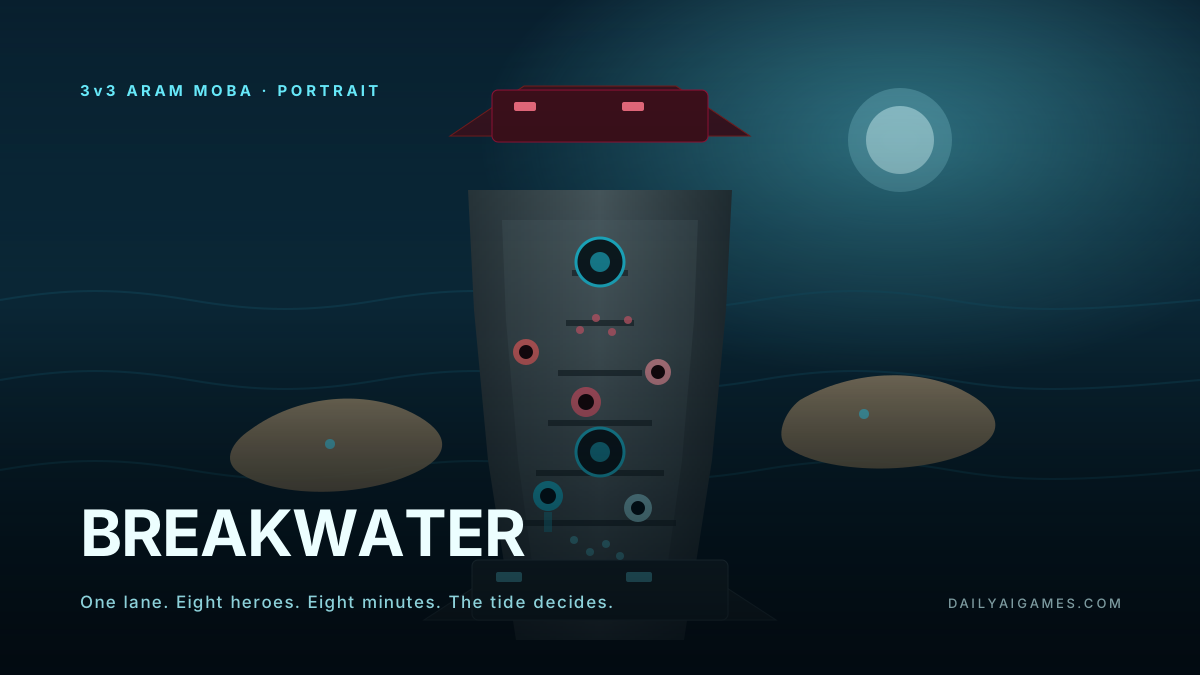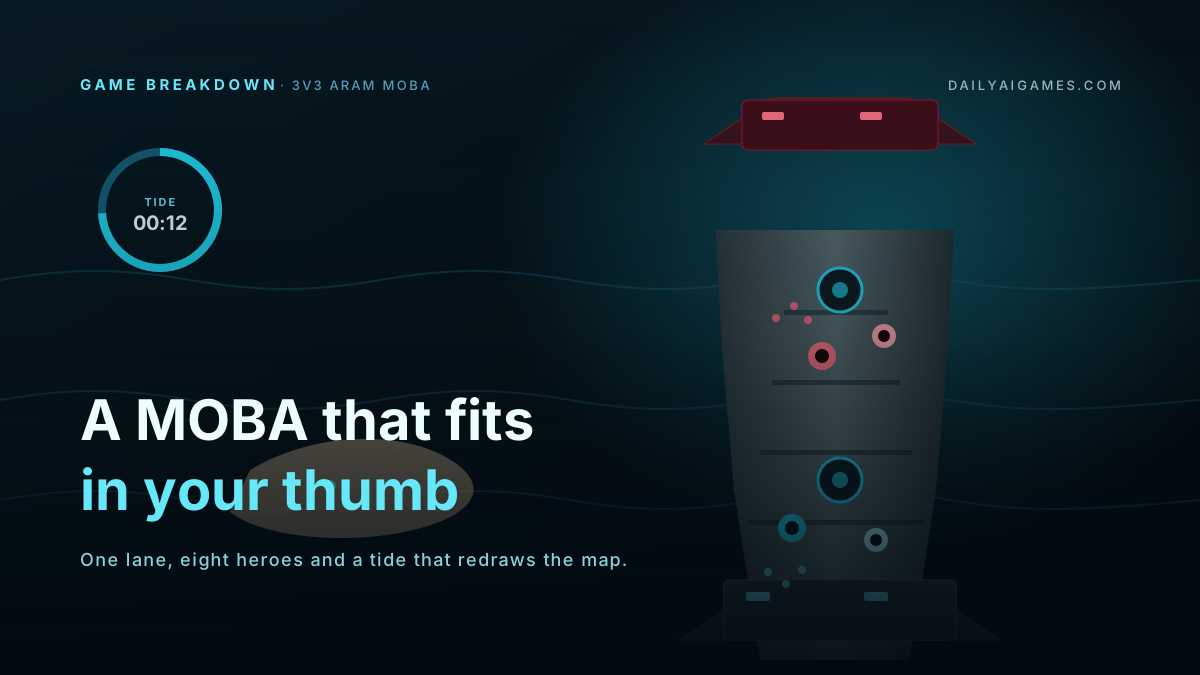
The first thing to understand about BREAKWATER is that it is a MOBA you play with one thumb, held upright, for about eight minutes. The second thing is that it is not a stripped-down demo of a MOBA. It has eight heroes, minion waves, towers, a core objective, items, three bot difficulties and a map mechanic that changes the shape of the battlefield every 90 seconds.
It is also, at the time of writing, the second-most-played game on AIGameShare by total time: 1,340 plays and 149 hours 53 minutes tracked, behind only Ren AI. For a genre that normally demands a launcher, a queue and a forty-minute commitment, that is a notable number.
One lane is the feature
BREAKWATER takes the ARAM idea literally. There is one lane, running from the bottom of your screen to the top, a stone breakwater across the sea between two island keeps. Each side gets towers and a Tide Core. You queue alone, get two bot teammates and three bot opponents, and you get a random hero. There is no draft, no ban phase, no jungle and no second lane to rotate to.
Removing those systems does more than save development time. It changes what the game is about. Without rotations and vision control, every match becomes a sequence of spacing decisions on the same narrow strip of stone: when to step up, when to trade, when to give the wave, when to commit an ultimate. That is the part of a MOBA that survives contact with a phone screen, and BREAKWATER is smart enough to build the whole game around it.
Eight heroes, no shop
The hero pool is eight, each with four abilities. A chain-hooking tank, a whirlwind bruiser in a bear cloak, a sun knight, a shadow assassin, a harpoon crossbow marksman, a fire mage with a meteor, a frost support and a drowned sorcerer whose whirlpool pulls an entire team into one spot. The kits are deliberately blunt: each one is readable within a single fight, which matters when the hero is random and you have thirty seconds to work out what your buttons do.
Items buy themselves on a timer. That is the single best decision in the build. A shop screen is a desktop convention that becomes a scrolling nightmare on a portrait phone, and removing it keeps gold meaningful without asking the player to learn an item tree before their first match. The HUD shows the next item and when it arrives, so the economy still creates a power curve.
The tide is the map
The mechanic worth stealing is the tide cycle. Every 90 seconds the water pulls back. Sandbars rise out of the sea with healing pearls on them and room to flank, and the lane effectively gets wider. Then the water floods back in, the sandbars disappear, and everyone is squeezed onto the dyke again.
That one cycle gives a one-lane map a second dimension. You can bait a fight onto the sand, take the pearls, and then get caught by the returning water with no route around. It rewards timing that is measured in seconds rather than minutes, which is exactly the right scale for an eight-minute match. It also creates a shared rhythm that every player on the map can read, which is what makes a fight on a straight line feel tactical rather than random.
Our tide-cycle arena prompt breaks the system down into states, telegraphs and reachability checks. The reachability rule is the one that matters most: if the flood can trap a player in a dead end, the mechanic stops reading as atmosphere and starts reading as unfair.
Built at 1M tokens
BREAKWATER is credited to Claude Opus 5.5 with a 1M-token context window, driven through Claude Code. That context budget is not a marketing detail here. Eight hero kits, thirty-two abilities, minion and tower logic, three bot difficulties, touch and mouse input, and a map that changes state on a timer is exactly the kind of codebase that falls apart when the model forgets what it wrote an hour ago.
The result is coherent in a way that large AI-generated projects often are not. The desktop controls mimic League conventions — right-click movement, hold-and-release aiming, a blink on F, a diagonal camera — while the mobile layout is a joystick and four buttons. Both exist in the same build, and neither feels like an afterthought.
Where it is rough
The honest caveat is the one printed on the game page: your teammates and opponents are bots. There is no matchmaking, no human queue and no anti-cheat. That is fine for a browser game, but it means the social half of a MOBA — the part where a stranger does something inexplicable and you have to adapt — is missing. The bots are competent enough to punish bad spacing and passive enough that a patient player can carry, which is a reasonable trade for a solo lobby.
The leaderboard was also not live at the time of writing, and a portrait MOBA still asks a lot of a thumb. Precision skillshots on a small screen are harder than they are on a mouse, and the game knows it — most abilities are generous about aim.
What to copy if you are building a mobile MOBA
Our portrait 3v3 ARAM MOBA prompt is the reusable version of this build. The four decisions that make it work:
- Cut the shop before you cut the hero count. Auto-buying items preserves the economy and removes the worst mobile UI problem in the genre.
- Randomise the hero but keep the pool small. Eight kits that can be understood in one fight beat twenty that cannot.
- Treat bots as a launch requirement. A 3v3 match with passive allies is unplayable, no matter how good the heroes are.
- Give the map a clock. A timed state change is the cheapest way to make one lane feel like more than one lane.
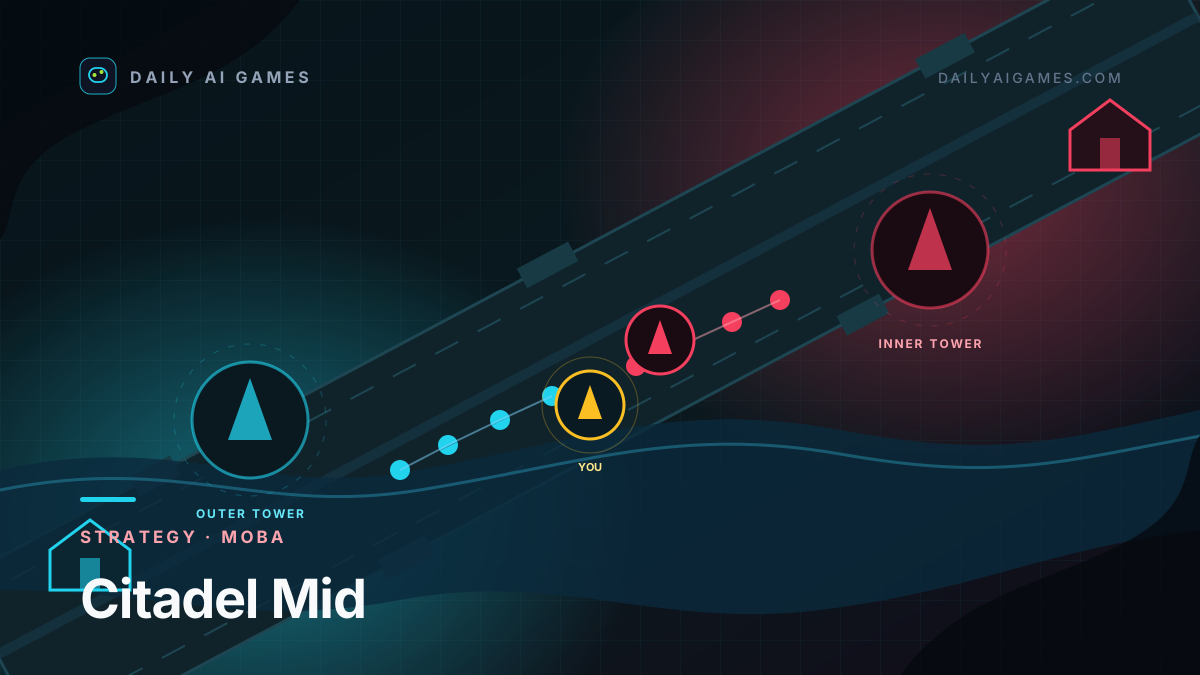
If you want the smaller, desktop-first version of the same genre, the one-lane browser MOBA prompt behind Citadel Mid is the place to start.
Verdict
BREAKWATER is the most technically ambitious AI-generated game we have covered this month, and the most surprising thing about it is how normal it feels to play. You open a tab, get a hero, lose a lane, win a fight on the sand, and the tide takes the advantage away. Eight minutes later it is over and you want another one.
Play it on a phone, on a train, with the sound off. It is the first browser MOBA where the phrase “one more match” does not sound like a threat to your afternoon.