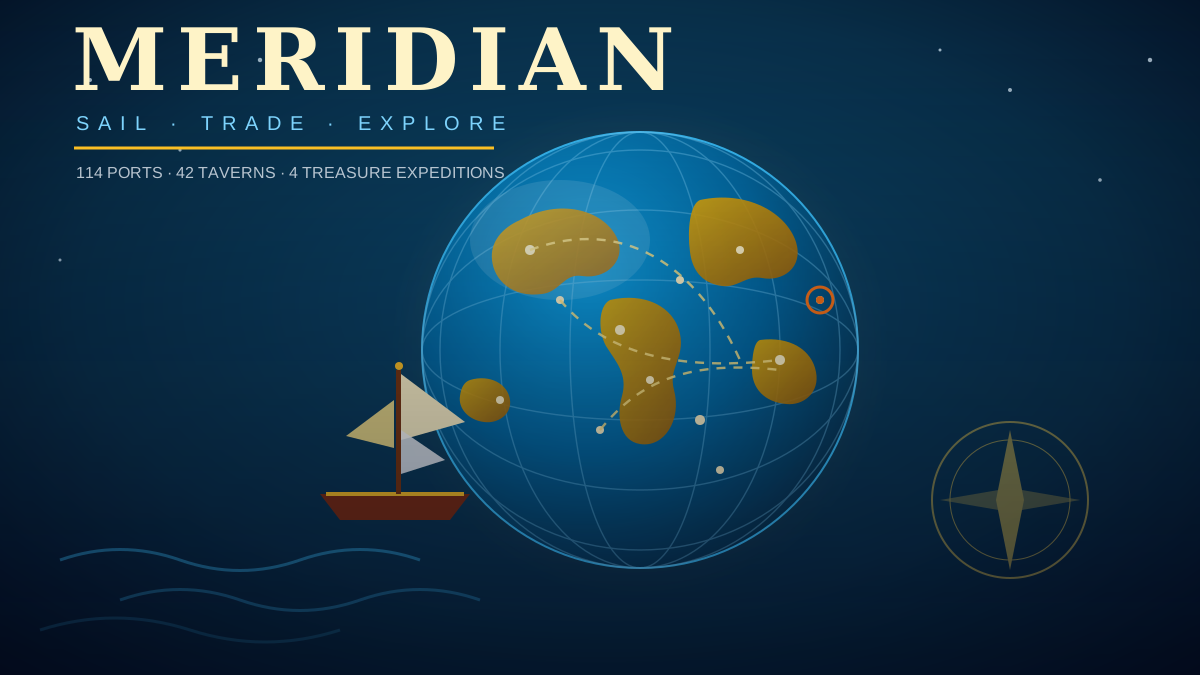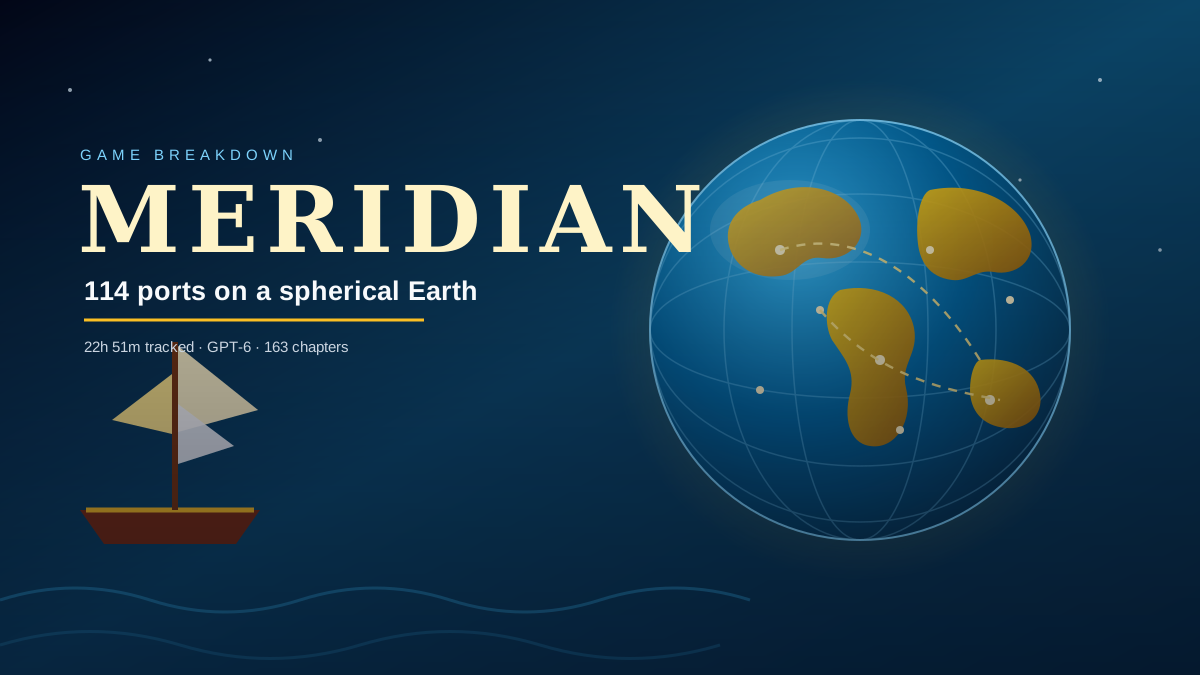
The first thing you notice about MERIDIAN is the horizon. It curves. Not in a painted-backdrop way, where the skybox pretends, but because the game is rendering a spherical Earth and letting you sail across it continuously. You raise the sails, pick a heading, and a coastline resolves out of the mist ahead of you. For a browser game that loads in a tab, that is an unusual amount of world.
At the time of writing MERIDIAN had 467 plays and 22 hours 51 minutes of tracked play on AIGameShare, with 327 plays in the last 30 days. Those numbers are not a viral spike; they are the profile of a game people keep coming back to. The average session is about two minutes, which sounds short until you realize that most of those minutes are a single crossing, and the game has a x3 speed control specifically so a crossing can fit in a coffee break.
A globe, not a map
MERIDIAN places 114 ports on the sphere. Each one has a name, a culture, a market and a short description, and each one is reachable by sail. That last part matters: the game ships a first-voyage guide that is completely skippable, but if you take it, it teaches the whole economy in one crossing — buy low, sail somewhere the price is high, dock, sell, upgrade the hull, repeat.
The sailing model is deliberately readable. W and S raise and reduce sail, A and D steer, Space furls. Wind has a direction and strength shown on a small compass rose, and your speed depends on sail area, point of sail and hull upgrades. Sailing into the wind is slow, and the game lets it feel slow rather than broken. That is a design choice, and it is the right one: the fantasy of a sailing game is that distance costs something.
Mist bands thicken as you move away from the starting region, so the horizon becomes a navigational problem rather than decoration. On mobile, tapping a port on the chart sets a route for automatic navigation, which turns a long crossing into a planning decision instead of a steering chore. On desktop, you can drag the chart, zoom the camera and read the guide while you sail.
An economy small enough to plan
The trading layer is simple on purpose. Every port sells and wants different goods, prices drift with supply, distance and local scarcity, and your cargo hold is small enough that every purchase is a real decision. There is no hidden fee and no random confiscation; if you lose cargo, it is because you saw the risk and took it anyway.
The result is a game where a two-hop route is a plan rather than a grind. You check prices, note that one island is short on a good three ports away, and set a course that pays for the trip. Ship upgrades for hull, hold and sail area give the profit somewhere to go. It is not a deep economic simulation, and it does not need to be; it is a loop that makes the map make sense.
The one thing I would change is price history. The game shows enough to plan a short route, but a longer view would turn the market from a set of price tags into a proper reading exercise. That is a live design question, not a bug.
Taverns, treasure and 163 chapters
Then there is the part that gives MERIDIAN its personality: the taverns. Forty-two illustrated taverns, thirty-nine heroines, full-size portraits and 163 chapters of romance and friendship. You dock, talk, and the story accumulates between voyages. The dialogue is optional and never blocks trading, which is the correct way to bolt a visual novel onto a sim — the people are a reason to return, not a gate in front of the economy.
Four treasure expeditions run through the same world. Each begins with a written clue in a tavern, continues through one or two ports, and ends with a search along a stretch of open water and a keepsake for your collection. The clues are text, not waypoints. That single choice changes the genre: instead of following a marker, you read a description, look at the chart and make a guess about which coastline it means.
The writing is English by default, with a Simplified Chinese option. Cloud saves mean progress survives a refresh, which is the single most important quality-of-life feature a long-session browser game can ship.
Why it works
MERIDIAN was created by nilni and built with GPT-6 in ChatGPT. The technical story is straightforward — a spherical ocean, a port table, a market model, a dialogue system. The design story is more interesting. The game understands that a sailing fantasy is mostly anticipation: the coastline you cannot quite see, the price you hope is still there, the clue you think you have solved. Everything in the build protects that anticipation instead of shortcutting it.
It also understands the browser context. The x3 speed control, the skippable guide, the tap-to-route chart and the cloud saves are all concessions to the fact that you are playing in a tab and might close it at any moment. None of them break the fiction.
The limits are real. The economic model is shallow compared to a dedicated trading sim, and the mist can make a long voyage feel like a commute if you are not in the mood for it. The treasure clues are good, but four expeditions is a small number for a world this size. And the tavern stories, while generous, are not going to satisfy someone who wants a full romance game rather than a sailing game with romance in it.
None of that undercuts the core. MERIDIAN is a world you can cross, a market you can read and a set of people you can visit. That is a lot for a browser tab.
What to copy if you build one
Our spherical sailing and trading prompt is the reusable version of this build. The decisions worth stealing:
- Model the globe, not a scrolling texture. The curved horizon is the whole fantasy.
- Make clues readable, not marked. A treasure you can only find by waypoint is a shopping list.
- Show price history. Two hops of context turn a market into a plan.
- Add a time-scale control. Long voyages are the point; a x3 toggle makes them fit a session.
- Keep the story optional. Dialogue should be a reason to dock, never a gate in front of the economy.
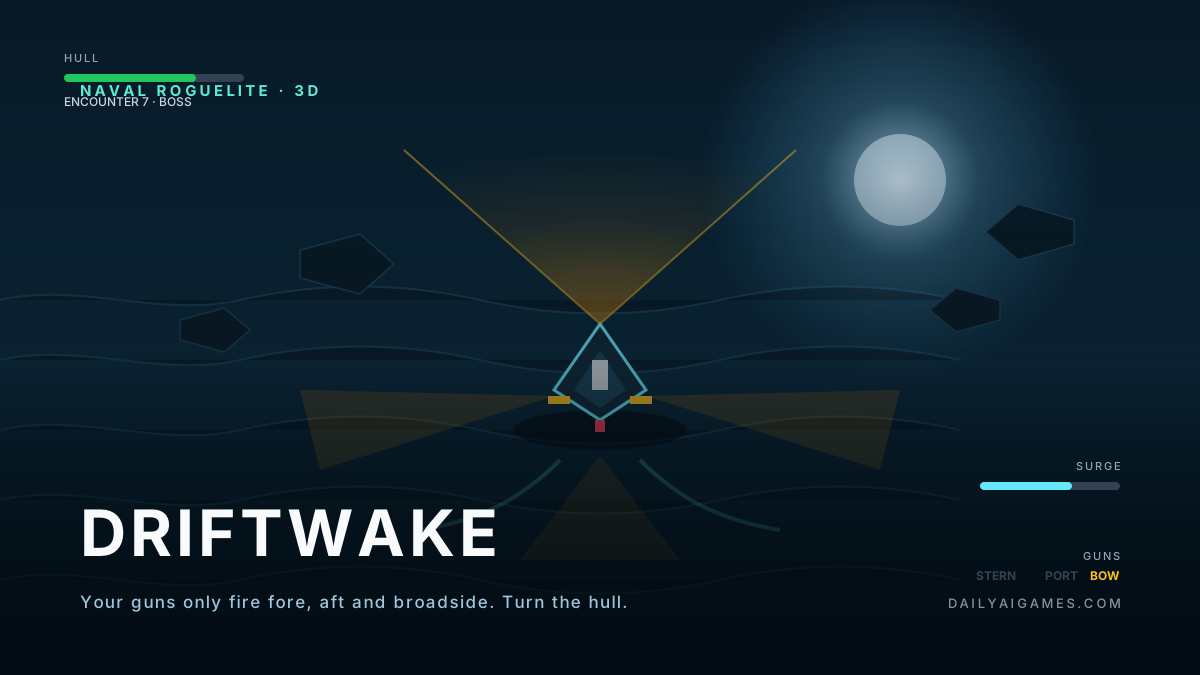
If you like naval games with more combat, Driftwake turns the same water into a boss-fleet roguelite, and our naval roguelite prompt covers the broadside combat model.
Verdict
MERIDIAN is the rare browser game that feels bigger than its tab. It is a spherical ocean with a small, legible economy and a tavern on every coast, and it trusts you to read a clue and pick a heading. Raise the sails, check the price, and see what is over the curve of the world.