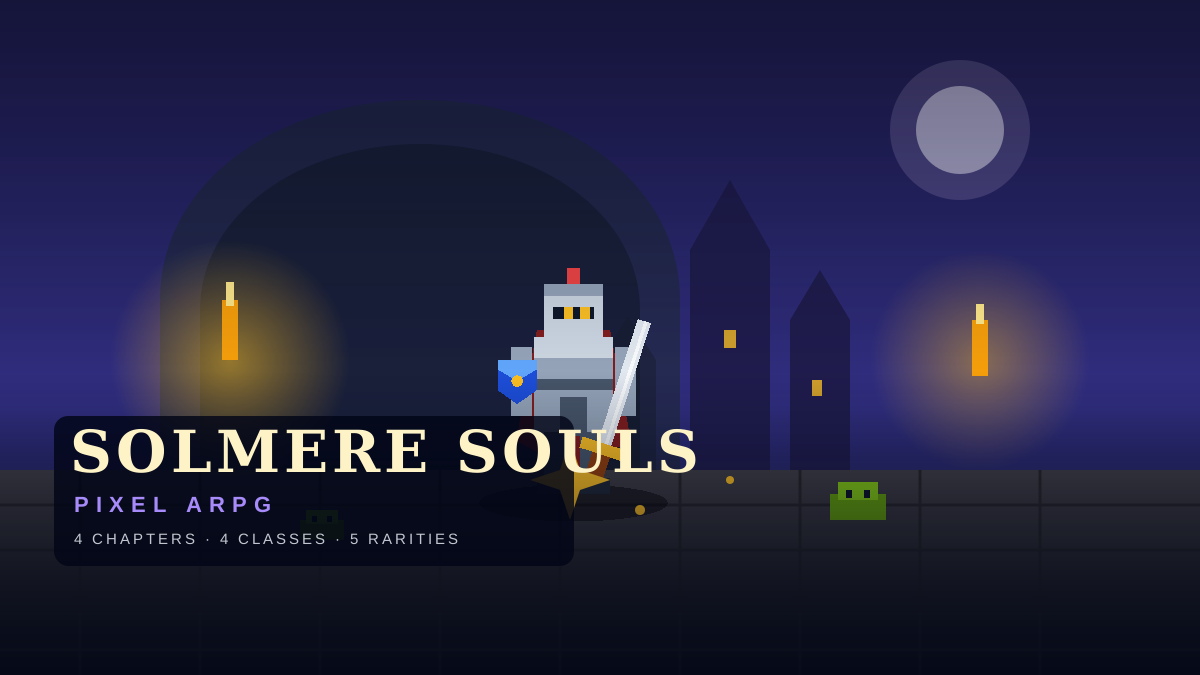
Browser RPGs usually ask for a lot of patience and give back very little: a level bar, a number, and a promise that the next room will be more interesting. SOLMERE SOULS: Pixel ARPG does something rarer. It hands you a finished story — four chapters, four bosses, four classes — and then it makes the moment-to-moment combat good enough that you keep playing after the story is over.
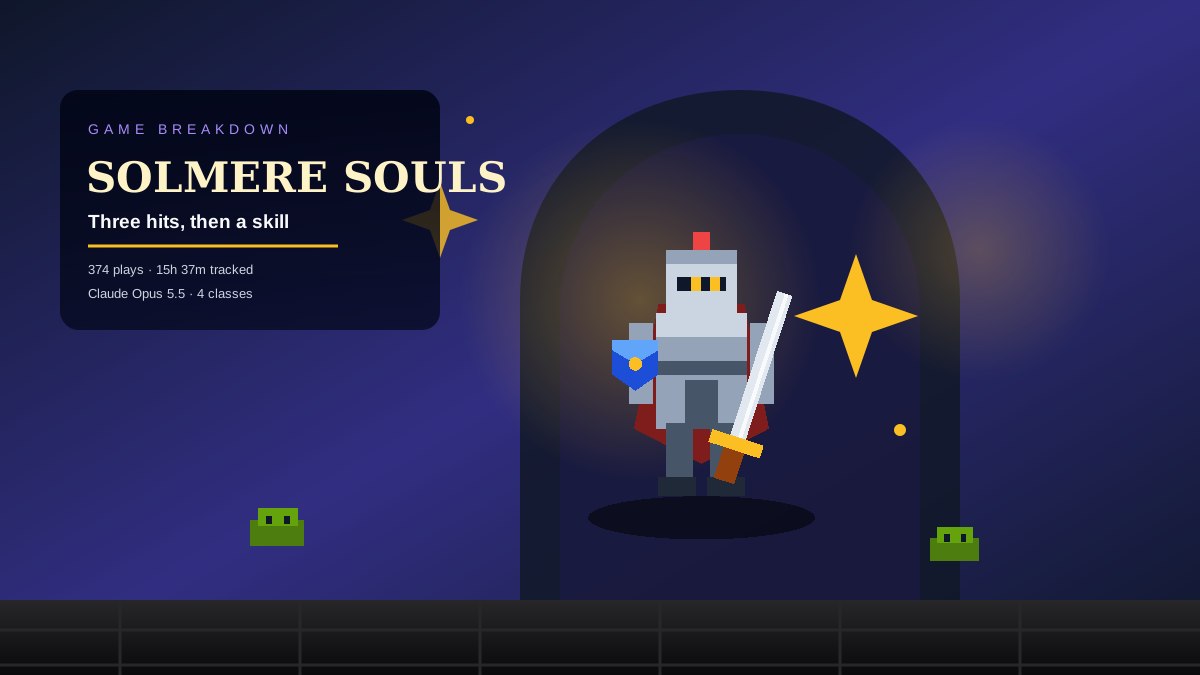
At the time of writing SOLMERE SOULS had 374 plays and 15 hours 37 minutes of tracked play on AIGameShare, with 210 plays in the last 30 days. The average session is about three minutes, which is exactly what a dungeon crawler should want: short enough to fit a break, long enough to clear a floor.
A small game with a complete shape
The setup is refreshingly direct. Solmere Keep fell in one night with no wall breached, and Princess Elinor was dragged into the dark. You pick a class, talk to the townsfolk, walk through the keep gate, and the game opens up into four chapters: the Fallen Keep, the Drowned Catacombs, the Hollow Spire and the Throne Beneath. Each chapter is a run of dungeon floors ending in a boss, and each boss frees a soul you can bind at the Temple of Light.
That soul is not a token. Once bound, it can be raised through five tiers and turned into a screen-clearing blast. The ultimate gauge is separate and fills on kills and finishers. Between the soul blast and the class ultimate, every class has two panic buttons, and the game is balanced around the assumption that you will use them.
The hub town is the other half of the shape. It visibly rebuilds between chapters, the steward reacts to progress, and villagers have short, changing lines. It is not a sprawling town sim, but it gives the dungeon loop a “home” to return to, which is the thing most browser RPGs forget to build.
The finisher window is the whole combat system
Here is the rule that makes SOLMERE SOULS feel like an ARPG instead of a clicker. Land three basic attacks, then press a skill within one second, and that skill casts a stronger, free version. The skill buttons flash gold while the window is open, so you learn the timing without a tutorial.
That one rule changes everything downstream. It makes basic attacks matter, because they are the setup. It makes SP matter, because a free finisher saves you a resource. It makes the skill bar matter, because the finisher inherits the skill’s shape — a Knight’s Bash becomes a shield slam, an Archer’s Snare pins a room, a Mage’s Chain jumps further. And it makes the ultimate gauge fill faster, because finishers charge it.
The rest of the combat supports the same idea. Enemy attacks are telegraphed, with a clear colour language for safe, warning and active frames. The dodge has a short cooldown and a visible stamina ring. Getting hit feels like a mistake you made rather than an input the game ignored, which is the bar every action game has to clear.
Four classes, four reasons to replay
The Knight is the steady pick: Bash, Leap and Cry. The Archer fights at range with Volley, Snare and Rain, and Snare is the kind of skill that changes a room before the fight starts. The Mage has Lance, Chain and Ward, with Lance freezing what it hits. The Dragonute — Tail, Wing Leap and Roar — unlocks after your first boss, which is a good way to make the first replay feel like a reward rather than a reset.
Each class keeps its own level, skills and gear, so switching does not erase progress in another. That is the correct decision for a game this size. It also means the four classes are effectively four save files, and the loot system has room to give each one a different reason to keep playing.
Loot that respects the loop
Gear comes in five rarities: white, green, blue, violet and orange. Rarer items carry more affixes, and legendary items carry one named power with a clear effect. Weapons are class-bound; armour fits anyone. Equipped armour, helms and weapons show on the hero sprite, which is a small thing that does a lot of work — you can see your progress.
Each level gives one skill point and three stat points, spent in the bag. Skills cap at tier III; tiers IV and V require breakthrough books, which drop from first kills and marked enemies and must be read from the bag. The forge upgrades gear. A waystone opens after chapter two so you can jump to your deepest floor or a boss door, which is the single best quality-of-life decision in the build.
The economy is honest. You are not swimming in gold, and you are not starved. A legendary drop is a decision about which affix to give up, not a slot-machine jackpot. That is the correct scale for a browser game.
Controls and the mobile build
On desktop, WASD moves, J attacks and holds to charge, K/U/I cast class skills, L or Space dodges, O fires the soul blast, R fires the ultimate, 1–3 drinks potions, Tab opens the bag and E talks to townsfolk. It is a lot of keys, but the layout is sane and the important buttons are clustered.
On mobile, a left stick replaces movement and an arc of action buttons replaces the keyboard. The inventory supports drag and drop. The touch build is the one I expected to be compromised, and it is not: the finisher window is a timing rule, not a precision aim, so it survives the translation to a thumb.
What AI got right, and where it is thin
SOLMERE SOULS was created by nilni and built with Claude Opus 5.5. The impressive part is not that an AI produced a pixel ARPG — smaller ones exist. It is that the systems interlock. The finisher feeds the ultimate gauge. The ultimate feeds boss pacing. Breakthrough books give first kills a purpose. The town gives the chapter structure a spine. That is design work, not code generation.
The limits are real. Four chapters is a short campaign, and once you have learned a boss’s tells, the fights become a routine. The town is a mood piece rather than a simulation. The loot pool is wide enough for one build per class, not three. And the leaderboard is not populated yet, so the endgame is whatever you make of it.
None of that undercuts the core. SOLMERE SOULS is a browser game that understands the shape of an ARPG: a short run, a clear build, a boss with a tell, and a reason to press the skill button at exactly the right moment.
What to copy if you build one
Our pixel ARPG loot and progression prompt is the reusable version of this build. The decisions worth stealing:
- Make the finisher a rule, not a stat. “Three hits then a skill” teaches itself and gives every class a combo identity.
- Bind weapons to classes and armour to anyone. It keeps loot exciting without forcing four full gear sets.
- Show hitboxes honestly. A browser ARPG lives or dies on whether the dodge feels like it should have worked.
- Gate tiers IV and V behind books. First kills and marked enemies need a reason to exist beyond XP.
- Open the waystone early. Walking back through cleared floors is not content.
If you like small games with big systems, CINDERDEEP builds a roguelike out of falling sand, and THIMBLE KNIGHTS builds a real-time card battle out of a garden and three minutes.
Verdict
SOLMERE SOULS is the best argument yet that a browser ARPG can have a real combat verb. Three hits, a gold flash, a skill that costs nothing and hits twice as hard — that is the whole game, and it is enough. Pick a class, bind a soul, and see how far the finisher window takes you.