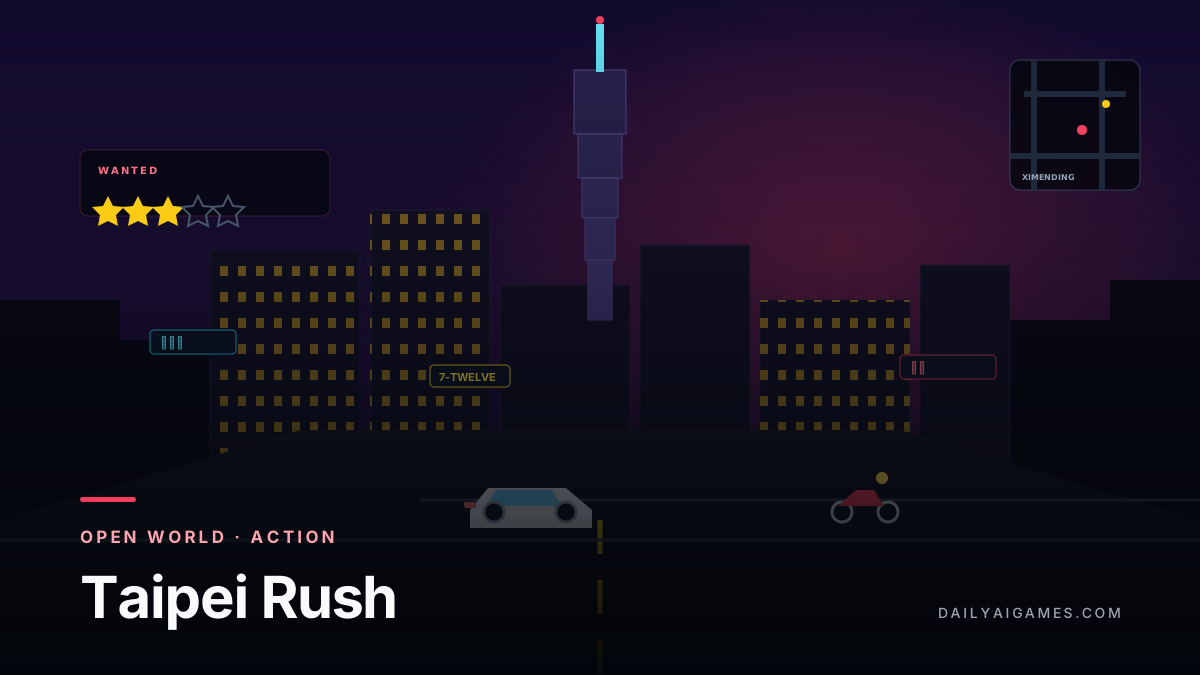
A city-sized crime sandbox is supposed to be a studio project. Hundreds of people, years of production, a budget measured in hundreds of millions. Taipei Rush is one developer, about a month, and more than US$10,000 in AI tokens — and it runs in a browser tab.
It began life as Taipei GTA, which tells you almost everything about the pitch: Grand Theft Auto, but set on streets the creator actually knows. The name has since changed to Taipei Rush, the old address forwards players and their saves, and the game now lives at taipei-rush.app. It is free, it supports Chinese and English, and the developer recommends a computer over a phone.
What is actually in the game
You arrive in Taipei with the clothes on your back, your fists and about NTD$500. The story is not a crime empire. It is a fight to save your grandmother’s old street from redevelopment, told across 93 missions.
The city is the argument. Ximending, Taipei Main Station, Taipei 101, Shilin Night Market and Chiang Kai-shek Memorial Hall are all present, on streets with their real names. Traffic is mostly scooters. Red-light cameras and speed cameras actually catch you. You can ride the MRT, and the convenience stores are called 7-TWELVE and sell tea eggs. Punch a stranger or steal a car and the police respond in Mandarin, with a dispatcher reading your escape route over the radio and a wanted system that climbs to five stars.
It is not a static map. An early October update added Hong Kong, with Central and Victoria Harbour missions reached by flying out of Songshan Airport. A later update added an in-game stock market and a Kaohsiung map reached by high-speed rail. The scope keeps growing in the direction players ask for.
The token bill is the new art budget
The developer, who posts as aicodewithme, says the project burned through more than US$10,000 in AI tokens. That number is the most useful fact in the whole story. It is cheap next to a game studio and expensive next to a weekend experiment. It also matches what large AI builds tend to cost when the scope is real: a city, traffic, police AI, missions, saves, two languages and a phone build.
The performance claim is just as striking. Reports say the game runs above 100fps on a laptop with integrated Radeon 890M graphics, with graphics presets from Auto to Ultra. If accurate, that is a serious piece of browser engineering: object pooling, draw-distance limits and a low-poly art direction doing the work that a discrete GPU usually does.
What we do not know is which models or tools made it. The developer has not confirmed a stack. Several reports link the project to AICodeWith, a paid platform that resells access to multiple frontier models, but the creator has not verified that. We added AICodeWith to the directory with that caveat attached, because it is a lead worth investigating rather than a confirmed credit.
The popularity claim needs a footnote
The developer says 1.2 million people were playing within three days. No traffic data has been published, and it is not clear whether that means concurrent players or visits over three days. The announcement post passed 100,000 likes, Taiwanese and Hong Kong outlets covered the game within days, and the comments filled with requests for more districts. The attention is real even if the number is loose.
The other caveat is legal. The game has no connection to Rockstar Games, every brand in the city is a parody, and the rename from Taipei GTA to Taipei Rush was a sensible move. AI has made it cheap to build a familiar-looking world; it has not made it cheap to defend one.
Why a city you know beats a bigger map
The lesson is not “AI can make GTA”. The lesson is specificity. A generic open-world demo has to invent a reason for you to care about its streets. Taipei Rush gives players their own landmarks, their own traffic patterns, their own convenience-store joke. That is a kind of content advantage a large studio cannot easily copy, because it requires local knowledge rather than more production budget.
The second lesson is staging. A city-sized project ships when you build one loop at a time: on foot, then one car, then traffic, then police, then missions. Our reusable open-world city sandbox prompt encodes that order explicitly, along with hard budgets for traffic, draw distance and save migration.
If you are building in this genre, copy these five things:
- Pick a place you can walk in your head. Real street names and landmarks beat a larger, generic map.
- Make traversal fun before you write missions. A city that is not fun to cross cannot be saved by story.
- Put hard numbers on traffic and pedestrians. Unbounded spawning is what turns a browser game into a slideshow.
- Keep every brand a parody and keep a rename plan. The lawyers are faster than your next update.
- Stage the build in loops. Ship movement, then driving, then systems, then story.
Verdict
Taipei Rush is the most important browser game of the month, and not because it is polished. It is important because it proves a single creator can ship a city-sized world with AI as the main workforce, for a token bill that a small team could actually raise. The 1.2 million figure may never be verified, the tool stack is still a rumour, and the game is one legal letter away from a rename. None of that changes what it demonstrates.
Play it for the scooters, the speed cameras and the pleasure of seeing a city you know rendered as a playground. Then read the build notes on MadRobot and ask what your own city would look like with 93 missions.